

The short version: In WABC’s 4-out, 1-in flash-cut example, a passer can cut inside after recognizing a post advantage. The existing low-post player lifts to at least the elbow. From there, that player may receive the ball for a high-low pass or move to the perimeter to complete the exchange. A favorable matchup is a reason to look inside, not a reason to force the pass.
Key takeaways
- Read both the matchup and the route the ball would need to take.
- In the WABC Coaching Manual Level 2 English example, the low post player lifts to at least the elbow as the basket cut is made.
- A high-low opportunity requires two available passes: one to the lifted player and another into the post.
- The position exchange can still be useful when no entry pass is available.
When is the post advantage worth using?
You pass to the wing and see an opportunity to play inside—but a teammate already occupies the low post. In WABC’s Level 2 coaching manual, the 4-out, 1-in flash-cut example solves that spacing problem with a position exchange. The passer may make a post-up cut after reading an advantage against their defender; a coach can also use the action to exchange particular players into and out of the post. WABC Coaching Manual Level 2 English
A post-up cut is a cut toward the basket that finishes with the cutter establishing an inside receiving position. As a coaching example, imagine the passer has a smaller defender and sees room to receive near the basket. That is worth exploring. But ask a second question: can a teammate actually deliver the ball there? A defender between the ball and the target, or help waiting beside the target, can make the entry unavailable even when the matchup looks favorable.
Use three practical checks: can the cutter establish a balanced receiving position, show a target away from the defender, and stay connected to the passer’s view? A seal means using position to keep the defender away from the intended receiving space. Treat it as an invitation to assess the pass. If the passer cannot see a clear route to the target, keep looking for another option.
How do the cut and the lift fit together?
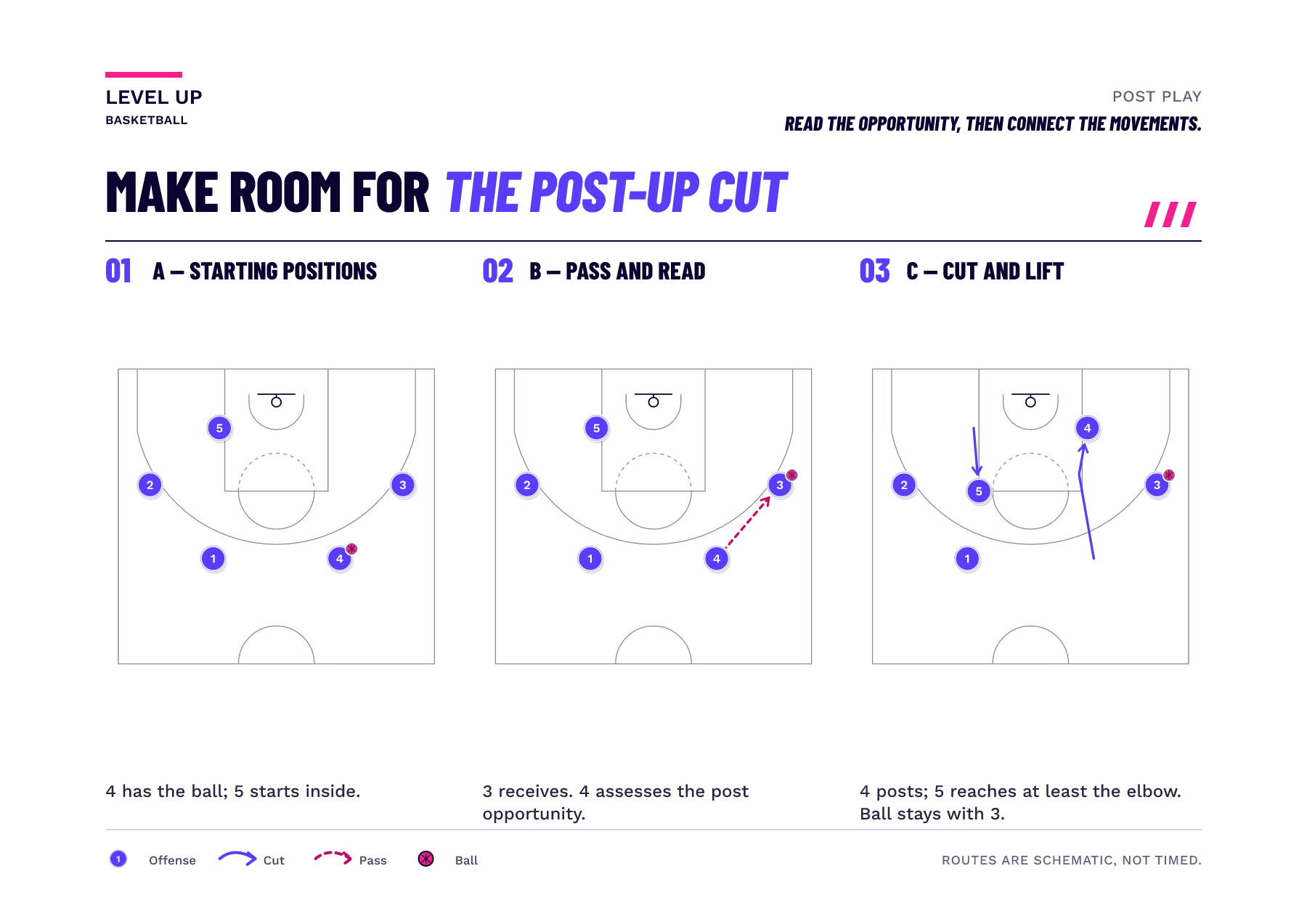
WABC describes a 4-out alignment with two players high and two on the wings. In this example, 1 and 4 start high, 2 and 3 occupy the wings, and 5 starts at the left low post. Player 4 has the ball and passes to 3 on the right wing. Keep this starting picture separate from the neighboring 5-out illustration: this lesson begins with a player already inside.
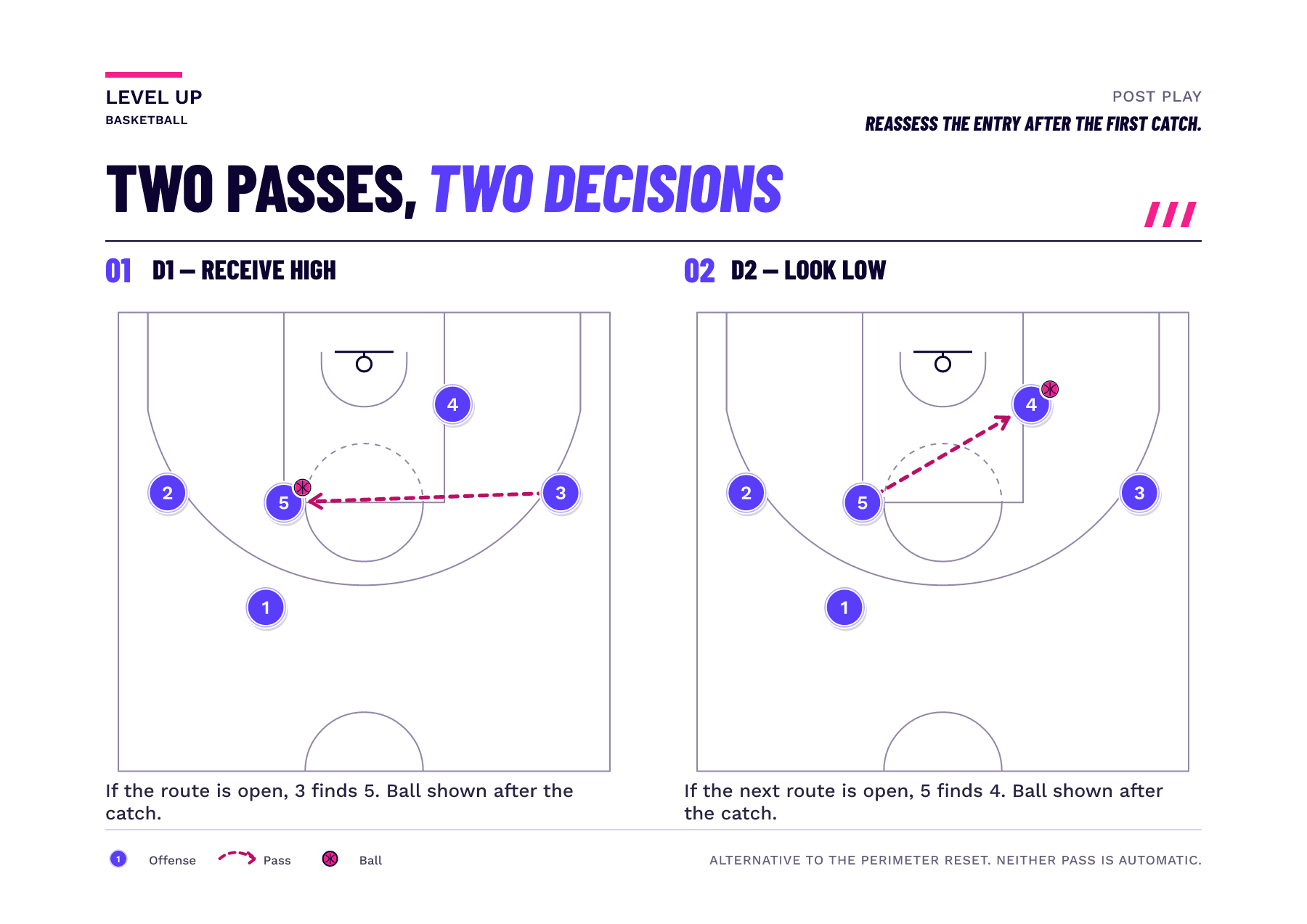
If 4 reads a post opportunity, 4 cuts toward the basket and establishes a post position. WABC specifies that 5 lifts to at least the elbow as the basket cut happens. The elbow is the corner where the free-throw line meets the side of the lane. Think of these as connected movements: 4 takes the inside role while 5 creates room by leaving it. Player 3 still has the ball. Basketball offensive spacing
Swipe sideways to explore the full diagram.
How does the high-low option become available?
WABC identifies a possible high-low pass from the free-throw-line area to the posting player. High-low simply means passing from a higher inside position to a teammate nearer the basket. Here, 5 must first receive the ball from 3. Then 5 assesses the pass to 4. These are two separate decisions: an available pass to 5 does not automatically make the next pass available.
Swipe sideways to explore the full diagram.
What if the inside pass is covered?
WABC also allows 5 to move to the perimeter and complete the exchange. In the coaching adaptation below, 3 declines the covered direct entry and keeps the ball while 5 fills the high perimeter spot vacated by 4. Player 4 remains the post player. That exact perimeter destination is a choice for this illustration; adapt it to your team’s spacing. If 5 has already received the ball but cannot find 4, use an available perimeter outlet and continue the offence.
Swipe sideways to explore the full diagram.
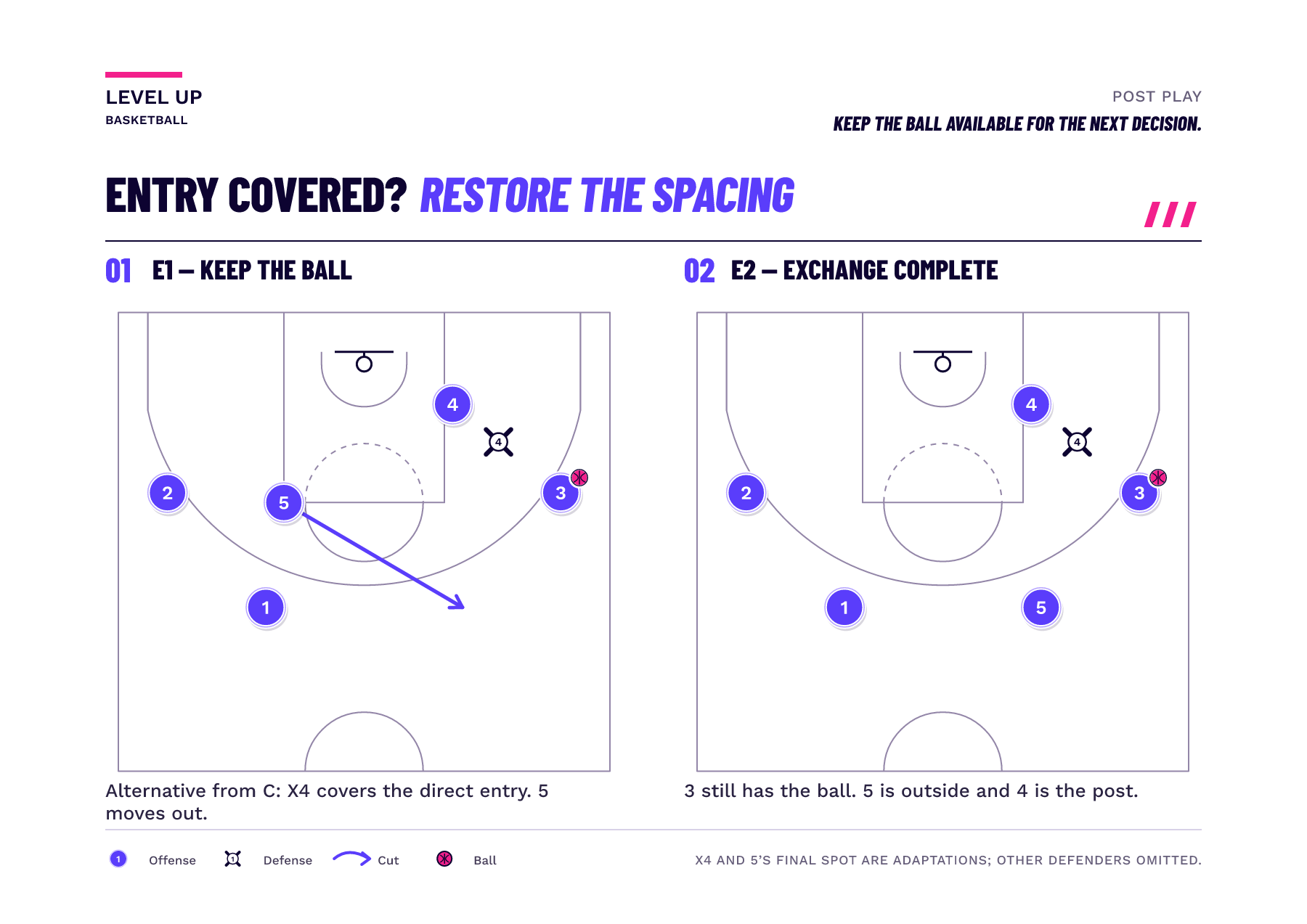
Player 4 has a favorable matchup, but X4 blocks the direct passing route from 3. Must 3 throw the entry to reward the cut?
No. The matchup and the passing route are separate reads. Player 3 can assess whether 5 is available to receive, or retain the ball while 5 moves outside. A useful cut does not oblige the passer to throw a covered pass.
How can coaches practise the decision?
Use the following progression as a coaching adaptation, adjusting the difficulty to your group. WABC encourages coaches to offer general movement rules while discussing a player’s reasoning when they make a different read. Give players a shared starting picture, then leave room for their decisions.
- Walk through the panels with five offensive players, one ball and one basket. Pause after the wing pass and after the exchange. Have players identify the ballholder, the post player and the available passing options.
- Introduce guided defence. Ask a defender to vary whether the direct entry is visible or covered. Let the offence decide whether to enter, use the lifted player or complete the perimeter exchange.
- Move to live five-on-five from the same starting alignment. Allow the possession to continue after a declined entry. Rotate the roles and mirror the setup so players experience both sides.
- Replay an unclear decision and ask what the cutter and passer each saw. Assess the read, spacing and pass choice separately from whether the possession produced a made shot.
Was this useful?