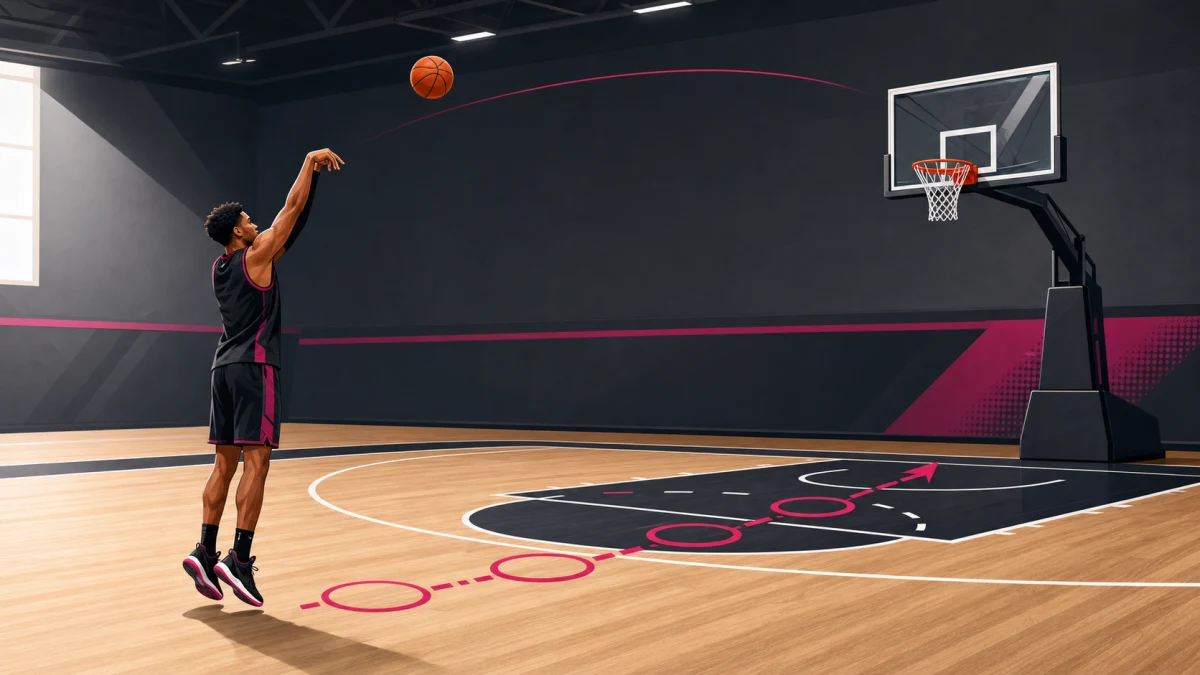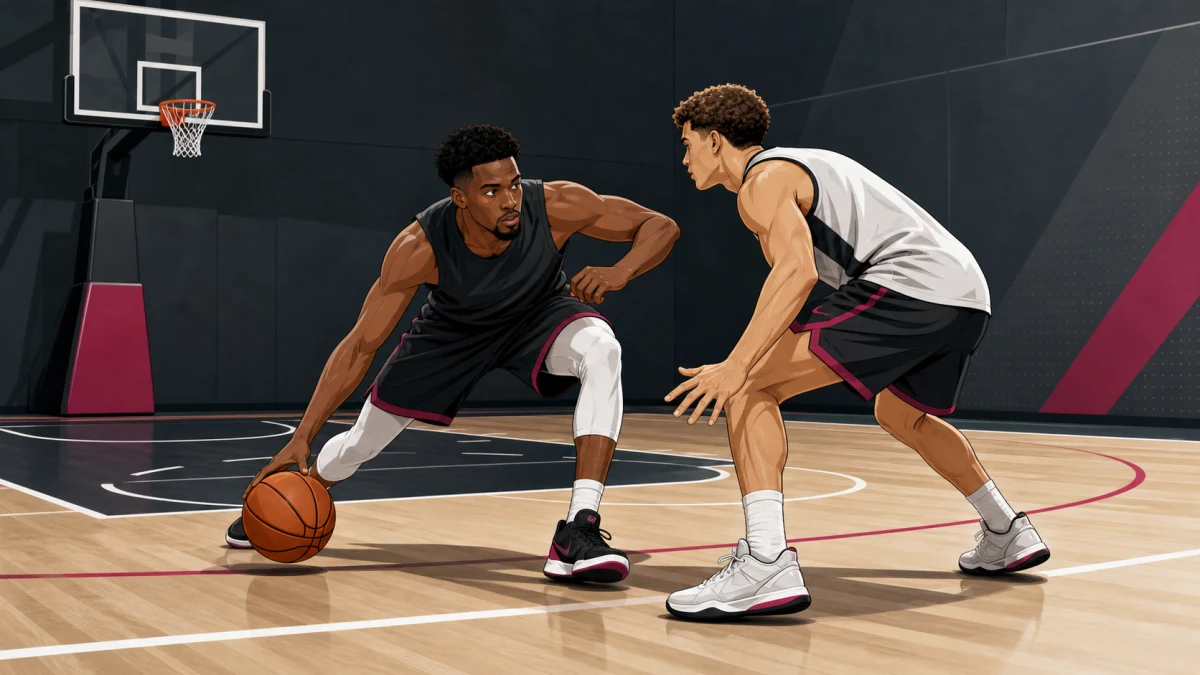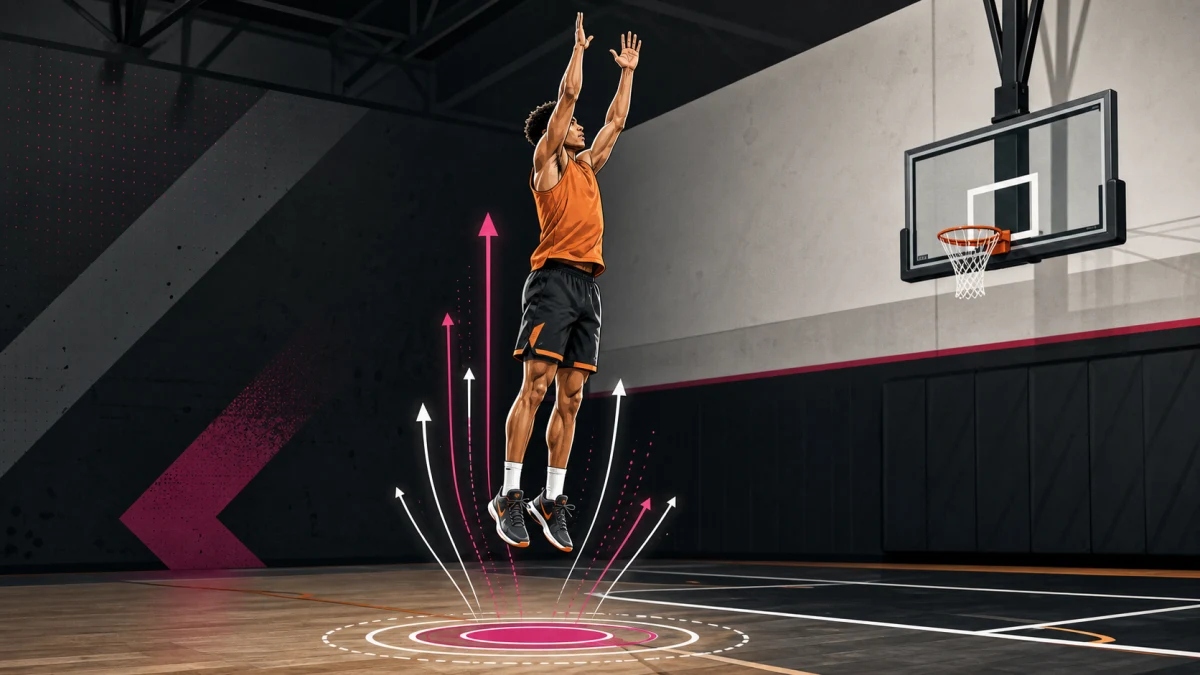
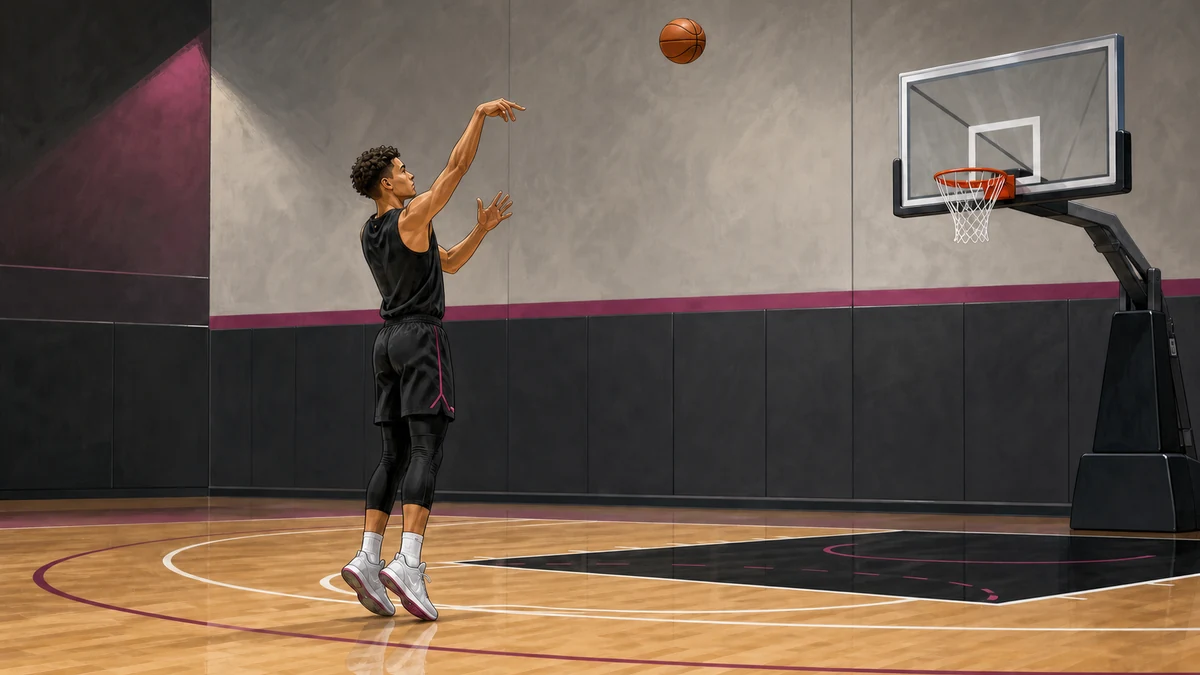
The short version: To shoot more like Stephen Curry, do not begin with logo threes or a frozen picture of his release. Begin with what Curry says comes first: fundamentals, footwork, balance, and coordination. Prepare before the catch, create power from the floor, move the ball through a clean path, and finish under control. His exact stance and release are personal. The sequence that makes them repeatable is what you can train.
Key takeaways
- Copy Curry's preparation and sequencing, not every foot angle or airborne adjustment.
- A quick shot starts before the catch: find the rim, organize the feet, and present ready hands.
- Power should travel from the floor through the body. If range requires an arm heave, move closer.
- A small rhythmic dip can help some shooters; a pause or sideways loop is the problem.
- Train stable makes first, then add footwork, movement, decisions, and pressure in that order.
Start with the right lesson: Curry built the difficult shots last
Stephen Curry is the NBA's career leader in made three-pointers and the first player to reach 4,000 regular-season threes. That record makes the spectacular shots easy to notice and the development process easy to miss. In his own explanation of how he learned to train, Curry warned players against starting with 40-foot attempts and off-balance highlights. He said his progression begins with fundamentals, footwork, balance, and coordination.
That is the useful meaning of "shoot like Curry." You are not trying to reproduce his body, release speed, strength, vision, or thousands of accumulated practice hours. You are building a shot that stays organized as the situation changes. The goal is not one identical pose. The goal is a repeatable chain of events.
1. Prepare the shot before the ball arrives
Curry's release looks fast because the visible arm action is only the final part of the shot. Before the catch, he is already reading the pass, finding the rim, lowering his center of mass, and organizing his feet. The catch does not begin the preparation; it completes it.
Use three checkpoints on catch-and-shoot reps:
- Eyes: locate the rim before the ball reaches your hands.
- Hands: show a clean target and receive the ball near your shooting pocket instead of reaching across your body.
- Feet: arrive in a stance from which you can rise without an extra shuffle.
Do not turn "Curry footwork" into one mandatory hop. Elite shooters use both a two-foot hop and a 1-2 step depending on pass angle, speed, and direction. Train both. The correct option is the one that lets you absorb momentum, align the shot, and leave the floor without drifting sideways.
2. Build power from the floor, not from an arm heave
Curry's own shooting curriculum breaks the motion into stance, alignment, and hand position, while emphasizing that the shot works from the ground up. His published mechanics guide describes a lower-body load followed by coordinated extension through the hips, legs, shooting arm, and wrist. It also recommends finding a natural stance through practice rather than forcing every player into one rigid shape. See the full Curry stance and alignment breakdown.
A practical test is the landing. After a normal uncontested shot, you should be able to land under control, with your chest and hips organized and no emergency step needed to recover. During a 2022 shooting adjustment, Curry and his coaches focused on weight distribution, core control, and where his feet landed. The staff connected an unstable landing on his toes with lost power through the body, according to the NBA's account of the correction.
For developing players, that lesson matters more than copying the exact angle of Curry's feet. If you need to throw the ball with your shoulders, fade backward without a defender, or kick forward to reach the rim, the distance is currently outside your stable range. Step in until the same coordinated shot returns.
3. Keep the ball path compact, but do not confuse compact with "no dip"
A dip is the brief lowering of the ball after the catch before it rises toward the set point. Coaches sometimes remove it because they fear a slower release. The better question is whether the dip supports rhythm or creates wasted motion.
In a controlled study of 36 experienced high-school and university players, shots with a dip produced roughly 7% to 9% higher accuracy scores than non-dip attempts. The authors also noted important limitations: the sample was small and uneven, the test was a controlled catch-and-shoot task, and it did not measure whether a defender could exploit the added time. Read the jump-shot dip study and its limitations.
The coaching takeaway is not "every player must dip." It is this: do not delete a smooth, centered rhythm simply because the ball moves down. Keep the ball close to the body, avoid a lateral loop, and let the dip flow directly into the upward motion. A hitch is a stop. A useful dip is part of the sequence.
4. Build a clean release, then allow it to adapt
The release should send the ball through a consistent shooting line: the shooting hand supports the ball, the guide hand stabilizes without adding side force, the elbow and wrist extend toward the target, and the wrist finishes relaxed. USA Basketball's mechanics guidance also emphasizes early target focus, balance, finger-pad control, coordinated delivery, and a held follow-through. Those are useful checkpoints, not a demand that every athlete look identical. Review the USA Basketball shooting fundamentals.
Distance changes the task. A 2023 kinematic study comparing free-throw-line and three-point jump shots found that players increased ball-release velocity at the longer distance, while release height and angle decreased in that sample. Experienced players still produced a higher average release height than less-experienced players. The study used only 17 men and three successful shots at each distance, so it should not become a universal formula, but it supports an important point: a farther shot is an adapted shot, not a perfectly frozen copy of a close-range rep.
Your non-negotiables are the outcome-producing relationships: centered control of the ball, coordinated force, a stable shot line, and a finish you can repeat. Set-point height, foot turn, jump height, and release timing can vary with the athlete and the contest.
5. Train the shot as a progression
This four-stage ladder turns the principles into practice. The numbers are coaching checkpoints, not universal laws. Reduce the volume for younger players and stop when fatigue changes the movement.
| Stage | Task | What to measure | Advance when |
|---|---|---|---|
| 1. Calibrate | Close form shots from five angles, alternating one-hand and normal finishes | Centered ball path, relaxed wrist, balanced landing | You can repeat the finish without reaching for range |
| 2. Prepare | Catch-and-shoot reps using both hop and 1-2 footwork | Eyes find rim early; no extra foot adjustment | Both entries produce the same controlled release |
| 3. Move | Relocation catches and one-dribble pull-ups in both directions | Deceleration, torso control, landing area | Movement no longer pulls the shot sideways |
| 4. Compete | Random spots, a guided closeout, and make-in-a-row pressure | Makes, shot quality, decision quality, miss pattern | The mechanics survive speed and uncertainty |
Start with the shooting-drill progression if Stage 1 is inconsistent. Use the shooting drill library to vary the movement task, or run a structured basketball shooting workout once the mechanics hold together.
How to review your own film
Film ten reps from the side and ten from the front. Do not judge only makes and misses. A make can hide a bad rep, and a clean miss can show the movement you want to keep.
- Was the base organized before the catch?
- Did the ball travel mostly upward, or loop across the face or body?
- Did the guide hand separate without twisting the ball?
- Was the release powered by a connected lower- and upper-body sequence?
- Did the player land under control in a predictable area?
- Do misses cluster short, long, left, or right?
Change one variable at a time and compare another set of ten. That is closer to how an elite shooter works than rebuilding the entire motion after every miss.
What not to copy from Curry
Do not copy the logo range before you own normal three-point range. Do not force his exact foot turn onto a different body. Do not add a dramatic leg split because it appears on a contested game shot. Do not chase release speed by rushing the catch. Most importantly, do not mistake the improvisation at the top of Curry's skill pyramid for the foundation underneath it.
The honest goal is not to become a visual duplicate of Stephen Curry. It is to build your own shot using the same priorities: prepare early, stay balanced, transfer force efficiently, control the ball, and earn complexity through repetition.
Frequently asked questions
Can a player copy Stephen Curry's shooting form exactly?
A player can study Curry's preparation, balance, rhythm, and compact release, but should not force an exact visual copy. Body proportions, strength, mobility, and shot context differ, so the useful goal is to understand transferable principles and test them with a coach.
What part of Curry's shot should players practice first?
Begin with preparation before the ball arrives: balanced feet, a ready stance, and efficient hand placement. Those details make the dip and upward motion easier to coordinate. Range and movement should come later, after the player can repeat the basic sequence.
Why does Curry practice footwork as much as his release?
The release depends on arriving under control. Consistent footwork helps a shooter organize the body before the ball moves upward, whether the shot follows a catch, relocation, or dribble. Poor preparation forces the upper body to compensate late in the motion.