
The short version: A game-ready handle is not a collection of tricks. It is the ability to protect the ball, see the floor, change speed and direction, and choose whether to dribble, pass, or attack. This 30-day plan moves from ball control to movement, then to pressure and decisions. Train four focused days each week, use one lighter review day, and test the same tasks on Days 1, 15, and 30.
Key takeaways
- Control comes before combinations. Own height, rhythm, and hand position before chaining moves.
- Change of pace creates the advantage. A crossover without a speed or direction change rarely moves a defender.
- Keep perception in the drill. Eyes-up cues, a live partner, and small-sided games connect technique to decisions.
- Track turnovers and advantage created. Fast dribbling is not useful if it does not produce space or a good next action.
Day 1: measure the handle you actually have
Use three tests before changing the program:
- Eyes-up control: alternate low pounds for 30 seconds while a partner shows numbers with their fingers. Record missed cues and lost dribbles.
- Change-of-direction course: complete a short zigzag with both hands. Record time, lost dribbles, and whether the outside foot can stop the body.
- One-on-one advantage: begin from the wing with a five-second limit. Record whether the first move creates a paint touch, clean pull-up, pass advantage, or turnover.
The tests separate speed from control and technique from transfer. Repeat them on Days 15 and 30 under the same conditions.
Week 1: control height, rhythm, and protection
Use 15 to 20 minutes per session. Begin with low pounds, hip-height pounds, front and side V-dribbles, and push-pull dribbles. The hand stays above and slightly behind the ball rather than carrying underneath it. Keep the off arm available to protect space without extending or pushing.
Add a visual task to every stationary drill: read numbers, name colors, track a partner's movement, or scan the rim and corners. The World Association of Basketball Coaches teaches dribbling through changes in height, speed, direction, and hand, not one unchanging rhythm. Its youth activities include coach-directed changes and “gears” from walk to sprint. See the FIBA mini-basketball coaching manual.
| Day | Main work | Constraint |
|---|---|---|
| 2 | Low and hip-height pounds; side V-dribbles | Read partner hand signals |
| 3 | Push-pull; in-and-out rhythm | Weak hand receives an extra set |
| 4 | Alternating two-ball pounds | Stop when posture rises or eyes drop |
| 5 | Mixed 20-second rounds | Coach calls height and pace changes |
| 6–7 | Light review and recovery | No timed fatigue test |
Week 2: connect the ball to the feet
Move from stationary control into retreat dribbles, lateral “horizontal” dribbles, crossovers, and between-the-legs changes. Walk the footwork first, then accelerate out for two or three dribbles. The FIBA/WABC advanced-dribbling guidance describes hesitation, punch, crossover, and fake-crossover actions as ways to create an opportunity to drive rather than as decoration. Review the WABC Level 2 coaching manual.
Use a simple rule: every move must change at least one of three things—speed, direction, or the defender's balance. Finish each rep at the rim or with a controlled pull-up so the handle leads somewhere.
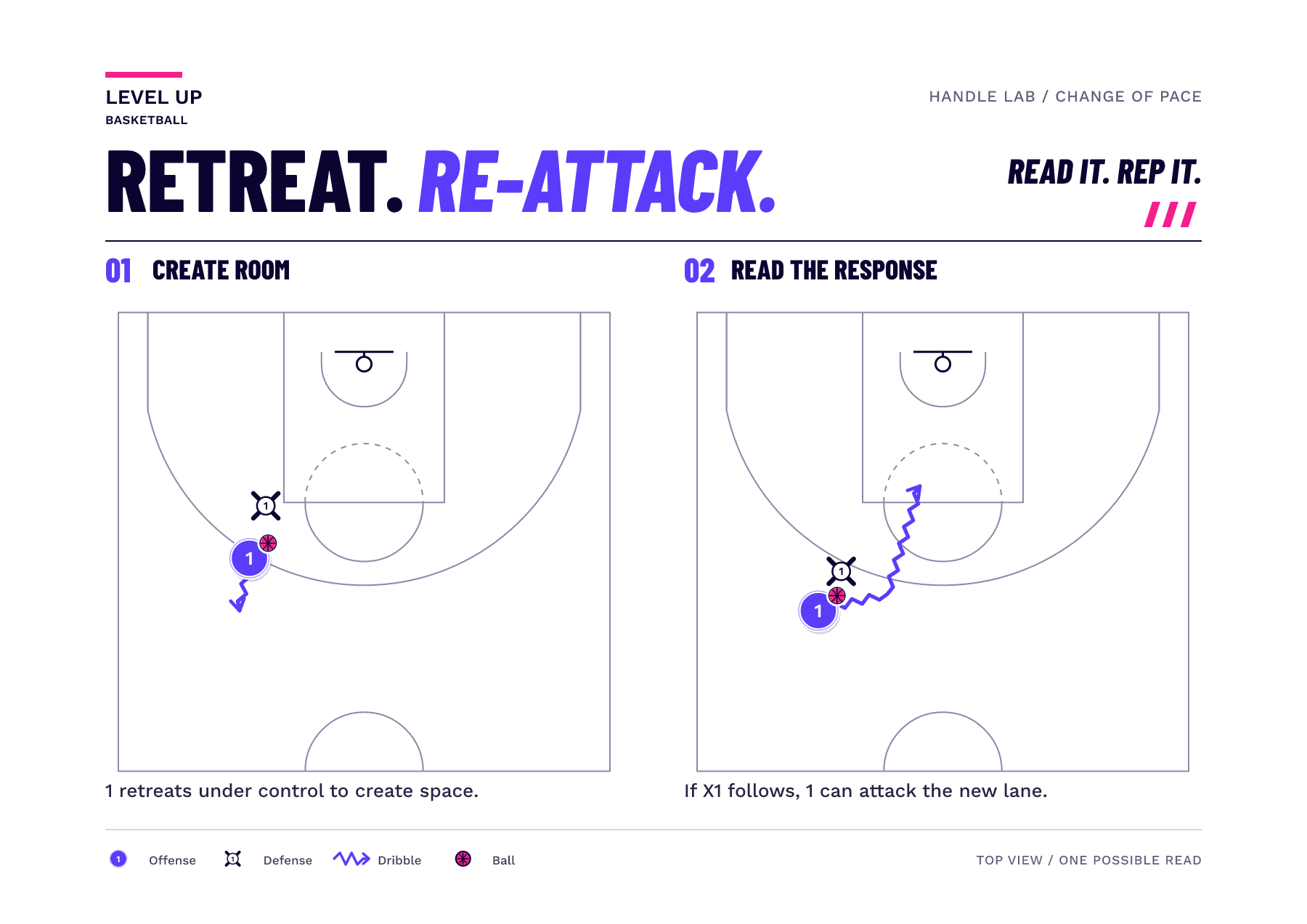
- Days 8–9: retreat into re-attack, both hands.
- Days 10–11: crossover and between-the-legs into two-dribble acceleration.
- Day 12: partner points left or right after the first dribble; react rather than preselect.
- Days 13–14: light review, then recovery.
Swipe sideways to explore the full diagram.
Day 15: retest and select one priority
Repeat the Day 1 tests. Do not change the second half of the plan based only on the fastest time. If the course is faster but turnovers increase, the priority remains control. If stationary control improves but one-on-one advantage does not, add more live or guided pressure rather than more cone combinations.
Week 3: apply pressure without losing the read
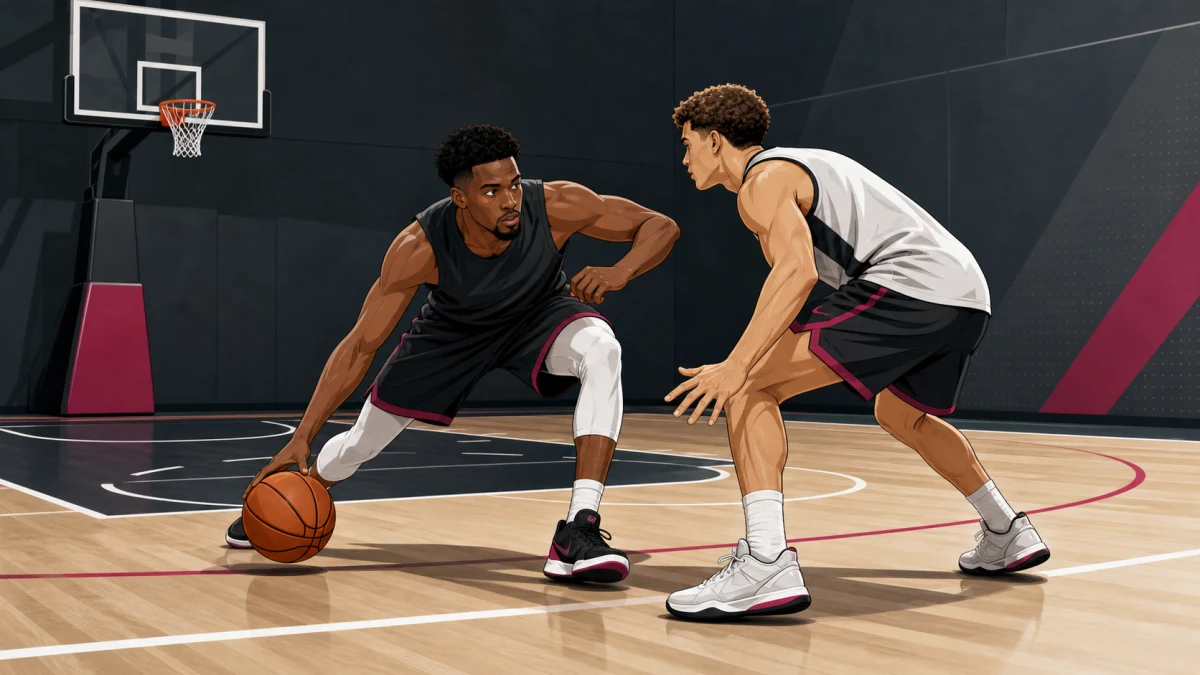
Introduce a guided defender. Begin with the defender shading one side, then progress to live one-on-one with a limited space or time. The ball handler must identify the defender's top foot and available gap before choosing the move. Score the possession as an advantage, neutral result, or turnover.
Small-sided play is useful because the ball handler must perceive teammates and defenders while controlling the ball. In one study of 32 young male players, six weeks of small-sided games produced larger improvements in control-dribbling and shooting tests than a running-based interval program, though the sample and setting do not make the result universal. Read the small-sided games versus interval training study.
- Days 16–17: one-on-one from the slot, defender shades one side.
- Days 18–19: two-on-two with a pass-or-drive decision.
- Day 20: three-on-three with a six-second decision clock after each catch.
- Day 21: recovery and film review.
Week 4: make the handle serve the possession
The final week reduces scripted dribbling. Play one-on-one, two-on-two, and three-on-three with constraints: weak-hand start, maximum three dribbles, bonus for a paint touch that creates a pass, or turnover penalty for dribbling without changing the defense. Research on game-based drills shows that player numbers and dribbling rules change the physical and technical demands, so the constraint should match the goal. Review the game-based drill demands study.
A no-dribble possession can improve the handle indirectly by teaching when not to dribble. A 2025 youth study found that limited-dribble small-sided games increased some physical outcomes relative to free play, but it did not test whether players developed a better dribble. Use that evidence narrowly: changing the rule changes the task. See the dribbling-restriction study.
Day 30: evaluate transfer, not tricks
Repeat all three baseline tests. Compare cue errors, lost dribbles, course time, and one-on-one outcomes. Then review five live possessions and ask:
- Did the player see help before entering the gap?
- Did the change of pace move the on-ball defender?
- Could the player stop without drifting or exposing the ball?
- Did the dribble create a shot, pass, or better angle?
- Was the weak hand available when the defense forced it?
The goal is not zero mistakes. It is a handle that gives the player more correct options under pressure.
Build the technical base with the ball-handling drills library, review how to dribble a basketball, or run the full ball-handling workout.
Frequently asked questions
What should change during a 30-day ball-handling plan?
The plan should move from basic control toward changes of pace, movement, pressure, and live reads. Repeating the same stationary pattern for 30 days may improve familiarity, but progression is what connects ball control to decisions a player must make in games.
How long should each ball-handling session be?
Session length should match the player's age, skill, and ability to maintain posture, vision, and control. A focused block with clear goals is more useful than extra minutes of careless repetitions. The plan should preserve enough energy for other basketball work.
How can players tell whether their handle is improving?
Retest the same controlled tasks under comparable conditions and also observe whether the player can change pace, protect the ball, and make decisions under pressure. Faster stationary repetitions alone do not prove that the skill transfers to live play.