
The short version: A give-and-go is a pass followed by a cut to the basket for a possible return pass. Defensive position can cue the cut; Jr. NBA practice also includes a perimeter return when no pass arrives.
Key takeaways
- The original passer cuts toward the basket looking for a return pass.
- A defender in a perimeter passing lane is a cue for a backdoor cut.
- Jr. NBA drills use directional fakes and a coach's ball position as cutting cues.
- In the Jr. NBA activity, a cutter who gets no return pass moves back outside the three-point line.
What is a give-and-go in basketball?
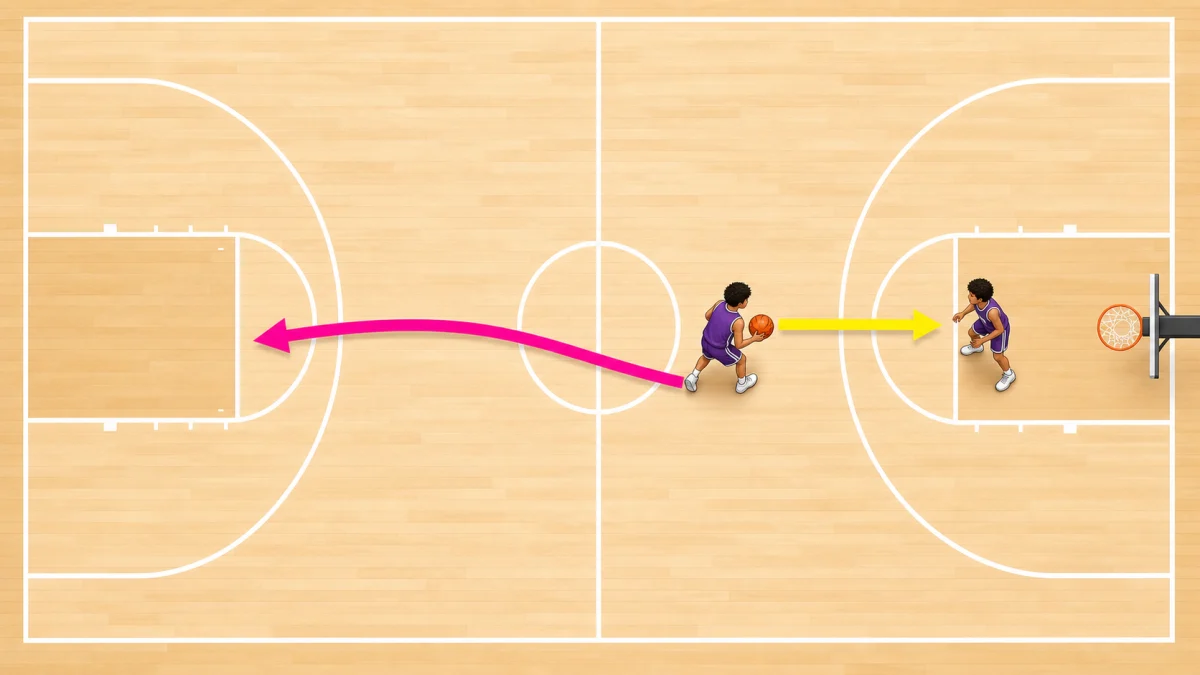
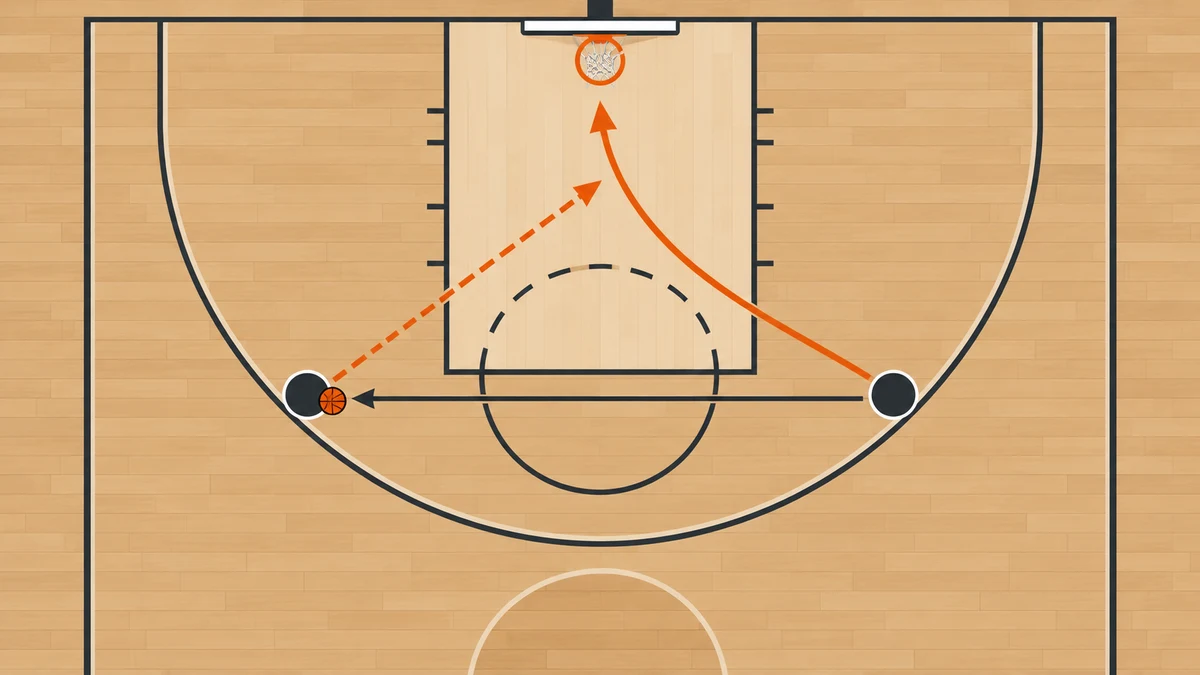
A give-and-go in basketball is a pass followed by a cut toward the basket, with the passer looking to receive the ball back. It is also called a pass-and-cut. When the return pass reaches a teammate inside the keyway, it is a form of penetration: getting the ball into that area through a pass. Penetration can also happen when a player dribbles the ball into the keyway. WABC Coaches Manual English
How should you deliver the pass?
For the pass itself, the WABC workbook gives concrete instructions: choose a teammate who is looking at you, and point your toe toward that teammate. Step forward as you deliver the ball; the workbook explains that this gives the pass strength. Straighten the arm or arms used to throw it. These instructions cover the receiver's attention, the direction of the step, and the passing motion. WABC Start Coaching English Coach Workbook passing motion
A pass fake can make the actual pass easier by getting opponents to move. Pretend to throw before making the intended delivery. For the ball's flight, the WABC workbook favors a flatter pass over a looping one. Its stated concern with a lob is the time the ball spends in the air, which makes that pass more easily intercepted.
The workbook also gives a specific example for passing to the left: move the basketball to the left side of your body and deliver it with your left hand. That is its instruction for avoiding a throw across your body.
Before starting a dribble, or after finishing one, a player can pivot by keeping the pivot foot on the floor and stepping with the other foot. The WABC workbook also describes what happens if that pivot foot lifts: the player must pass or shoot before it touches the floor again. The foot that stays grounded during the pivot and the foot that steps have different roles.
What cues guide the cut and its timing?
The Jr. NBA give-and-go drill includes a directional fake before the cut: the player can fake in the opposite direction, then begin cutting. Its execution guidance calls for good passes and a hard cut for a layup at full speed. The fake comes before the cutting movement in this drill. Rookie Practice Plans - NBA.com: Jr. NBA
Another Jr. NBA drill cue comes from the coach holding the basketball at either hip. Holding it on the right or left indicates which side of the coach the player should cut on. In the return-pass sequence, the coach catches the player's pass and sends the ball back to the cutter, who catches it and shoots a layup.
The drill can also include a defender assigned to the cutter. After the player passes to the coach, that defender moves to one side of the passer. The passer then fakes toward the defender and cuts off the coach to receive the return pass and score. Here, the defender's movement follows the initial pass.
Which defensive positions should players recognize?
A passing lane is the imaginary line between the player holding the ball and a teammate who could receive a pass. In the WABC manual's perimeter example, a defender occupying that passing lane is a cue for the offensive player to cut toward the basket. This is the backdoor cut: the cue concerns the defender's position in the passing lane.
From the defensive side, a player may position close to the passing lane while still seeing both the ball handler and their own opponent. The WABC manual describes an open stance as side-on to those two players, generally with the defender's back toward the basket or sideline. Both the ball and the direct opponent remain part of that positioning.
Against a dribbler, the WABC Level 1 manual gives the defender two different hand positions. The hand nearer the dribbler stays low to stop a crossover. The other hand is held at shoulder height to stop a pass. Those instructions distinguish the hand addressing the dribble from the hand addressing the passing option. WABC Coaching Level Manuals Level 1 English
If a defender is beaten, a teammate positioned between the ball and the basket may move across to defend the ball. The beaten teammate then switches. The WABC workbook says to teach players to communicate that switch loudly. For beginning players, it also says teaching defensive help rotations is unnecessary; its guidance at that stage includes the move across, the switch, and the spoken communication. defensive help rotations
Where does the cutter go without a return pass?
The Jr. NBA pass-and-cut activity includes a continuation for a cutter who does not receive the ball. If the coach does not deliver a return pass, the cutter returns to a spot outside the three-point line. That perimeter destination is the activity's instruction for the cut without a reception. perimeter destination
How can coaches structure give-and-go practice?
The WABC Level 1 manual suggests asking players about when to move to receive a pass as a way to set a game challenge. It also allows a coach to change what earns a score: a completed pass to a player in a designated area can count instead of a shot at the basket.
The Jr. NBA small-sided activity uses a different scoring condition. In its live two-on-two game, a basket earns one point, while a basket scored from a give-and-go pass earns two. These are the scoring values for that practice activity, including its extra point for a basket following the give-and-go.
Frequently asked questions
Are a give-and-go and a pass-and-cut the same thing?
Yes. The WABC manual uses both names for the action in which a player passes, then cuts toward the basket looking for the ball back. The player making the initial pass is also the player making the cut.
What does a defender in the passing lane tell the cutter?
For a perimeter player, that position is a cue to cut backdoor toward the basket. Here, passing lane means the imaginary line connecting the ball handler and a possible receiver. It is the defender occupying that line that supplies the cue.
Does every cut have to end with a return pass?
No. The Jr. NBA activity explicitly includes cuts where the coach does not pass the ball back. In that situation, the cutter returns to a spot beyond the three-point line. Receiving the return pass is therefore not required on every cut in that activity.