
The short version: A backcourt-return violation usually needs three things: the offense has established frontcourt control, that offense is last to touch before the ball goes back, and the same offense is first to touch in backcourt. A defender's deflection, a loose ball without established control, or an airborne-control exception can change the ruling.
Key takeaways
- Find team control first; without it, the usual frontcourt-to-backcourt restriction may not yet apply.
- Then identify whether frontcourt status was established under the competition's rule.
- Last touch in frontcourt and first touch in backcourt must both belong to the offense for the standard illegal-return sequence.
- The center line and an airborne player's status are rule-defined, not decided by where the torso appears on video.
- The eight- or ten-second advance count is a different violation from returning the ball after frontcourt control.
What is a backcourt violation?
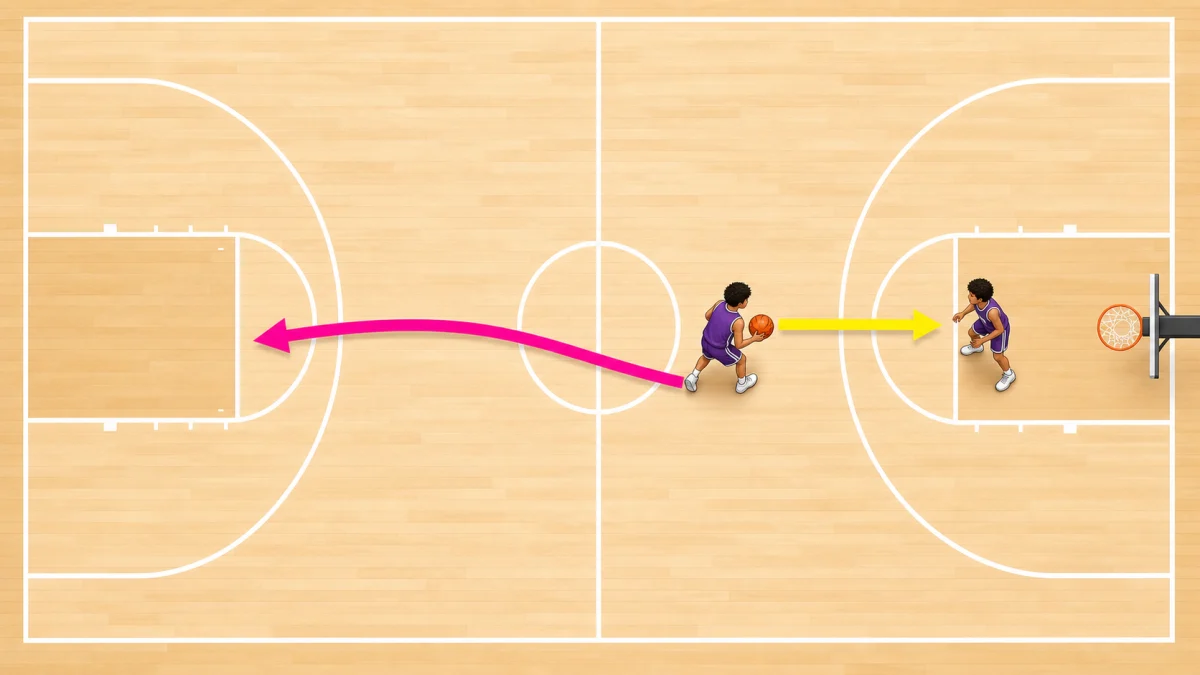
The common phrase “over and back” describes an illegal return, but the line crossing is only the visible part. In the NBA, the offense must control the ball, an offensive player must be the last to touch it before it returns from frontcourt toward backcourt, and an offensive player must be first to touch it in backcourt. If one element is missing, the standard return violation is missing too. NBA Rule No. 10 — Violations and Penalties NBA Video Rulebook — Backcourt Violations another basketball violation that depends on a defined sequence
- Control: Did the same team control a live ball? FIBA Official Basketball Rules 2024
- Frontcourt status: Had that team actually established the ball in frontcourt?
- Touch order: Was that team last to touch in frontcourt and first to touch in backcourt?
When is the ball established in the frontcourt?
FIBA gives a concrete frontcourt-control test. A player who is holding, catching, or dribbling the ball establishes it when both feet touch entirely in frontcourt. A team can also establish frontcourt control when teammates pass the ball among themselves there. That “both feet” detail prevents a player who still straddles the center line from being treated as fully established merely because the ball or upper body leans forward. why court location also matters for the three-second rule
Use that definition only where FIBA rules apply. The NBA expresses its restriction and location rules in its own language, and youth or school competitions may adopt another code. The safe officiating habit is the same: name the active rule set, determine player and ball status under that rule, and avoid making the call from a freeze-frame of the ball alone. NBA Rule No. 4 — Definitions
Does touching the center line count as backcourt?
Under FIBA definitions, the centre line is part of the backcourt. A player holding the ball with a foot on that line has not satisfied the both-feet-in-frontcourt test. Once frontcourt control exists, a player who touches the line while controlling the ball can create the backcourt side of the return sequence. Coaches should teach players to clear the line with space rather than dribble along it and invite a status decision.
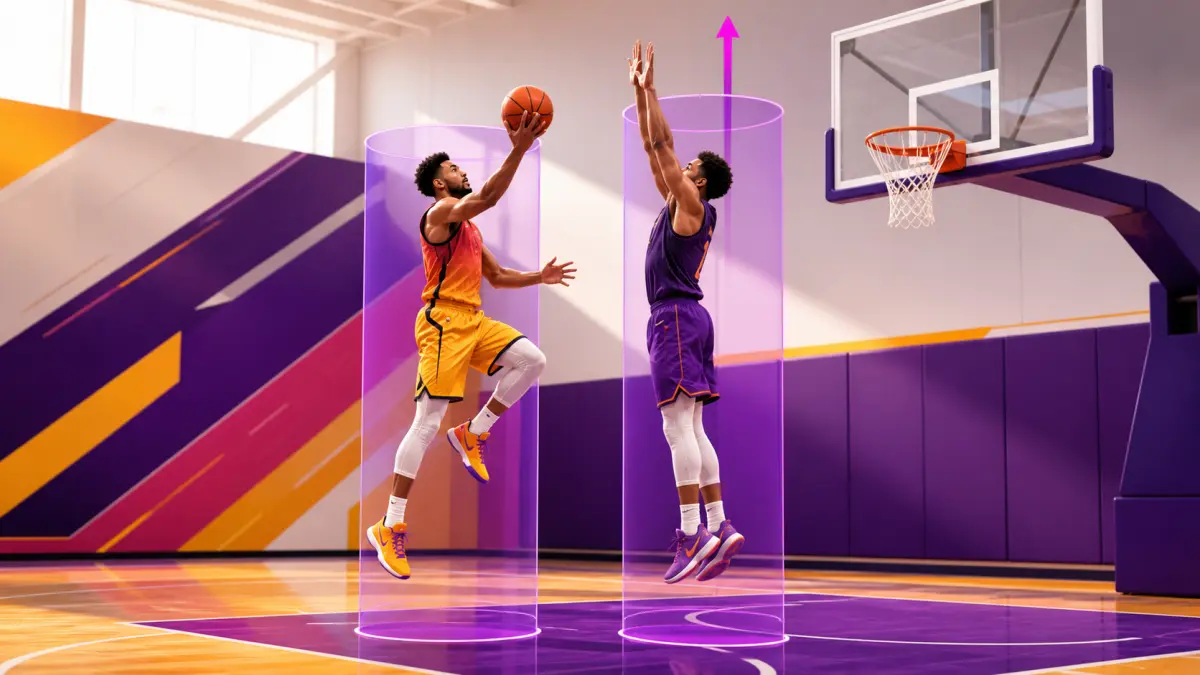
Airborne players keep the court location of their last floor contact in the NBA. That is why a pass caught in the air cannot be judged only by where the ball is floating. FIBA also has a narrow exception: a player may jump from frontcourt, establish new team control while airborne, and land in backcourt. The key words are new team control; the exception is not a license for a team that already controlled the ball in frontcourt to jump backward whenever pressured.
What happens after a defender deflects the ball?
A defender's touch can change the last-touch answer. In an official FIBA interpretation, if the defender is last to touch the ball in the offense's frontcourt and the original offense retrieves it in backcourt, the offense did not supply the required last touch in frontcourt. The recovery is legal even though the ball physically traveled backward. A deflection does not have to become full defensive control to matter to that element. FIBA Official Basketball Rules Interpretations 2024
Loose-ball plays require the same discipline. FIBA's interpretations distinguish a touch from established frontcourt team control. In the NBA, team control is absent during a try or tap and the rebound congestion that follows, as well as during a jump ball. Do not start the return-violation checklist from the ball's path; start by asking whether control existed and which team last touched it under the governing rule.
| Play | Likely ruling question | Why |
|---|---|---|
| Offense controls in frontcourt, mishandles backward, and recovers first | Illegal return | The same offense supplied the last frontcourt and first backcourt touches. |
| Defender tips the ball from frontcourt into offense's backcourt | Legal offensive recovery under the illustrated FIBA sequence | The defender supplied the last frontcourt touch. |
| Shot comes off the rim into backcourt during an uncontrolled rebound | Find new control first | The ordinary team-control premise may be absent. |
| Player jumps from frontcourt, gains new control airborne, lands backcourt | FIBA exception can apply | New airborne team control is expressly excepted. |
Can a throw-in create an over-and-back call?
Yes, a throw-in can lead into a backcourt-return ruling. FIBA interpretations include frontcourt throw-in sequences under Article 30: once the live-ball touch and control conditions are met, the same last-touch and first-touch logic applies. The fact that the inbounder stands out of bounds does not erase the receiving players' court status or the resulting team-control sequence.
Late NBA possessions add another reason to check the exact rule. Rule 8 contains special final-two-minute throw-in administration that can affect where the ball is inbounded and how frontcourt or backcourt status is treated. Players should execute the designated play and officials' administration, not assume the inbounder's physical spot alone settles every part of the next backcourt decision. NBA Rule No. 8 — Out-of-Bounds and Throw-In
Is over-and-back the same as an eight- or ten-second violation?
No. The NBA's eight-second rule asks whether a team in continuous backcourt control advances the ball in time. The illegal-return rule asks whether a team that reached frontcourt then completed the prohibited touch sequence back into backcourt. One can happen without the other: a team may fail to cross at all, or it may cross successfully and later send the ball back. another basketball rule that depends on control and sequence
Other competitions may use a different advance count, clock display, or throw-in administration. That changes the number or procedure, not the need to separate the two concepts. When reviewing film, label the clip “advance-count violation” or “illegal return” before debating the player action. Clear labels lead to clearer corrections.
How can players avoid backcourt mistakes?
- Clear the center line with both feet and useful space instead of stopping on it.
- Before passing backward, know whether your team already established frontcourt control.
- On a deflection, keep playing until the whistle; the opponent's touch may make the recovery legal.
- On rebounds and loose balls, secure control before assuming the ordinary return restriction has begun.
- Practice sideline and center-line traps with a safe outlet ahead, across, or back before frontcourt status is established.
Frequently asked questions
Can the ball cross half court and come back without a violation?
Yes. A physical crossing alone is not enough. A defender may have supplied the last frontcourt touch, the offense may not have established frontcourt control, or a defined airborne-control exception may apply. Identify control, status, and touch order before deciding.
Is the center line frontcourt or backcourt?
Under FIBA rules, the centre line belongs to the backcourt. That is why both feet must be entirely in frontcourt for a player holding, catching, or dribbling the ball to satisfy FIBA's frontcourt-control test.
Does a defensive tip reset everything?
Not automatically. A tip can make the defender the last player to touch in frontcourt, which may legalize the offense's recovery in backcourt. But a mere tip is not always a new defensive possession, so other control and clock questions must still be evaluated under the active rule.
Can an airborne player land in the backcourt with the ball?
Sometimes. NBA location follows the player's last floor contact, and FIBA expressly permits a player who jumps from frontcourt, establishes new team control while airborne, and lands in backcourt. The exception is narrow and depends on when new control begins.