
The short version: A double dribble usually happens when a player ends a dribble and then starts another one without a legal change of control in between. A dribble ends when the player controls the ball with both hands at the same time or lets it come to rest in one or both hands. The same label is also commonly used when a player dribbles with both hands at once. The result is a violation and possession for the other team.
Key takeaways
- Control is the key. The official rule turns on when the first dribble ends, not simply on how many times the ball bounces.
- Two hands end the dribble. Once both hands control the ball, the player may pass, shoot, or pivot legally, but may not begin a new dribble.
- A real interruption can reset the play. A shot attempt, an opponent touching the ball, or a pass or fumble touching another player can permit another dribble under the applicable rule.
- A fumble is not automatically a second dribble. Officials judge whether the player lost control accidentally or deliberately ended and restarted the dribble.
- Double dribble, carrying, and traveling are different calls. They can happen close together, but each violation tests a different action.
What is a double dribble in basketball?
The cleanest definition is: a player cannot voluntarily finish one dribble and then begin a second dribble while still controlling the same live-ball possession. The NBA states that a player may not dribble a second time after voluntarily ending the first dribble. FIBA uses the same core structure: after the first dribble has ended, another dribble is illegal unless a listed event interrupts control.
When does a dribble start and end?
A dribble starts when a player in control throws, taps, rolls, or bounces the ball to the floor and touches it again before another player does. During a continuing dribble, the ball may leave the hand many times. The number of bounces is irrelevant as long as the dribble remains live and legal.
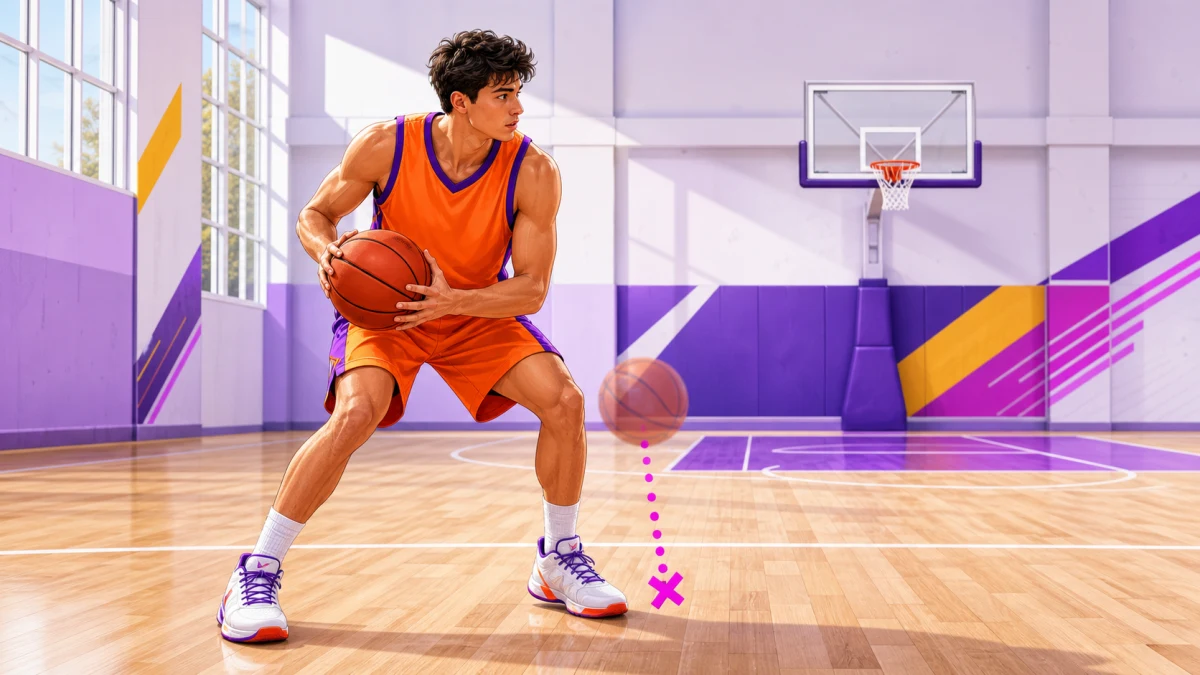
The dribble ends when the player touches the ball with both hands simultaneously or permits the ball to come to rest in one or both hands. In NBA language, a dribble also ends with a shot, pass, loss of control, dead ball, or gather. This is why the gather matters: once the player has enough control to hold, pass, shoot, change hands outside a continuous dribble, or cradle the ball, the live dribble has finished.
A player may stop, establish a legal pivot foot, survey the floor, and pass or shoot. The player may not pivot and then decide to bounce again. For the footwork rules that begin after control is established, see the basketball traveling rule explained and the guide to the triple threat position.
Why is the second dribble illegal?
The common sequence is easy to spot: dribble, secure the ball with two hands, hesitate, and bounce again. Another version is a player who lets the ball settle in one hand, pauses it, and then resumes. That second action may be described as an illegal or discontinued dribble depending on the rule set and exact mechanics, but play stops for the same practical reason: the first continuous dribble ended.
When can a player legally dribble again?
A new dribble can be legal after an event that genuinely interrupts the player’s control. The NBA and FIBA rules identify the same central situations:
- A shot for goal: after a genuine shot attempt, the player may regain the ball and dribble if the rule set’s conditions are met. In the NBA, the attempt must touch the backboard or rim for the listed second-dribble exception.
- An opponent touches the ball: a defender’s touch can interrupt the original control and permit another dribble. The play must be an actual touch; a ballhandler cannot manufacture an exception merely by throwing the ball at a defender who does not play it.
- A pass or fumble touches another player: once another player touches the pass or fumble, the original dribble restriction can reset.
The wording matters. A player who simply drops the ball after holding it has not necessarily earned another dribble. Officials distinguish an accidental fumble from a controlled release, and they judge whether the required intervening touch or shot actually occurred.
What counts as a fumble rather than a dribble?
FIBA defines a fumble as accidentally losing and then regaining control of a live ball. It also lists fumbling at the start or end of a dribble among actions that are not themselves dribbles. That protects normal basketball actions: a bobbled catch or accidental loss does not become an automatic violation merely because the player touches the ball again.
But “fumble” is not a free reset button. If a player has clearly ended the dribble, deliberately releases the ball, regains it, and bounces again without a qualifying touch, officials can still call the violation. The practical video-review question is not “Did the ball get loose?” It is “Was control genuinely lost, and what happened before the player began another dribble?”
Can a player use the backboard to restart a dribble?
This is one of the most misunderstood edge cases. Under current FIBA rules, deliberately throwing the ball against the backboard and regaining it is not classified as a dribble. Official interpretations explain that a player who has not dribbled may catch the backboard toss and then dribble. A player who already ended a dribble may catch that toss and shoot or pass, but may not use it to begin another dribble.
The NBA’s exception is worded differently: after a pass or fumble touches the player’s own backboard or the basket ring, or is touched by another player, a second dribble may be permitted. Because competition rules and interpretations can differ at the edges, players should follow the rulebook used by their league and officials should apply that competition’s case guidance.
Double dribble vs. carrying vs. traveling
Double dribble asks whether one dribble ended and another began illegally. Carrying or a discontinued dribble occurs when the hand gets under the ball, carries it from one point to another, or brings it to a pause before the dribble continues. Traveling governs illegal foot movement while holding or controlling the ball.
One move can create confusion because the actions are close together. A player may pause the ball in one hand, take steps, and bounce again. The official still identifies the first violation that occurred under the relevant rule set. For players, the correction is simpler: keep the hand on the side or top of the ball during the live dribble, gather once, and choose pass, shot, or legal pivot instead of trying to restart.
How should players and coaches train the rule?
On film, pause at the final legal bounce and watch the hands. Did both hands control the ball? Did it rest in one hand? Did a defender touch it? Was the next action a pass, shot, fumble, or new dribble? Players can reinforce continuous control in the ball-handling drill library, then apply it in a ball-handling workout. This trains the player to see a stopped dribble as a decision point, not an invitation to bounce again.
Common double-dribble questions
Is dribbling with both hands always a double dribble?
If both hands contact and push the ball during the same bounce, officials commonly call a double dribble. If both hands merely secure the ball, that action ends the dribble; the violation occurs only if the player then starts another one.
Can you stop, pivot, and dribble again?
No. A legal pivot does not restore the dribble. After gathering the ball, the legal choices are to pivot, pass, or shoot within the other time and movement restrictions.
Is a double dribble a foul?
No. It is a violation, not a personal foul. Play stops and the other team receives the ball for a throw-in according to the applicable rule.
Current FIBA rule note for 2026
As of July 2026, the 2024 FIBA rules remain in force. FIBA has already published updated Article 24 wording that becomes valid on October 1, 2026. The change clarifies that control must be lost because of a shot, an opponent’s touch, or a pass or fumble touching another player before another dribble is allowed. It does not turn a deliberate stop-and-restart into a legal move; it makes the control test more explicit.
Official rule sources
- NBA Rule No. 4: dribble and gather definitions
- NBA Rule No. 10: dribble violations and exceptions
- FIBA Official Basketball Rules 2024, Article 24
- FIBA Official Interpretations 2024, Article 24 examples
- FIBA 2026 rule changes, Article 24 clarification
About Level Up Basketball
Frequently asked questions
What is a double dribble in basketball?
A double dribble occurs when a player ends one dribble and then starts another, or when the player dribbles in a prohibited way with both hands. The exact ruling depends on whether control and the first dribble have legally ended.
Can a player dribble again after losing the ball?
It depends on why possession was lost. A defender touching the ball, a shot attempt, or another legal interruption can change the ruling, while voluntarily ending the dribble and starting again remains a violation. Officials judge the complete sequence.
Is touching the ball with both hands always a double dribble?
No. A player may legally gather or hold the ball with both hands, but that action normally ends the dribble. The violation occurs if the player then begins another dribble without a legal intervening event.