
The short version: The basketball cylinder principle protects legally occupied space and the space above it. Verticality is a legal upward contest, not simply raised arms. In FIBA language, responsibility can shift to the player who leaves their cylinder. NBA restricted-area interpretations add timing and jump-path conditions. Watch the feet, torso, arms, timing, and lane position under the rule code governing the game.
Key takeaways
- A cylinder is protected playing space, not an automatic foul call whenever bodies touch.
- Raised arms are not enough: a legal vertical contest depends on position, timing, trajectory, and body alignment.
- A player who leans, kicks, spreads into another player's protected space, or changes a legal line can create the contact responsibility.
- The restricted area changes some NBA block-charge analysis, but it does not erase verticality requirements.
- Use the rulebook for the league you are playing in and let the game officials rule the live play.
What is the basketball cylinder principle?
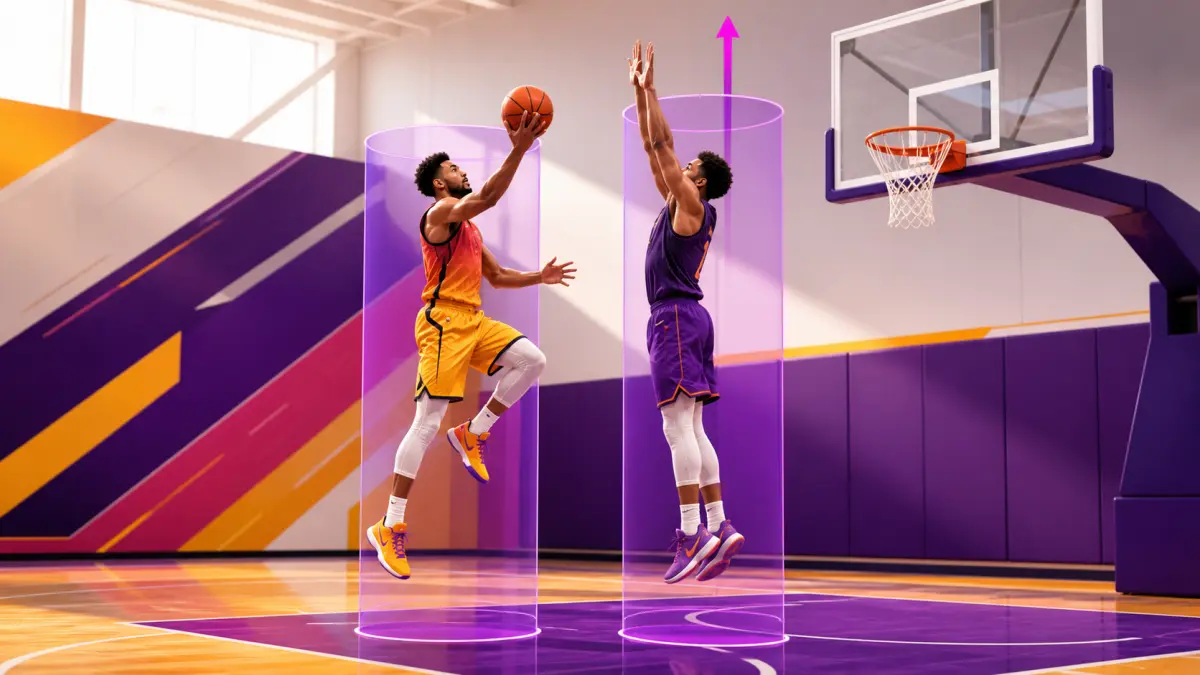
The cylinder principle is a way to describe each player's legally occupied space. In the current FIBA rule language, that includes the ground space the player occupies in a normal basketball position and the space above that player. It is useful because contact is not judged by who looks bigger, who jumps higher, or who reaches the rim first. The first question is more basic: where was each player entitled to be before the contact happened? A player does not own the entire lane or a straight line to the basket. They do have a claim to the space they have legally established. FIBA Official Basketball Rules 2024 help-defense rotations
That principle works in both directions. A post defender cannot lean into an offensive player simply because the offense initiated a move, and an offensive player cannot clear a path by extending an elbow, knee, or leg into a defender's established space. FIBA explicitly identifies arm and elbow extension outside the cylinder, plus spreading legs or arms during or immediately after a shot to cause contact, as offensive-contact examples. The rule is about the path and the space, not a reward for looking aggressive.
What does verticality mean in basketball?
Verticality is the legal version of contesting upward within your protected space. NBA comments describe a player's entitlement to a vertical position, including jumping straight up or holding the arms above the shoulders. But that phrase is often shortened into an unhelpful rule of thumb: hands up means no foul. It does not. An official still evaluates whether the defender was legally positioned, whether the jump stayed on a vertical line, whether the body created contact, and whether another rule applies to the play. NBA Comments on the Rules
The NBA's restricted-area verticality explanation makes the movement test concrete. In its example, the defender must be airborne to defend the shot at contact, jump straight up rather than toward or sideways into the opponent, maintain nearly straight vertical alignment, and avoid turning sideways. A slight backward angle can be part of absorbing contact in the league's explanation, but a forward lean, a jackknifed leg, or a sideways turn changes the picture. Coaches can teach this as a body-control skill: jump from balance, show the chest and hands without chasing the scorer, then land under control. NBA Rule Authority: Restricted Area and Verticality Plays
Who is responsible when bodies collide?
FIBA's wording offers a clear starting point: when a player leaves their cylinder and makes contact with an opponent who has already established a cylinder, the player leaving that space is responsible. This is why a driver cannot assume that moving toward the basket converts every collision into a defensive foul, and a defender cannot assume that standing nearby is enough. The observer has to identify the established position first and then follow the movement into the contact. Feet, hip line, torso angle, and the timing of the upward motion matter more than the final snapshot.
- Start before the collision: locate both players' feet, torso direction, and legal space before the gather or jump.
- Follow the path: ask whether the defender rose vertically or moved forward, sideways, or underneath the opponent.
- Check the offense too: an extended elbow, knee, or leg can create illegal contact even during a legitimate shot attempt.
- Treat the final result as evidence, not the whole answer. Contact can be legal, incidental, defensive, or offensive depending on the sequence.
How does the restricted area affect verticality?
The restricted area is not a free-contact zone and it is not the same rule as the cylinder. In the NBA explanation, a secondary defender inside the restricted area may avoid a blocking foul on a block-charge play if the defender established legal guarding position before the offensive player's upward motion and then jumps vertically to defend the shot. That is a specific league interpretation with specific conditions. A grounded defender with arms raised, a defender who slides into the drive, or a defender who jumps toward the shooter does not satisfy the described verticality conditions. basketball goaltending and interference
For players, the usable lesson is simpler than memorizing every exception: do not arrive late and try to sell a charge with your body. Beat the play to a legal position when possible. If you are contesting at the rim, load both feet, rise through your own space, keep your ribs and hips stacked, and avoid swinging arms or legs into the finisher. For offensive players, finish on a basketball path and avoid creating space with an unnatural kick or arm bar. Those habits make the clip easier to officiate and safer to repeat in practice.
Why NBA and FIBA wording should not be blended
The same basketball play can be discussed with NBA vocabulary, FIBA wording, or local federation mechanics, but the exact rule text and interpretation process may differ. The FIBA 2024 rules took effect worldwide on October 1, 2024, and FIBA publishes official interpretations as separate material. The NBA's verticality pages explain NBA rulings and examples. Neither is a substitute for the rule code, mechanics, and current interpretations used by a school, club, federation, or league. If a video is being reviewed after the game, use the right rulebook before declaring a call obviously correct or wrong. FIBA Official Basketball Rules 2024 come into force
This matters especially for player development. A coach should use rule language to sharpen decisions, not to turn every rep into courtroom debate. Build a drill where the defender establishes early position, contests with a controlled vertical jump, and then switches roles. Film one or two reps and ask a narrow question: did the defender stay in their space, or did either player create new contact space? That is more teachable than arguing from a frozen frame. Use the Level Up drill library to practice the footwork and balance that make legal contests repeatable. basketball three-second rule
Frequently asked questions
Are raised arms automatically legal verticality?
No. Raised arms can be part of a legal contest, but NBA guidance also looks at legal position, whether the defender is airborne at contact in the restricted-area example, jump trajectory, body alignment, and whether the defender turns sideways. FIBA likewise frames the issue through the cylinder and responsibility for leaving it. Watch the whole movement, not only the last frame with hands above the shoulders.
Can an offensive player get a foul while shooting?
Yes. Shooting does not authorize a player to create contact outside normal basketball space. FIBA specifically describes offensive contact through extended arms or elbows outside the cylinder and spreading legs or arms during or immediately after a shot to cause contact. The actual decision depends on the game sequence and applicable rules, so players should avoid trying to manufacture space with a kick, knee, or arm bar.
Does the restricted area mean the defender is always late?
No. The NBA's published restricted-area explanation includes a verticality exception for a secondary defender who established legal guarding position before the offensive player's upward motion and then meets the listed verticality conditions. That does not make every contest inside the arc legal. It means the timing, path of the jump, and body position still have to be evaluated under the NBA rule framework.