
The short version: Team defense is a continuous chain of positioning, communication, and recovery. By mastering gap positioning, stunting, tagging rollers, executing X-outs, and closing out under control, teams can protect the paint and contest perimeter shots.
Key takeaways
- Defense is a fluid chain where every off-ball movement triggers a corresponding rotation.
- Gap defense and help-side defense require distinct positioning based on distance from the ball.
- Stunting allows defenders to disrupt drives without fully abandoning their primary matchup.
- Tagging the roller is essential to stop pick-and-roll penetration but requires weak-side rotation.
- The X-out rotation is a weak-side defensive movement pattern used after a defender tags a roller.
- Closeouts represent the transition from helping in the paint to guarding a player on the perimeter.
The Foundation of Team Defense: Gaps vs. Help-Side Positioning
In basketball, team defense involves coordinated movements among players. When an offensive player drives or a screen is set, off-ball defenders typically adjust their positioning relative to the ball and their assignments. This defensive approach involves several concepts, including gap positioning, stunting, tagging rollers, executing X-outs, and performing closeouts.
Gaps vs. Help-Side: Defining the Positions
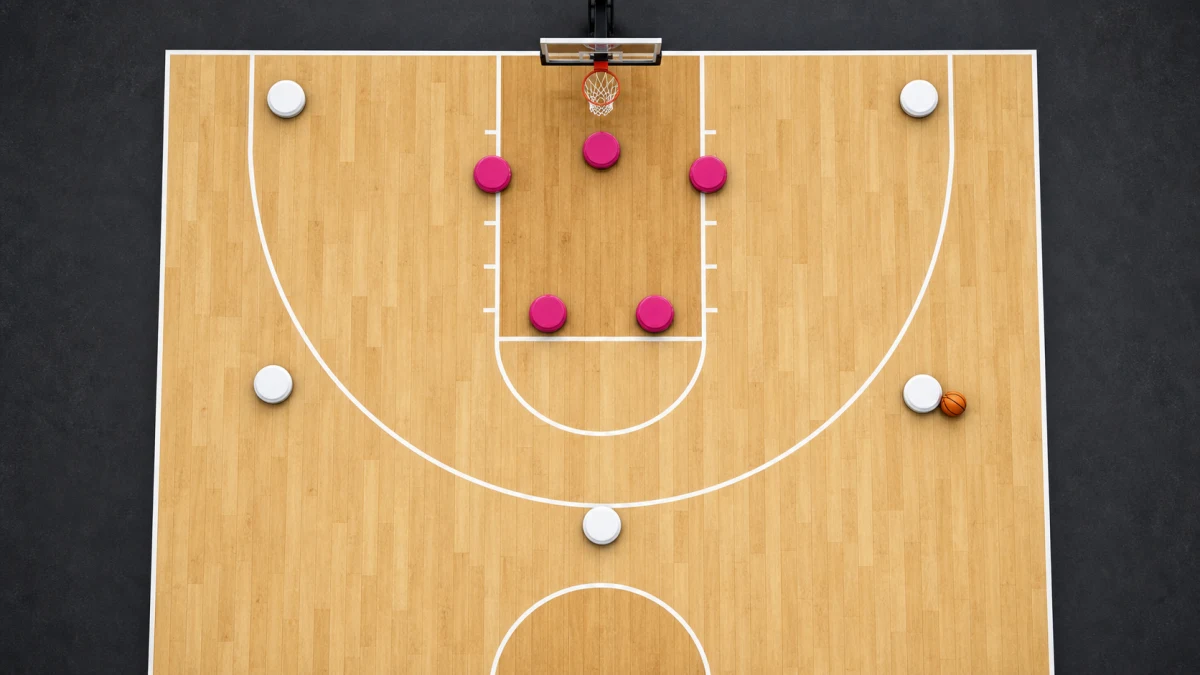
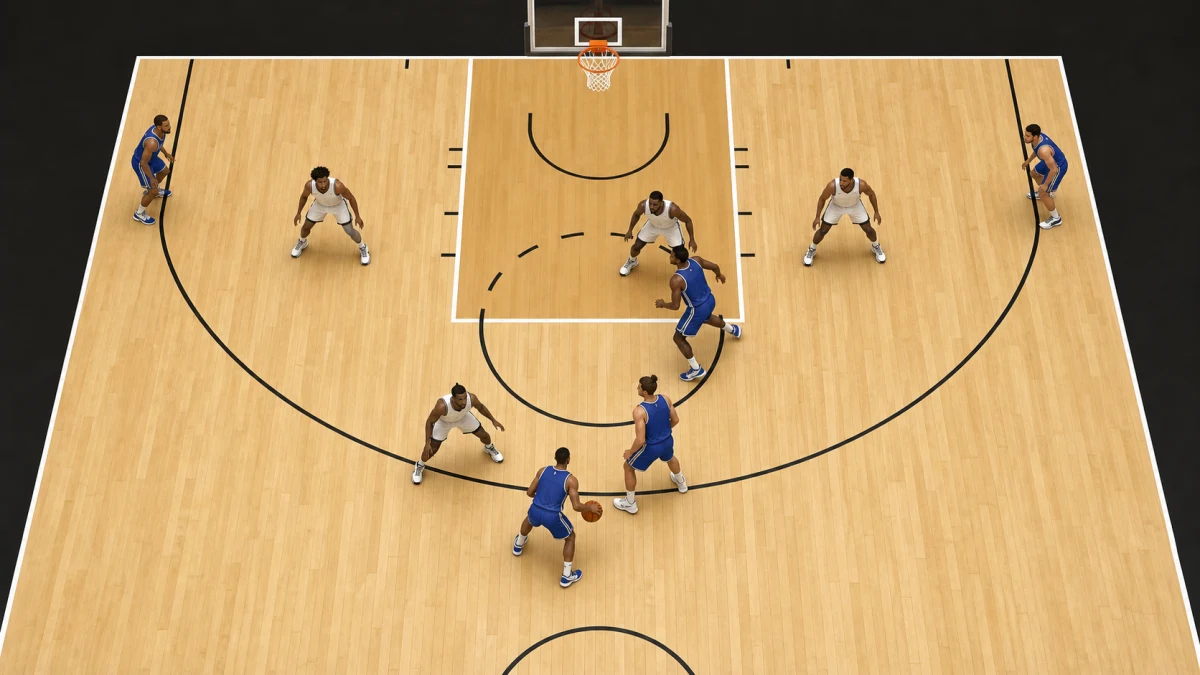
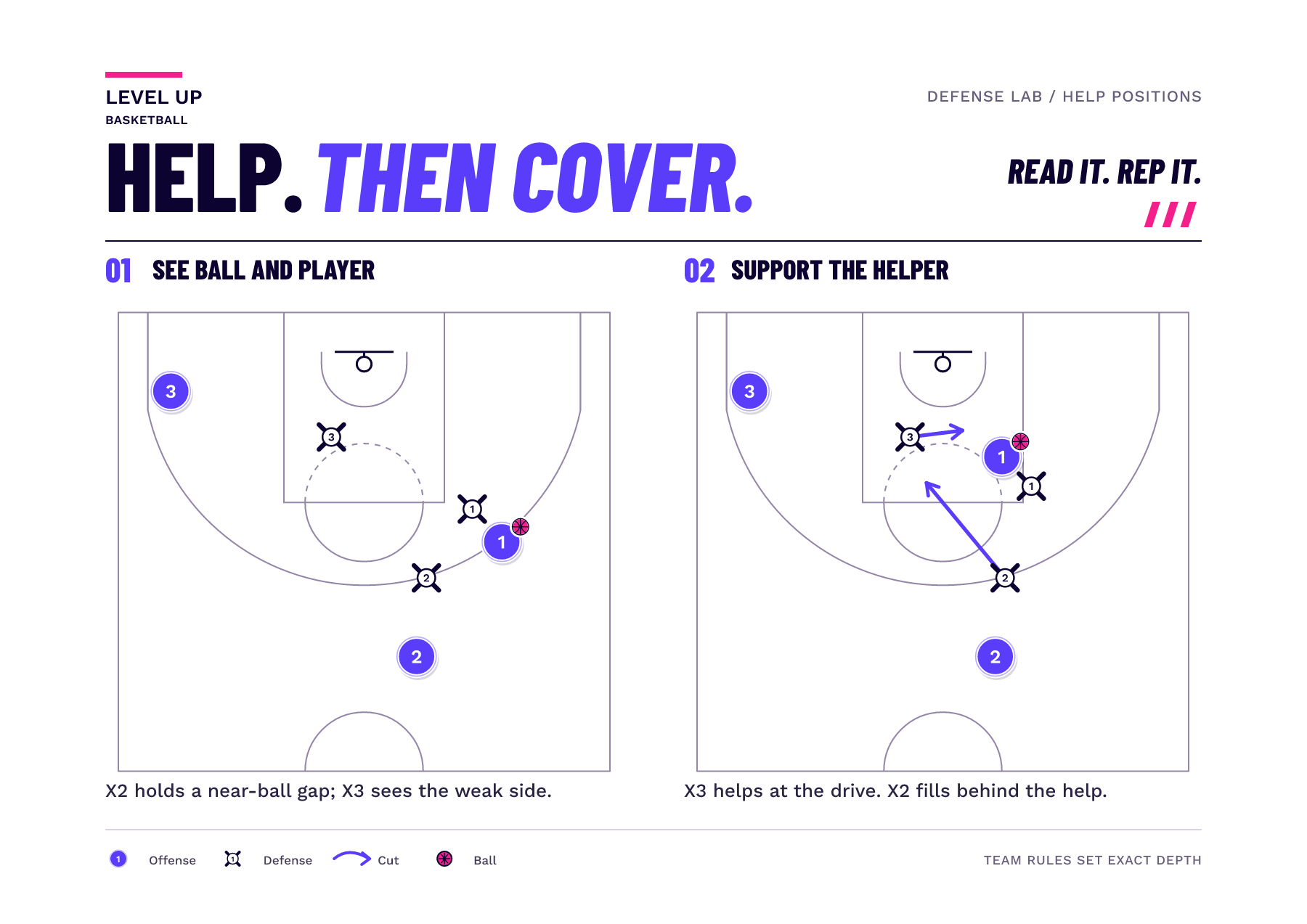
Defenders categorize their positioning based on their distance from the ball. Gap defense is played by defenders who are one pass away, who position themselves in the space between the ball-handler and their direct assignment. Help-side defense is played by defenders who are two or more passes away, who typically position themselves near the split line, which is an imaginary line dividing the court from basket to basket.
For players younger than 11, team defense requires teaching them to see both the ball and the person they are guarding.
To prevent staring at the ball and losing their player, defenders can be reminded to point one hand at the ball and one hand at the player they are guarding with their head straight ahead. Defense - NBA.com: Jr. NBA
While these principles form the bedrock of man-to-man help, they also serve as a bridge to more structured defensive systems. For instance, understanding how to shrink the floor from the weak side is highly relevant when transitioning to zone concepts, which you can explore further in our guide to what is a 2-3 zone defense. Regardless of the system, the goal remains the same: protect the paint first, then recover to the perimeter. what is a 2-3 zone defense
Swipe sideways to explore the full diagram.
Stunting and Recovering: The Art of the Bluff
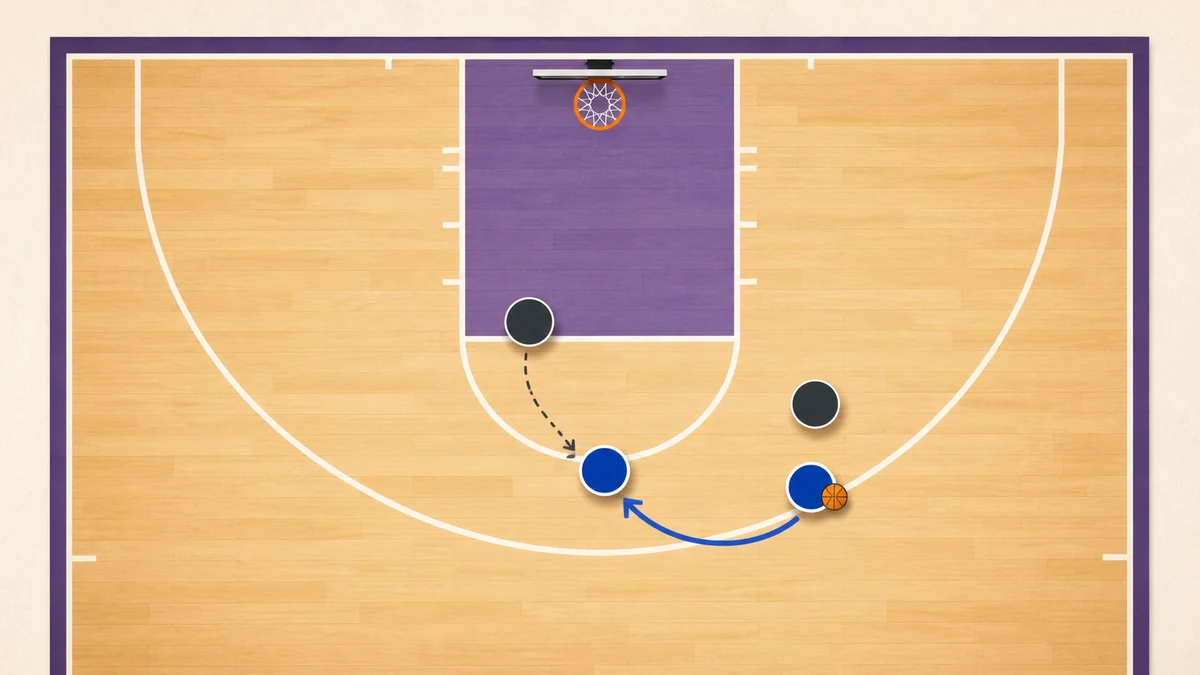
Stunting is a defensive movement where an off-ball defender takes a step toward a driving player before recovering to their original assignment. This action is designed as a temporary help movement while maintaining positioning relative to the primary matchup.
To practice fundamental closeout and help-side positioning skills, players can work on shifting their positioning and vocalizing their responsibilities.
In the 2-Person Closeout Drill, when the ball is passed to the other wing, the defender must jump to the help position and vocalize 'help, help, help!'. Starter Practice Plans - NBA.com: Jr. NBA
Maintaining vision during this high-speed transition is paramount. In the 2-Person Closeout Drill, players in the help position must see both their player and the ball.
Pick-and-Roll Rotations: Tagging the Roller
Pick-and-roll actions involve specific defensive rotations. When a screen is set, teams coordinate their coverage, which can include dropping, hedging, or blitzing the screen. To understand the various ways teams handle the initial screen, check out our breakdown of basketball pick-and-roll coverages explained. In these schemes, weak-side off-ball defenders are typically positioned to monitor the rolling player. basketball pick-and-roll coverages explained
In the Rebounding Tag & Pursue Drill, the defensive player starts in help defense guarding a player without the ball and must vocalize 'help, help, help'. MVP Practice Plans - NBA.com: Jr. NBA
The drill then simulates the rapid transition from help to ball containment. During the Rebounding Tag & Pursue Drill, when the ball is passed to the partner, the defensive player must close out and vocalize 'ball, ball, ball'.
Finally, the drill completes the defensive loop by forcing the player to recover and secure the possession. In the Rebounding Tag & Pursue Drill, when the ball is passed back, the defender must jump back into the help position, vocalize 'help, help, help', and then locate, tag, and pursue the ball after a shot.
Weak-Side Coordination: The X-Out Rotation
When a low helper moves to tag the roller, weak-side perimeter players may be left without a direct defender. To address this positioning, teams can employ the X-out rotation, which is a coordinated weak-side exchange involving the corner and the wing.
| Role | Starting Position | Primary Action | Recovery Target |
|---|---|---|---|
| Low Helper (Tagger) | Weak-side low block / corner | Tag the rolling big man in the paint | Recover high to the weak-side wing |
| High Helper (X-Out) | Weak-side elbow / wing | Drop to cover the weak-side corner | Contest the corner shooter |
| On-Ball Defender | On the ball-handler | Fight through screen / contain drive | Recover to the ball-handler or switch |
Finishing the Possession: Controlled Closeouts
No matter how perfectly a team executes their stunts, tags, and X-outs, the entire defensive possession is highly likely to break down if the final defender cannot execute a controlled closeout. The closeout is the bridge between team rotation and individual containment. It is the moment a defender transitions from helping in the paint to guarding an open shooter on the perimeter.
If a defensive player continues to get beat when the ball is passed, coaches should ensure they understand a good close out and try having them close out shorter or closer to the basket.
In the 2 on 2 Closeout drill, when the coach passes the ball to a perimeter player, the first two players on the baseline must close out to the ball or help defense. MVP Practice Plans - NBA.com: Jr. NBA
In the 3 on 3 from Closeout drill, the first three players on the baseline must close out to the ball when the coach passes to a perimeter player.
To practice defensive movement and conditioning, explore our library of basketball defense drills. basketball defense drills
System Limitations and Risks
- Over-helping: Stunting too deep or tagging too long can leave elite perimeter shooters completely open, making recovery impossible even with an X-out.
- System dependency: Rotations like X-outs and baseline help 'eyes' depend heavily on whether a team's system forces the ball middle, baseline, or to the weak hand.
- Physical limitations: X-outs and long closeouts require high-level conditioning, lateral quickness, and anticipation; youth players may struggle with the spatial awareness required.
- Miscommunication: If the 'In' and 'Out' defenders do not talk, they will often recover to the same offensive player, leaving a shooter wide open.
Elevate Your Defensive Game
Frequently asked questions
What is the difference between gap defense and help-side defense?
A gap defender is commonly one pass away and positioned between the ball and an assignment. A help-side defender is farther from the ball and positioned to protect shared space. Team terminology and exact locations can vary by defensive system.
What does it mean to tag the roller?
Tagging the roller means an off-ball defender briefly makes contact with or blocks the path of the player rolling to the basket. That help buys time for the primary coverage but also requires teammates to rotate toward the space the tagger leaves.
Why do defensive rotations fail even after good help?
The possession can still break down if defenders do not communicate, recover to the correct players, or close out under control. Effective help is only one link in the chain; the team must complete the rotation and finish with containment or a rebound.