
The short version: The offensive three-second count generally matters when a team controls a live ball in the frontcourt and the game clock is running. A shot, loss of control, legal exit, or recognized shooting movement can change the count. NBA defensive three seconds is a separate rule with a different test and penalty.
Key takeaways
- Check three conditions first: live team control, frontcourt status, and a running game clock.
- Under current FIBA rules, both feet must be established outside the restricted area to clear it.
- A released shot ends team control, so an offensive rebound starts a new control period under FIBA interpretation.
- The NBA's defensive three-second rule asks whether a defender is actively guarding or leaving the lane; it is not the offensive rule applied to the other team.
- League details differ, so players and coaches should train to the rulebook used in their competition.
When does the offensive three-second count start?
Start with three questions: Does the offense control a live ball? Is that control in the frontcourt? Is the game clock running? Under FIBA Article 26, all three conditions must be true before an offensive player can violate by remaining in the opponents' restricted area for more than three consecutive seconds. The NBA uses the same core frontcourt-control trigger for its offensive rule. NBA Rule No. 10 — Violations and Penalties FIBA Official Basketball Rules 2024 basketball traveling rule
That means a player is not automatically guilty because a broadcast replay shows three seconds of total time near the basket. During a frontcourt throw-in, for example, FIBA's interpretation says no violation occurs before the game clock starts. The official's count follows the rule conditions, not a viewer's stopwatch detached from possession and clock status. FIBA Official Basketball Rules Interpretations 2024
How does a player clear the paint—and what resets the situation?
Under the FIBA rule currently in force on August 1, 2026, a player is established outside the restricted area only when both feet are on the court outside it. An attempt to leave earns an allowance, but stepping out of bounds over the endline is not a legal shortcut: the official interpretation treats leaving that way and re-entering as a violation. The clean habit is to move both feet through a lane line and re-establish on the court. FIBA Resource Hub — Basketball Rules Downloads
A shot changes the control picture. FIBA's interpretation gives a legal example in which a player releases a shot after 2.5 seconds, the ball misses, and the same player rebounds it. Team control ended on the release, and the rebound created new team control. This is better described as a new count situation than as the player's old count continuing through the ball's flight.
- Throw-in before the clock starts: the clock-running condition is missing under the FIBA interpretation.
- Shot released: team control ends; a same-team rebound creates a new control period.
- Attempting to leave: the official should allow the legal exit to finish.
- Endline step-out: leaving the court to dodge the restriction does not make the player legal.
What is different about the NBA offensive rule?
NBA Rule 10 defines the offensive three-second area as the free-throw lane from the endline to the far edge of the free-throw line, with the counted space extending four feet beyond the endline on an imaginary continuation. The count does not begin until the offense controls the ball in the frontcourt, and no violation can occur when an opponent bats the ball away.
The NBA also allows a player who entered for less than three seconds to continue in the act of shooting with continuous motion toward the basket at the end of the count, or to complete an imminent exit. If that shooting motion stops, the prior count continues. The rule therefore rewards a real move toward legality or a continuous finish; it does not create unlimited extra time for holding position. An offensive violation costs possession, with the opponent receiving a sideline throw-in at the free-throw line extended.
What is NBA defensive three seconds?
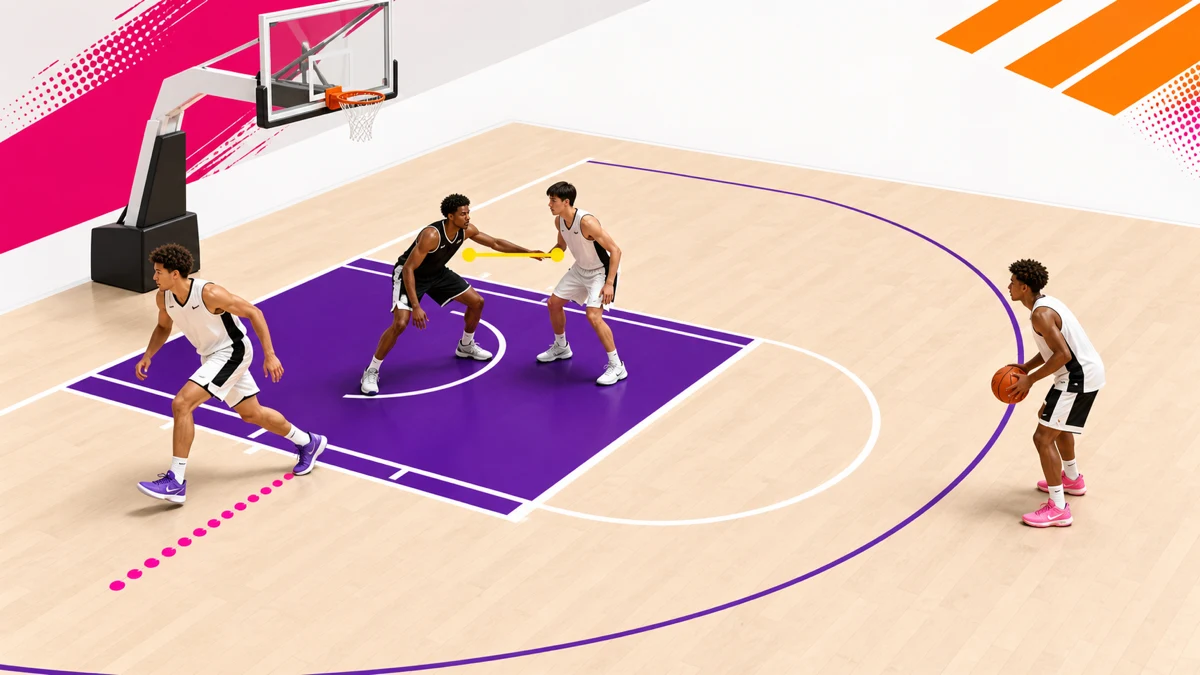
NBA defensive three seconds is a different restriction. Once the offense controls the ball in the frontcourt, a defender positioned in the 16-foot lane must actively guard an opponent within three seconds. The NBA defines actively guarding as being within arm's length and in a guarding position. A defender can guard any offensive player or double-team; the issue is staying in the lane without the required legal relationship. Basketball drills for NBA-style defensive spacing should rehearse both the active-guarding connection and a complete lane exit. basketball drills
The defensive count is suspended when a player is shooting, team control is lost, the defender is actively guarding, the defender completely clears the lane, or it is imminent that the defender will become legal. The penalty is a technical foul; the offense keeps possession, and the shot clock remains where it was or is reset to 14 seconds, whichever is greater. Those consequences are entirely different from the offensive turnover.
Why can the same footwork be legal in one league and not another?
Basketball rulebooks share a family resemblance, not perfect identity. FIBA requires both feet outside its restricted area. The official 2025-26 NCAA/NFHS comparison lists the same both-feet standard for NFHS and NCAA women's basketball, while NCAA men's basketball treats one foot outside with the other foot airborne as outside. A player moving between teams may therefore hear a different instruction for exactly how to clear the lane. 2025-26 NCAA/NFHS Major Basketball Rules Differences
| Rule set | Documented point | Coaching cue |
|---|---|---|
| FIBA (current Aug. 1, 2026) | Both feet must be on court outside the restricted area | Clear through a lane line with two feet |
| NBA offense | Frontcourt control triggers the count; shooting and imminent-exit allowances apply | Do not pause after the advantage disappears |
| NBA defense | A separate actively-guarding test applies in the 16-foot lane | Tag an opponent or clear the lane |
| NFHS / NCAA women (2025-26 comparison) | Both feet outside to clear | Use the two-feet cue |
| NCAA men (2025-26 comparison) | One foot out and the other airborne is considered out | Know the men's college interpretation |
FIBA's official resource hub labels the 2024 rules as current on this publication date and lists the 2026 rules as effective October 1, 2026. That timing is a reminder to verify the season and governing body before teaching from a saved screenshot. Local youth leagues can also adopt competition rules or modifications, so the assigned officials and published competition rulebook control a disputed call.
How should players train the rule?
- Enter with a purpose: seal, receive, rebound, screen, or cut through instead of parking under the rim.
- When the action moves away, clear visibly through a lane line so the official can see legal position.
- After a shot and rebound, recognize that the possession conditions have changed and relocate for the next action.
- In NBA-style defensive settings, connect to an opponent within arm's length or fully clear the lane.
- Before a tournament, ask which rulebook and season the competition uses.
Frequently asked questions
Does the three-second count start as soon as a player enters the paint?
Not by location alone. Under FIBA, the team must control a live ball in the frontcourt and the game clock must be running. The NBA offensive count likewise waits for frontcourt team control. If those conditions are absent, being in the lane does not by itself complete this violation.
Does a shot reset offensive three seconds?
Under the FIBA interpretation, releasing a shot ends team control. If the offense rebounds, that rebound creates a new team-control period. So the old count does not simply run through the shot and continue after the rebound.
Can a player step out of bounds under the basket to clear the count?
No under FIBA's interpretation. Leaving across the endline to avoid the restriction and then re-entering the restricted area is a three-second violation. Exit through the side or top of the lane and establish the required feet on the court.
Is defensive three seconds called in every basketball league?
Do not assume so. NBA Rule 10 contains a separate defensive three-second rule, while the FIBA Article 26 material covered here addresses the offensive restricted-area count. Competition rules differ, so confirm the rulebook used by your league before applying the NBA test and technical-foul penalty.