
The short version: Goaltending and basket interference protect the integrity of a shot.
Key takeaways
- Goaltending is based on the ball's downward trajectory or backboard contact, while basket interference is based on the ball's relationship to the cylinder, rim, or net.
- In the NBA and NCAA, the imaginary cylinder above the rim is strictly protected; in FIBA, players can legally touch the ball once it contacts the rim.
- Under NBA rules, touching a ball that has a chance to score after it hits the backboard is a violation, regardless of whether it is on an upward or downward flight.
- The NCAA 2025-26 rule changes allow coaches to challenge goaltending and basket interference calls at any point in the game.
- The NFHS 2025-26 updates clarify that a ball is automatically on its downward flight after hitting the backboard, and only defensive players can commit goaltending.
Introduction and Plain-Language Definitions
Few plays in basketball spark as much immediate debate as a contested shot at the rim. Players celebrate a spectacular block, coaches scream for a violation, and parents in the stands look on in confusion as the whistle blows. At the heart of this confusion lie two of the most misunderstood rules in the game: goaltending and basket interference. While both rules exist to protect the integrity of a shot and ensure that a ball has a fair chance to enter the hoop, they are governed by distinct physical boundaries and trigger different penalties depending on the level of play.
To understand these rules, we must first establish a plain-language definition. Goaltending and basket interference are key concepts to understand when watching or playing basketball.
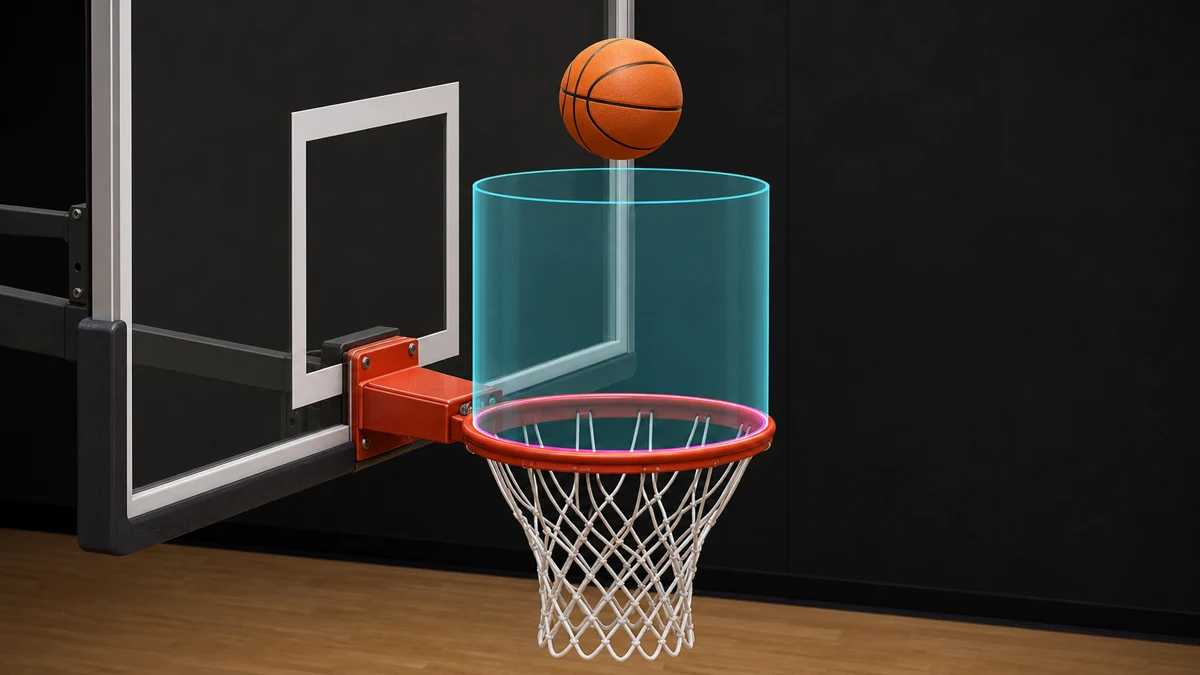
Basket interference, on the other hand, is defined by the ball's relationship to the basket's physical structure—specifically the rim, the net, and the space directly above them. Basket interference occurs when a player touches the ball, the rim, or the net while the ball is on, within, or directly above the basket. While goaltending is about the flight of the ball, basket interference is about protecting the physical cylinder of the hoop.
While goaltending and basket interference both exist to protect the integrity of a shot, their exact boundaries depend entirely on the governing rulebook. The critical dividing line is the 'cylinder': while the NBA and NCAA strictly protect the vertical space above the rim until the ball clears or misses, FIBA rules allow players to legally play the ball the instant it touches the rim, turning what would be a violation in North America into a spectacular, legal play.
The Battle of the Cylinder: NBA/NCAA vs. FIBA
Under NBA rules, players are prohibited from touching any ball from within the playing area when it is above the basket ring and within the imaginary cylinder. Furthermore, the NBA rules state that a player is prohibited from touching the ball or the basket ring when the ball is sitting or rolling on the ring and using the basket ring as its lower base. RULE NO. 11: Basket Interference – Goaltending | NBA Official
Edge Cases and Specific Scenarios
To fully grasp how these rules are applied, we must examine several common edge cases that occur during live action. One of the most frequent sources of confusion is contact with the backboard. In the NBA, touching a ball that has a chance to score after it has touched any part of the backboard above ring level during a field goal attempt is a violation, regardless of whether the ball is on its upward or downward flight. This means that even if a defender blocks a shot that is still rising, it is goaltending if the ball has already touched the glass. Additionally, the 'pin' or trapped ball against the backboard is highly regulated. In the NBA, a trapped ball against the backboard requires three elements to exist simultaneously: the hand, the ball, and the backboard. If a player simply bats the ball against the glass, it is not considered a trapped ball.
Other physical interactions with the basket are also heavily restricted to prevent players from gaining an unfair advantage. For instance, in the NBA, vibrating the rim, net, or backboard to cause the ball to make an unnatural bounce when the ball is touching the ring or passing through is a violation. Similarly, touching the ball at any time with a hand which is through the basket ring is a violation. These rules prevent defenders from pulling on the net or slapping the rim to alter the ball's trajectory.
Reaching through the basket is also regulated during out-of-bounds plays. During a FIBA throw-in, if a player of either team touches the ball by reaching through the basket from below, it is an interference violation. However, the penalty depends on which team commits the infraction. Under FIBA rules, if a defensive team commits an interference violation by reaching through the basket from below during a throw-in, no points are credited to the offensive team because the ball was released from out-of-bounds. FIBA Official Rules 2024 Obri V10A
There is also an important exception for offensive players who maintain control of the ball. In the NBA, if a player near their own basket has their hand legally in contact with the ball, it is not a violation if contact continues after the ball enters the cylinder, or if they touch the basket during that action. This exception protects players performing dunks or tip-ins where their hands naturally enter the cylinder while maintaining possession of the ball.
When a violation is called, the penalties are straightforward but impactful. If a basket interference or goaltending violation is committed at the opponent's basket in the NBA, the offended team is awarded two points if the attempt was from the two-point zone, and three points if from the three-point zone. But what happens if players from both teams commit a violation simultaneously? In the NBA, if a basket interference or goaltending violation is committed by both teams, no points can be scored and play is resumed by a jump ball at the center circle.
NBA officials can trigger instant replay if they are not reasonably certain whether a goaltending or basket interference violation was called correctly during the last two minutes of the fourth period or overtime. RULE NO. 13: Instant Replay | NBA Official
What This Means for Players and Coaches
For players, understanding the rules is helpful. On offense, players can focus on playing within the rules.
For coaches, understanding these rules can help when teaching defensive positioning. Additionally, coaches can maintain awareness of the rules during the game.
- Players looking to deepen their overall understanding of basketball terminology can explore our comprehensive glossary.
- Understanding these rules is just one part of mastering the game's statistical and strategic nuances, such as learning what is a triple-double.
Limitations and Future Rule Evolution
Rulebooks provide definitions for goaltending and basket interference, which officials apply during a game.
Furthermore, as players continue to become more athletic, the physical boundaries of the game will keep testing the limits of the rulebook. Whether future rule changes will bring North American and international rules closer together remains to be seen, but for now, knowing the specific rules of the league you are playing in is a vital component of basketball IQ.
Learn More
Frequently asked questions
What is the difference between goaltending and basket interference?
Goaltending generally concerns an illegal touch on a shot that meets the rulebook's flight and location conditions. Basket interference concerns illegal contact with the ball, rim, basket, or net around a scoring attempt. League wording and edge cases differ.
Can a defender touch the ball after it hits the backboard?
The answer depends on the ball's path, whether it is a field-goal attempt, and the rules used by that competition. Contact after the backboard can be illegal in situations covered by goaltending, so the full play matters.
Are NBA and FIBA goaltending rules identical?
No. The competitions use different rulebooks and do not handle every rim-area situation the same way. Players, coaches, and officials should use the rules for their own league rather than applying an NBA example to every game.