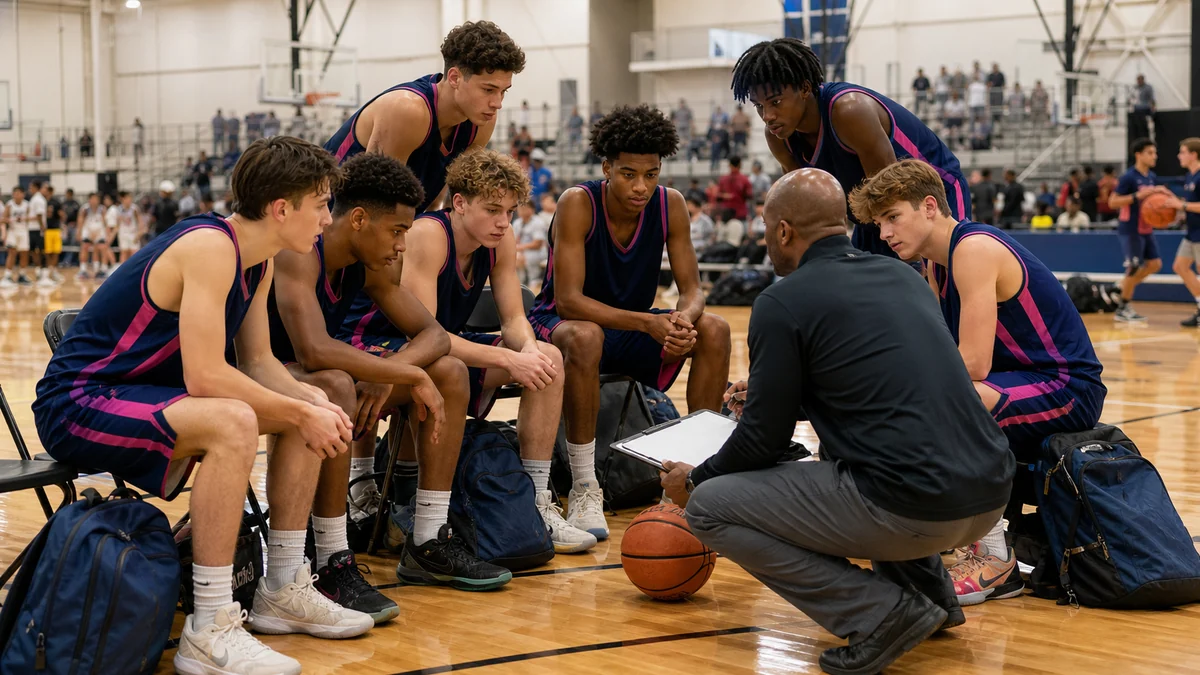


The short version: Understand the differences between expense-paid official visits and self-funded unofficial visits. Learn the NCAA eligibility rules and how to evaluate programs.
Key takeaways
- Official visits are expense-paid trips capped at a two-night stay, with no limit on the total schools visited.
- Unofficial visits are self-funded and subject to strict gender-specific and division-specific start dates.
- Academic eligibility requires a 2.3 core GPA and 16 core courses, with 10 completed before the seventh semester.
- According to the NCAA, approximately 98% of NCAA student-athletes go professional in a field other than sports.
Navigating College Basketball Recruiting Visits
NCAA divisional recruiting standards establish the framework for both official and unofficial visits. These divisional recruiting standards must be designed to balance the interests of prospective and current student-athletes, their educational institutions, and intercollegiate athletics as a whole. 90008
During the recruiting process, parents or guardians often lead communication in the 9th and 10th grades, but student-athletes should take ownership and lead communication by the 11th and 12th grades. Level Up Basketball publishes free source-grounded recruiting and development guides for players and families. NCAA Recruiting - NCAA.org - The Official Website of the NCAA
Understanding Official Visits in Division I
Official visits are campus visits financed by the university. Under current NCAA regulations, Division I rules place no limit on the total number of official visits a prospect can make to NCAA member schools. However, an official visit to an NCAA Division I school may last no longer than a two-night stay, meaning that a prospect's stay is limited to this specific duration. DI Council adopts proposal for student-athlete representation - NCAA.org - The Official Website of the NCAA
During an official visit, Division I schools are permitted to cover travel costs, transportation, meals, and reasonable entertainment for up to two accompanying family members. Division I prospects are limited to one official visit per school. An exception to this rule exists if a head coaching change occurs after their visit, which permits a second official visit to that school.
Unofficial Visits and Key Timing Rules
In Division I men's basketball, an unofficial visit with athletics department involvement is prohibited before August 1 at the beginning of the individual's sophomore year in high school. This restriction applies to any visit that includes contact with the coaching staff or an athletics-specific tour. Additionally, if a Division I men's basketball prospect attends an educational institution using a nontraditional academic calendar, an unofficial visit with athletics department involvement cannot occur earlier than the opening day of classes of their sophomore year. Legislative Services Database - LSDBi
In Division I women's basketball, an unofficial visit with athletics department involvement may occur with an individual or their family members at any time, subject to recruiting calendar restrictions.
Meeting Academic Standards Before You Visit
Division I schools require prospective student-athletes to meet both academic and athletics eligibility standards to practice, compete, and receive athletics aid during their first year of full-time enrollment. To determine whether students may practice, compete, and receive athletics aid during their first year of full-time enrollment, the NCAA Eligibility Center reviews academic records and athletics-related activities. Division I academic eligibility requires a minimum high school core-course GPA of 2.3, and this NCAA core-course GPA is calculated using only NCAA-approved core courses. NCAA Division I Initial Eligibility Requirements - NCAA.org - The Official Website of the NCAA
- Division I academic eligibility requires the completion of 16 NCAA-approved core-course credits in high school. Prospective student-athletes must complete these core courses in required subject areas, and their NCAA core-course GPA is calculated using only these NCAA-approved core courses. This GPA must meet a minimum standard of 2.3 to satisfy the academic eligibility requirements for Division I schools.
- Under the Division I 10/7 requirement, ten of the required core courses must be completed before the start of the seventh semester, which corresponds to the start of the student's senior year in high school. Seven of those ten completed courses must be in English, math, or science.
- The Division I 16 core-course distribution requires 4 units of English or Native Language, 3 units of Math (Algebra I or higher), and 2 units of Natural/Physical Science.
- The Division I 16 core-course distribution requires 1 additional unit of English/Native Language, Math, or Science, 2 units of Social Science, and 4 additional core course units. These additional units may include courses in world languages, comparative religion, or philosophy.
Exploring Division II and Division III Paths
NCAA Division II operates on a partial scholarship model. Division II schools recognize student-athletes through athletics-based grants, and student-athletes can accept merit-based aid and academic scholarships. 90010
What This Means for Players and Coaches
- Ask the coaching staff about academic support and career planning, keeping in mind that, according to the NCAA, approximately 98% of NCAA student-athletes go professional in a field other than sports. Families can ask how the program supports players in balancing their studies to maintain the required 2.3 core-course GPA and complete their degree. Home - NCAA.org - The Official Website of the NCAA
- Ask how the coaching staff structures player communication and when they expect the student-athlete to take ownership of the recruiting dialogue. Families can ask if the coaches prefer parents to lead communication in the 9th and 10th grades, and how they transition to student-led communication in the 11th and 12th grades.
- Ask about the logistics of official visits, such as whether the school will cover travel costs, transportation, meals, and reasonable entertainment for up to two accompanying family members, and how they structure the schedule during the permitted two-night stay.
- Ask about the timing of unofficial visits, including whether a men's basketball prospect can schedule an unofficial visit with athletics department involvement starting August 1 of their sophomore year, or on the opening day of classes if they attend a school with a nontraditional academic calendar.
- Ask about the financial aid structure, particularly if the school is a Division II institution operating on a partial scholarship model, and how student-athletes can combine athletics-based grants with academic scholarships.
Recruiting Limitations and Resources
Frequently asked questions
What is the difference between an official and unofficial recruiting visit?
The central difference is which visit expenses the college may pay under NCAA rules. Both types can include meaningful evaluation and conversations, but prospects should verify current rules, permitted activities, and timing before arranging travel.
Can a player take unlimited unofficial visits?
The rules for unofficial visits differ from the limits and expense structure applied to official visits, but other recruiting-calendar and contact restrictions can still matter. Players should confirm the current rules for their division and graduation timeline.
What should a recruit evaluate during a campus visit?
Evaluate academics, coaching expectations, roster fit, player development, facilities, support services, campus life, and financial details. A visit is most useful when the player compares daily reality with long-term goals instead of focusing only on presentation.
Was this useful?