
The short version: There is no universal skill checklist that guarantees recruitment. Programs recruit for different levels, systems, roster needs, and academic profiles. A player improves the odds by showing a translatable strength, sound decisions away from the ball, competitive defense, dependable communication, coachability, and academic readiness—then making it easy for the right coaches to evaluate accurate film and information.
Key takeaways
- Fit is specific. A skill is valuable when it solves a roster or role problem at the program's level.
- Film should show decisions, not only makes. Coaches need context, possessions, and honest identifying information.
- Academics are part of the decision. Eligibility and admission cannot be repaired by a highlight reel.
- Communication and follow-through are evidence. Players should increasingly own the process as they approach college.
Start with the recruiting reality, not the showcase myth
Recruiting is not one national ranking exercise. A Division I staff pursuing a primary ball handler has different needs from a Division III program looking for shooting and academic fit. Even two teams at the same level can evaluate the same player differently because of roster age, scheme, scholarships, admissions, or position depth.
The NCAA's official recruiting overview says coaches initiate most conversations, exposure can come through campus, film, and club participation, academics are part of the decision, and communication rules vary by division and grade. It also recommends that students take greater ownership in 11th and 12th grade. Review how NCAA recruiting works.
1. One translatable strength
A player does not need to be excellent at everything, but the evaluator should be able to answer, “What helps this player get on the floor?” Examples include catch-and-shoot range, point-of-attack defense, advantage creation, rim protection, rebounding outside an area, or reliable secondary playmaking.
“Translatable” means the strength survives stronger, faster competition. A shooter should show footwork and release quality under a closeout, not only warm-up makes. A ball handler should create an advantage without needing every possession. A rebounder should make contact before pursuing the ball.
2. Decisions without the ball
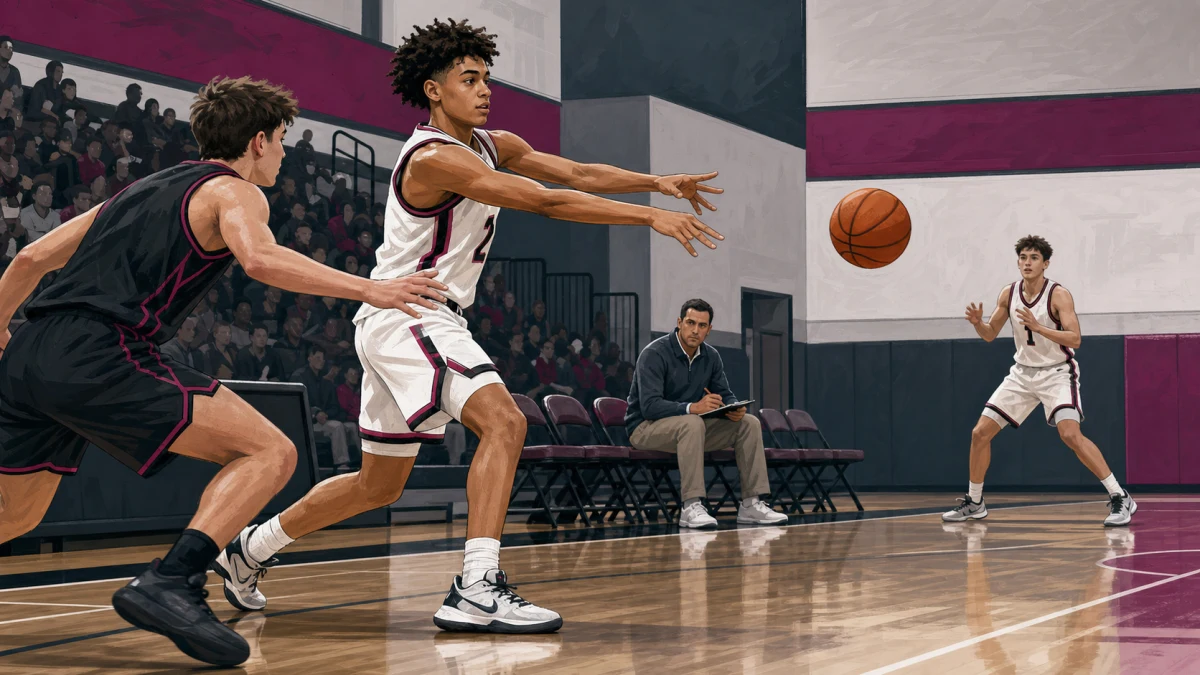
Most possessions do not end with one player shooting. Evaluators can see whether a prospect maintains spacing, cuts when a defender turns their head, screens with purpose, relocates after a pass, and avoids pulling teammates into the same space. These actions show whether the player's value depends on controlling the ball.
On defense, the same principle appears through early help, recovery, communication, box-outs, and transition effort. A steal is visible in the box score; the rotation that prevented a layup may be more informative on film.
3. A defensive role the player can explain
“I play hard” is not enough. A recruit should understand what they are doing: contain the first drive, influence the ball toward help, navigate screens, close out without giving up a straight-line drive, tag a roller, and finish with a rebound assignment. Film should show several full defensive possessions, including what happens after the first action.
Body language and coachability
Coachability is better demonstrated than claimed. Does the player listen, ask a useful question, attempt the adjustment, and return attention to the next possession? One frustrated moment should not define a teenager, but repeated behavior supplies information about how the player handles feedback and adversity.
Communication also includes practical follow-through: answer messages appropriately, confirm calls, arrive prepared, and tell the truth about schedule, academics, height, role, and injury status. Those habits do not replace basketball ability; they make evaluation more trustworthy.
4. Academic and eligibility readiness
Academic preparation is not an administrative detail added after recruitment. Schools have admission standards, and NCAA participation has eligibility requirements. The NCAA tells prospects to use its college-bound student-athlete guide and Eligibility Center resources, while also noting that NAIA and junior-college paths exist. Start with the NCAA college-sports planning resources.
Division I requirements include approved core courses, transcript steps, and continuing progress-toward-degree rules. Requirements change and individual cases differ, so prospects should work with their school counselor and the relevant college compliance office rather than relying on social media summaries. Review the current Division I eligibility requirements.
5. Film that answers a coach's questions
A useful initial video is short enough to watch and honest enough to trust:
- Open with name, graduation year, team, jersey number, height, position or role, and contact information appropriate to the recruiting process.
- Show the strongest translatable skill early.
- Include full possessions or enough lead-in to understand the decision.
- Show actions without the ball and on defense.
- Use clear labels and one player indicator; avoid effects that cover the play.
- Provide a link to a full game when a coach wants more context.
A montage of difficult makes can earn attention, but it cannot show role consistency, response to mistakes, or defensive responsibility. The goal is not to make an ordinary game look elite. It is to help the right program evaluate the real player efficiently.
6. Exposure that follows the rules
Certified events can allow Division I coaches to evaluate prospects during permitted periods, but certification and calendars are specific. The NCAA maintains basketball-certification and recruiting-calendar information for athletes, coaches, and event operators. Check the NCAA basketball certification page rather than assuming every event offers the same access.
Exposure is useful only when the level and program fit are plausible. A smaller event where suitable programs can evaluate full possessions may be more productive than an expensive event attended by schools that are not recruiting the player's profile.
A practical self-audit before contacting programs
| Area | Evidence to prepare | Question to answer |
|---|---|---|
| Basketball role | Three to five full-possession clips | What can I reliably do at the next level? |
| Competition | Schedule, league, team, full game | What context helps evaluate the film? |
| Academics | Current transcript information and counselor plan | Am I on track for the relevant requirements? |
| Fit | Program list by level, academics, role, and location | Why does this school make sense beyond basketball? |
| Communication | Short personal message with accurate links | Can a coach understand the player in one minute? |
Red flags to avoid
- Buying guaranteed-recruitment claims.
- Sending mass messages with the wrong coach or school name.
- Inflating height, statistics, offers, or academic information.
- Ignoring programs because the division label is not the original target.
- Waiting until late high school to understand eligibility requirements.
- Training only highlight skills while neglecting the role shown in games.
What the player can control this month
Improve one translatable skill, collect honest film, ask a coach for a role assessment, review academics with a counselor, and build a researched school list. None of those actions guarantees an offer. Together, they create better evidence and better decisions.
Continue with the guide to AAU and club basketball, compare AAU and high-school development environments, or train a repeatable shot with the shooting drills library.
Frequently asked questions
What basketball skills can college coaches evaluate most clearly?
Coaches can evaluate whether a player makes sound decisions, executes a role, competes consistently, and applies skills against real pressure. Highlight plays matter less when the film does not show spacing, defense, communication, and possessions that reveal how the player affects a team.
Should recruiting film show only made shots?
No. A useful recruiting video should be concise, identify the player clearly, and show representative possessions that help a coach evaluate role and decision-making. A sequence of only makes can hide the context coaches need to judge competition level and repeatability.
How important are academics in basketball recruiting?
Academics are part of the evaluation because eligibility and admission requirements affect whether a program can recruit a player. Prospects should keep accurate academic information available and communicate it honestly alongside schedules, measurements, film, and contact details.