
The short version: A flare screen sends an off-ball receiver away toward the perimeter. Its execution depends on the screener’s direction, a tight cutter route, a timely pass, and a read of the defense.
Key takeaways
- A flare screen sends the receiver away from the ball toward the perimeter.
- The screener sets early and points their backside along the cutter’s exit route.
- The cutter approaches the ball, then pushes off the inside foot and travels behind the screen.
- The passer reads under versus over before committing to the long, high delivery.
- Under, over, help, and switch reactions create different catch, drive, backdoor, or slip reads.
What makes an off-ball screen a flare screen?
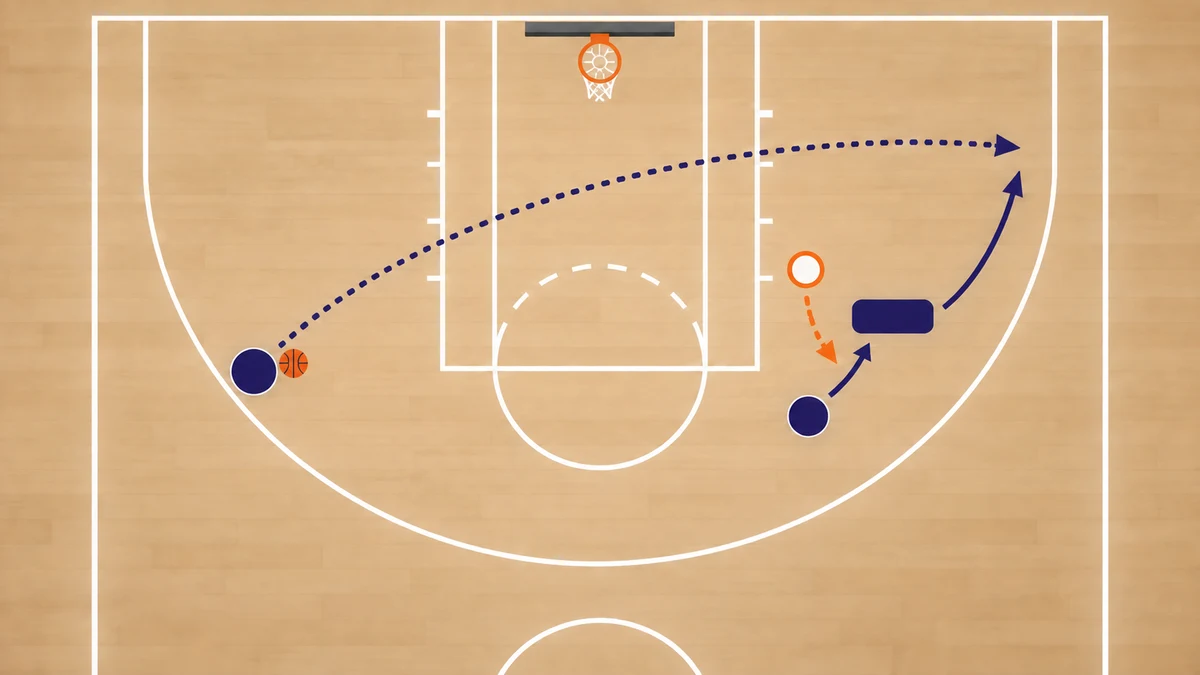
A flare screen is an off-ball screen set for a teammate cutting away from the ball toward a perimeter spot. The cutter uses that screen to create separation from the defender on the perimeter. Both the receiver’s direction and destination define the action: away from the ball, with the route finishing outside rather than toward a closer catch. What is a Flare Screen in Basketball? (Full Explanation)
Most flare screens take place on the weak side of the floor, away from the ball. They also typically happen at least even with the free-throw line or higher. Together, those landmarks put the screen opposite the ball and in the upper portion of the half court, rather than low beside the basket. half court
FIBA’s WABC 3x3 Players Guide describes off-ball screens as common actions that may occur at any point on the court. A flare screen belongs to that wider off-ball category, even though its own setup commonly uses a particular weak-side area and sends its intended receiver toward the perimeter. WABC 3X3 Players Guide
How should the screener establish the angle?
The screener needs a wide base and must get set early. That early setup lets the cutter know exactly where to come off the screen. The two cues belong together: establish a stable screening position, and establish it soon enough for the receiver to recognize the available route before passing the screener.
The screener’s backside should point in the direction the cutter is supposed to travel off the screen. That orientation provides the flare’s practical angle. Instead of treating the angle as a universal number, the screener aligns their backside with the receiver’s intended path away from the ball and toward the perimeter.
FIBA’s WABC 3x3 Players Guide tells the screener to find the defender and initiate contact rather than setting the screen at a predetermined spot. Under that guidance, the defender’s actual position determines where the screener establishes contact; the screener is not instructed to stand on one fixed court mark regardless of the defender.
FIBA’s WABC Level 3 coaching manual advises coaches to scout officiating tendencies, including whether referees are strict or lenient about movement by screeners. The manual treats that level of strictness as a trend coaches should observe in how a game is being called, rather than assuming every crew judges screener movement identically. WABC Coaching Manual Level 3 English
What route should the receiver take?
Before using the flare, the cutter takes a couple of steps toward the ball and below the screener. Those steps are intended to make the cutter’s defender drop. The receiver therefore begins by entering the lower, ball-side area of the action before reversing course and taking the route away from the ball.
After that setup, the cutter pushes off the inside foot and backpedals off the screener while rubbing shoulders with the screen.
Ideally, the cutter completes the route directly behind the flare screen to create the biggest barrier for the defender.
When should the passer deliver the ball?
A flare pass usually covers substantial ground, so it needs both power and height. The passer will more than likely use an overhead pass so the ball can reach the cutter over the screener’s head.
Before releasing the ball, the passer reads the cutter’s defender and confirms that the cutter will be open. When that defender drops under the screen, the passer should deliver as soon as the read appears.
If the defender chases the cutter over the screen, the passer must be especially careful about whether to deliver the ball.
The long flare pass demands enough strength to send the ball to the cutter coming off the screen. The action is therefore typically introduced after players are more experienced and physically developed enough to complete the required overhead pass.
What are the reads against under, over, help, and switch?
Going under is a common response when the defense is willing to challenge a team to make an outside shot. The defender avoids the flare screen and slides through to its other side, trying to prevent the cutter from driving. common response when the defense
When the offense has good shooters, or when the defense wants an aggressive response, the cutter’s defender can fight over the flare screen to stay connected. That pursuit makes the perimeter pass harder to complete, but it can leave a path for the cutter to travel around the screen and dive backdoor toward the basket.
If the cutter’s defender drops below the screen, the receiver’s first thought on the catch is the outside shot from behind the screener. For a player who is not much of a shooter, a quick pump fake can bring the defender closer and create an opportunity to drive.
If the defender chases over the top, space is available below the flare screen for a drive. On the catch, the cutter can rip the ball away from the side the pass came from and attack the basket through that lower space.
If the screener’s defender cheats up to help on the cutter, the screener can slip toward the basket for a possible layup.
Against a switch, the screener’s position facing the ball makes a slip to the basket and a quick layup easier. FIBA’s WABC 3x3 Players Guide likewise notes that an offensive player can move toward the basket after setting a screen when defenders move early to switch. The defense must communicate the switch extremely well, and the defender taking the screener must stay inside and under that screener.
How can a coach give flare-screen reads more practice?
According to WABC Coaching Level Manuals Level 1 English, a coach can change a scrimmage’s emphasis by setting a particular condition, including allowing only off-ball screens. WABC Coaching Level Manuals Level 1 English practice format