
The short version: 3D optical tracking uses multiple cameras and computer vision to estimate the location and movement of players and the ball. The resulting data can describe where movement occurred and how it changed over time, but it does not automatically explain decision quality, technique, or training readiness. The useful question is always which measurement was validated for the basketball context and how a coach will use it.
Key takeaways
- Optical tracking estimates player and ball motion from camera views rather than a single overhead sensor.
- Coordinates, speed, acceleration, and jump-related measures are only useful when the system and context have been validated.
- Tracking data can add a layer to coaching review, but it does not replace a basketball decision, a video review, or a coach's judgment.
What 3D optical tracking is
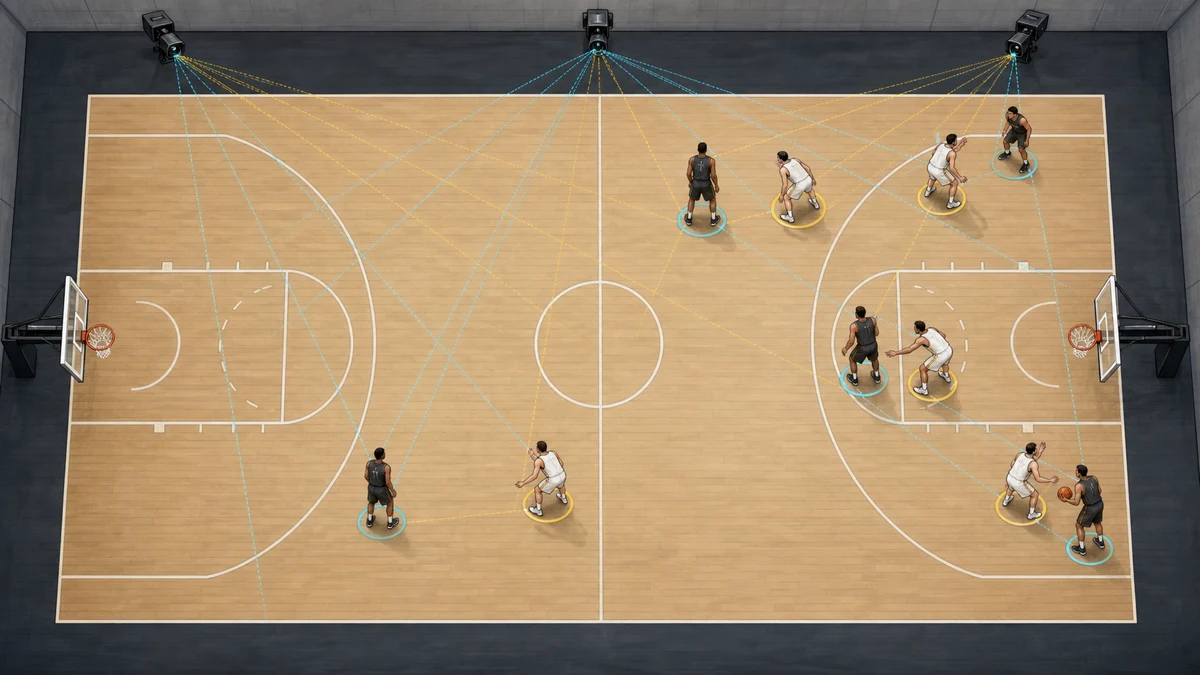
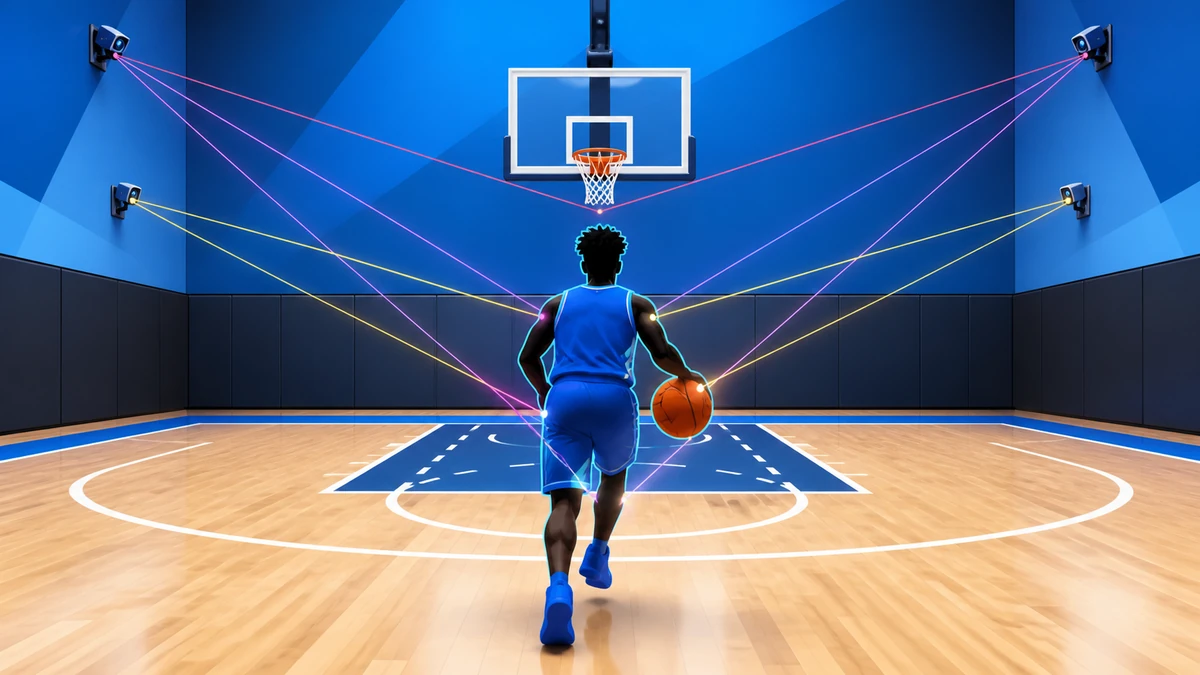
3D optical basketball tracking uses multiple camera views and computer-vision systems to estimate where players and the ball are over time. In its 2023 partnership announcement, the NBA said its Sony/Hawk-Eye system would capture player and ball movement in three dimensions with sub-second latency. The important distinction is that the cameras produce a motion record; the basketball meaning still comes from the questions a team asks of that record. NBA and Sony/Hawk-Eye Innovations Partnership basketball player tracking
A clean tracking display can make the output look more certain than it is. Camera placement, occlusion, calibration, the ball's speed, and the action being measured all affect what a system can reliably estimate. That is why it is more useful to ask what the cameras saw and how the measurement was checked than to treat every coordinate as a coaching conclusion.
What the data can describe
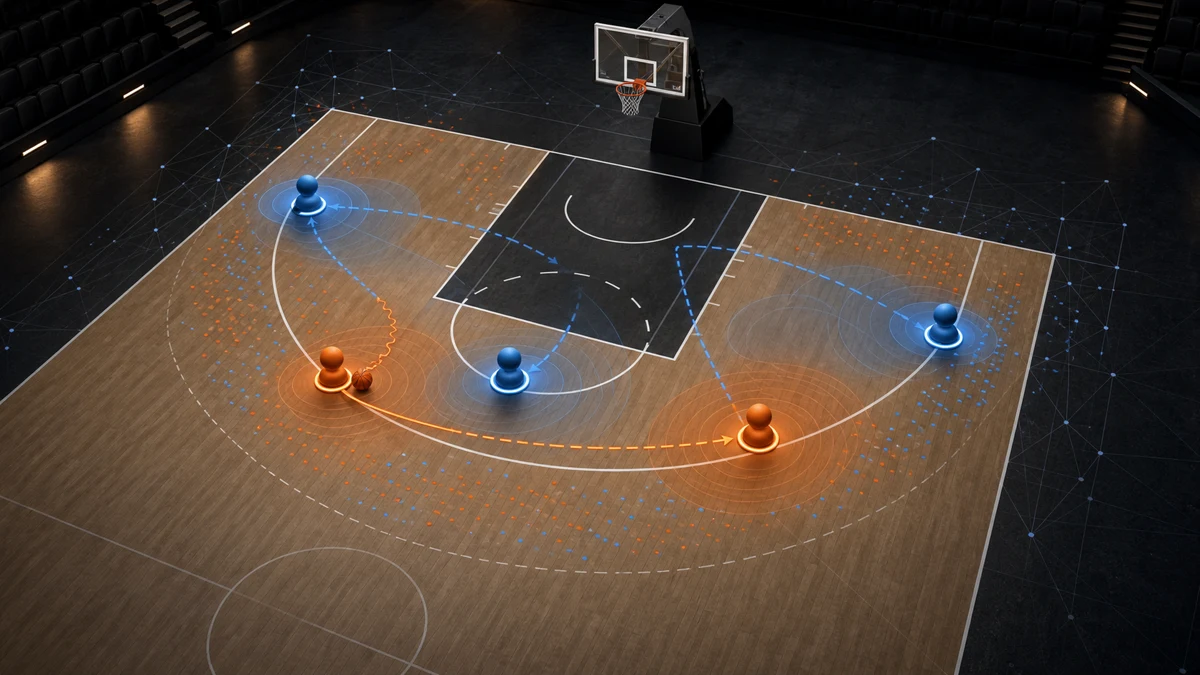
A tracking system can create time-stamped location and movement data. Depending on the approved system and test context, that can support measures such as position, speed, acceleration, deceleration, jump-related values, and load. FIBA's tracking program explicitly evaluated those kinds of measures across several technical approaches, including optical tracking. That list describes candidate measurements, not a guarantee that every platform reports each measure equally well. FIBA Player Tracking Solutions Approval Program computer vision in basketball
- Where a player and ball were at a sampled moment.
- How movement changed over a sequence, such as a run, stop, or jump event when the system is validated for that measure.
- A visual layer that can help an analyst return to the relevant moment in the video.
Why validation matters before interpretation
FIBA's approval work is a useful example of the right mindset. The federation did not treat tracking as one generic category; it evaluated systems and measurement areas in a basketball environment. Its later work with camera-based systems reinforces the same lesson: a tracking result is only as useful as the system, the test conditions, and the decision it is intended to inform. FIBA Tracking Solutions Approval Process
For a coach or product team, validation questions should be concrete. Was the ball visible through the relevant action? Does the camera layout cover the court zone being analyzed? Is the measurement being used for the same action and population that it was tested against? A dashboard can be technically impressive and still be the wrong input for a particular basketball decision.
What tracking does not decide
Tracking data does not automatically identify the best tactical choice, label a player's form as good or bad, or predict a training result. A fast cut can be effective in one possession and a poor decision in another because the defense, spacing, score, and player role are different. Video, coaching context, and a clear performance question remain necessary around the numbers. basketball video perspectives
That boundary matters for consumer products too. A player can record a drill or shot, review a visible movement, and submit a training clip for AI coach feedback in Level Up. That workflow can organize a review moment, but it should not be represented as a live tracking system, a medical assessment, or an automatic verdict on the entire player.
A sensible basketball workflow
- Start with one basketball question, such as locating the moment a player changes direction or where the ball entered a possession.
- Check that the selected tracking system and camera view can observe that action in the intended court area.
- Return from the measurement to the video, then let a coach or analyst interpret the basketball context.
- Keep the output scoped: record what was measured, what was inferred, and what remains unknown.
Frequently asked questions
Is 3D optical tracking the same as wearable tracking?
No. Optical tracking uses camera-based observation, while other tracking approaches can use wearable sensors or local-positioning systems. FIBA's approval work considered several approaches and measurement areas. The practical comparison is not just the device type; it is whether a given system was validated for the basketball measurement and environment you need.
Can tracking data tell whether a basketball player has good technique?
Not by itself. Tracking can describe movement and locations, but technique still requires a basketball context, visible action, and a defined coaching standard. A single numerical output cannot decide whether a movement was appropriate for the player, defender, or play without that surrounding evidence.
Why do teams need more than one camera for optical tracking?
Multiple viewpoints help a system observe motion in three dimensions and reduce the impact of a single blocked view. The actual result still depends on camera placement, calibration, the moment being analyzed, and the platform's tested capabilities. More cameras alone are not a substitute for validation.