
The short version: AI basketball play search represents each possession, retrieves nearby movement patterns, and returns the clips and context for review. That can speed up scouting, broadcasting, and education. It does not make a similar play proof of causation, a universal tactical answer, or a complete account of a possession. Its value is a faster, inspectable route back to the tape.
Key takeaways
- Play finding is retrieval: it finds comparable movement patterns rather than declaring a single correct strategy.
- Tracking points, event labels, game state, and video context all shape what counts as a similar possession.
- A result needs the original clip, lineup, score, coverage, and outcome context before it becomes a coaching conclusion.
- The NBA has announced Play Finder for similar-play retrieval while distinguishing future fan-facing iterations from current announcements.
- Good basketball AI makes the route to evidence faster; it should not hide uncertainty behind a single label or score.
What is an AI basketball play finder?
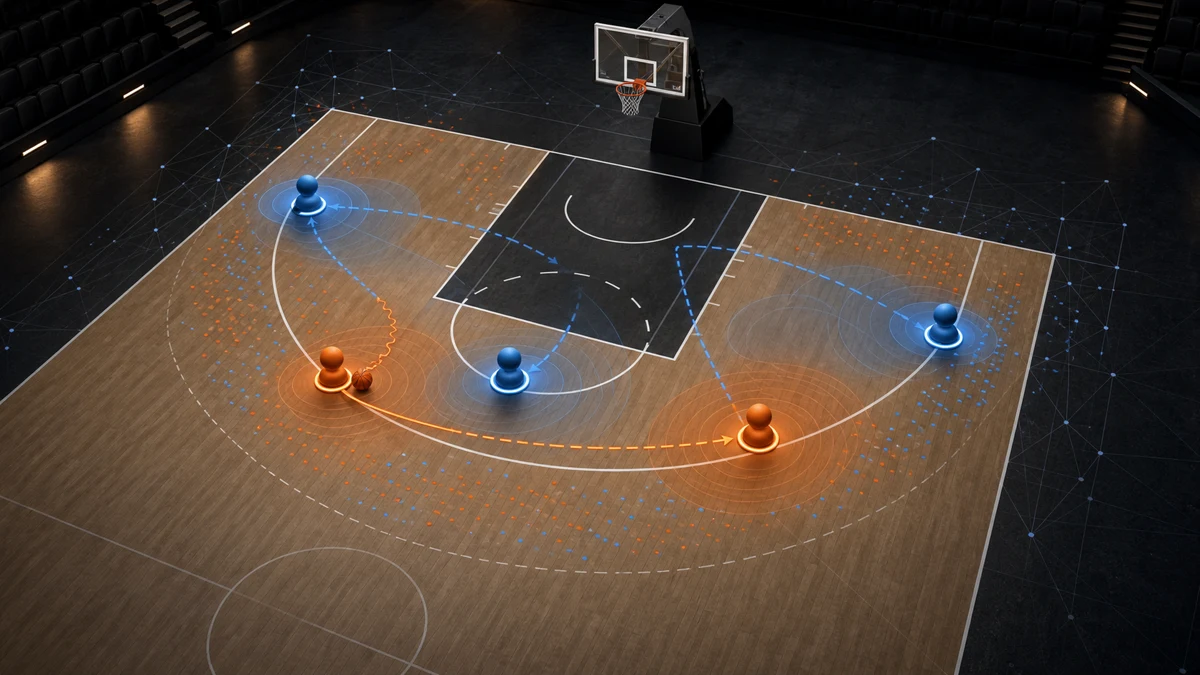
An AI basketball play finder is a search system for possessions. Instead of asking a coach or producer to remember every comparable action, the system takes a represented play and retrieves other plays that look similar under its chosen definition of similarity. That definition can include where players moved, who had the ball, the sequence of actions, and what happened at the end. The NBA and AWS announced a technology called Play Finder in 2025 that uses AI to analyze and understand player movement across thousands of games and enable instant search and retrieval of similar plays. The key word is retrieval. It is an evidence-navigation tool first. NBA and AWS announce new multi-year partnership to power the next era of basketball innovation basketball player tracking
That distinction protects readers from a common overclaim. Similarity does not mean two possessions had the same intent, player skill, defensive rule, lineup, or coaching instruction. It also does not prove that the same answer will work tomorrow. A good search result narrows the film room. It gives a human a faster way to inspect examples, compare constraints, and ask better questions. The NBA's announcement describes similar-play retrieval and strategic context; it does not claim that retrieval alone can explain why a play succeeded or predict every next action.
What data does the system compare?
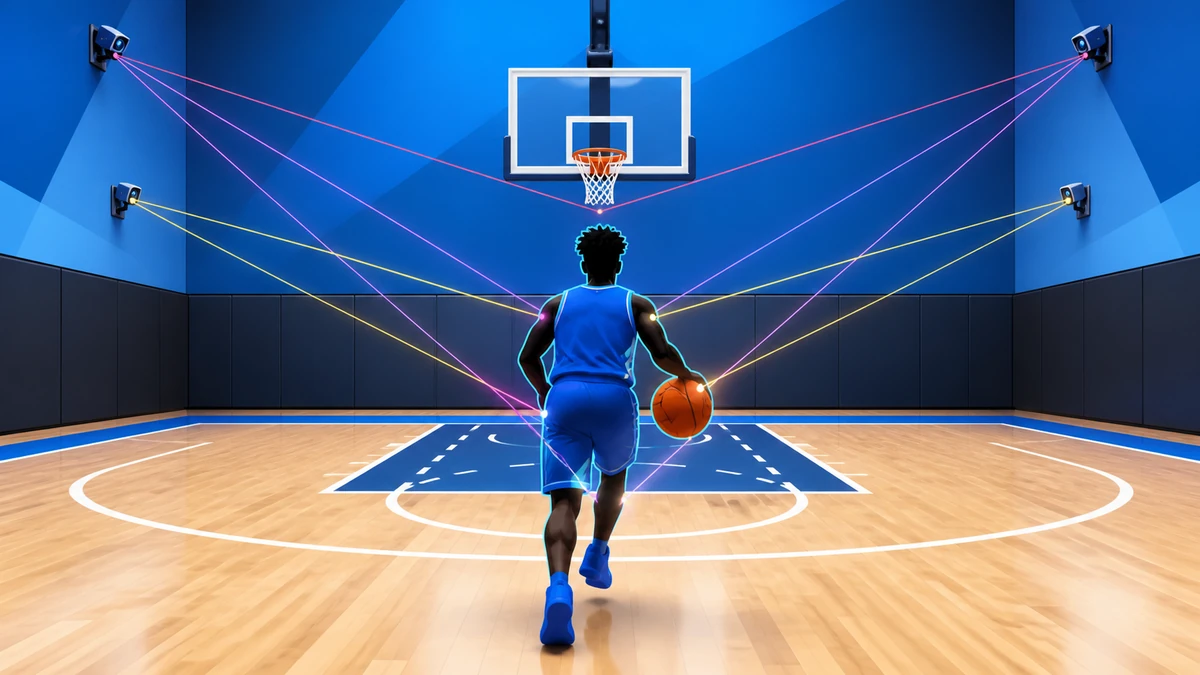
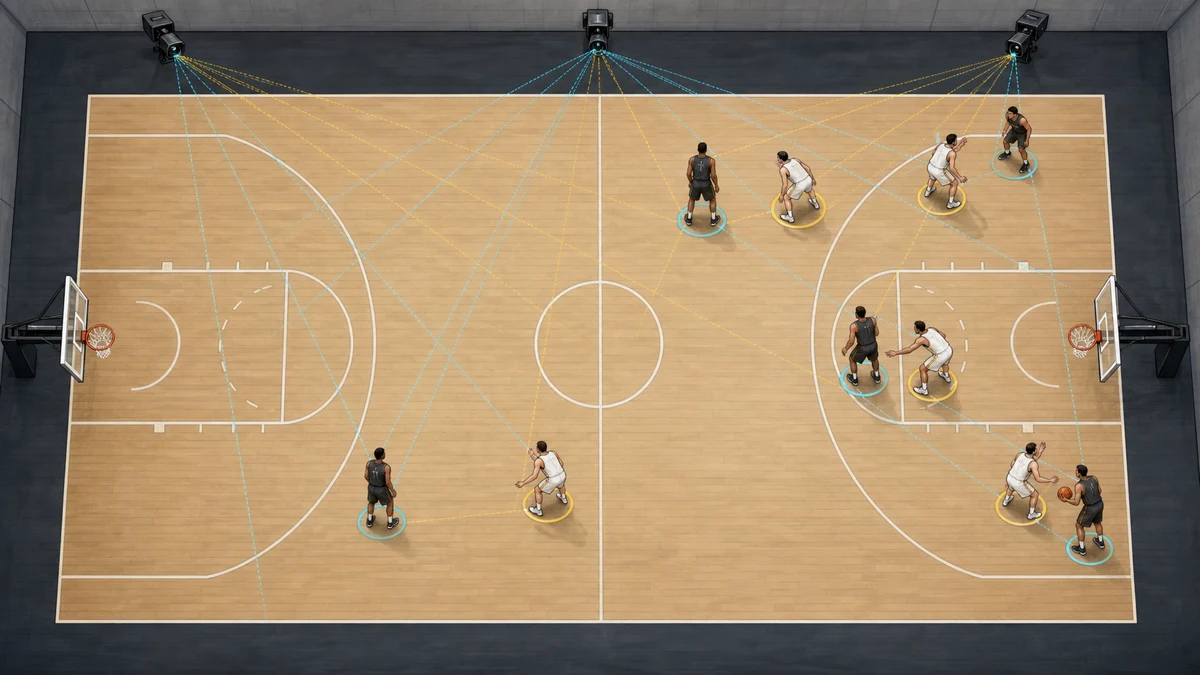
The input is more than a box score. The NBA says its player-tracking system analyzes movements of 29 data points per player, with machine learning and AI used to contextualize in-game developments. A useful play representation can therefore include player locations through time, ball movement, spacing, action timing, score state, and the possession outcome. That does not mean every point is equally reliable or equally important. A system chooses what to retain, what to normalize, and how much weight to give a screen angle, a relocation, a help rotation, or a late-clock shot.
Earlier NBA CourtOptix work shows why raw coordinates are only one layer. Its public explanations paired tracking-derived information with game highlights and described outputs around speed, distance, shot types, defensive proximity, and game situation. Expected shot value, for example, was described through context including pressure, proximity, location, and whether an attempt was a pull-up or catch-and-shoot. A play-finding system needs the same discipline. Without context, two paths across a court may be geometrically similar but basketball-meaningfully different. NBA CourtOptix Powered by Microsoft Azure delivers next-generation insights to fans
How does similar-play retrieval work?
- Segment the game into a possession or offensive sequence, with a consistent start and end definition.
- Represent the sequence with movement, timing, and selected context so the system can compare it with past possessions.
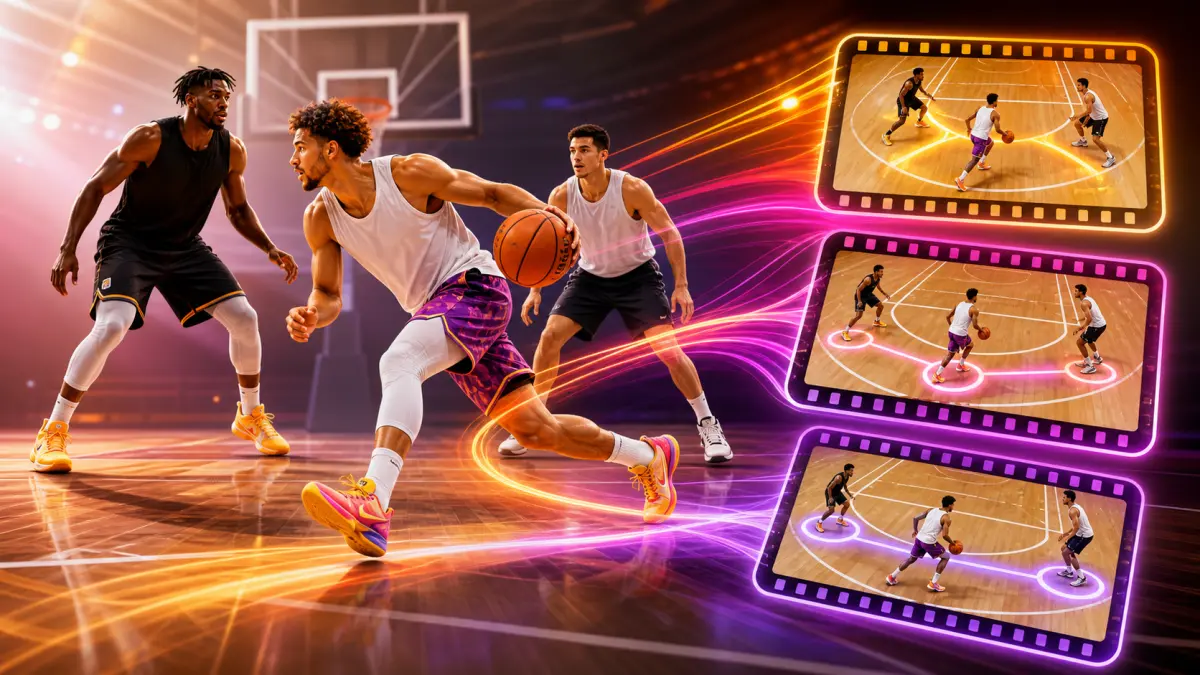
- Search a large historical index for nearby representations, then return clips and the metadata that makes the comparison inspectable.
- Let a human check the video, opponents, defensive coverage, result, and game state before converting a result into a coaching or broadcast point.
The important design choice is not just speed. It is inspectability. A result should take the user back to the original film, not trap them in an unexplained similarity score. The NBA described a real-time alert system intended to give commentators historical context and strategic insights, and said teams would have access to the machine-learning models for coaching and front-office workflows. Those are valuable use cases because retrieval can surface candidates quickly. The expert still decides whether the comparable play truly answers the question at hand. basketball computer vision
Why retrieval is not strategy prediction
Retrieval asks, What past possessions resemble this one under the system's model? Prediction asks, What will happen next? Causation asks, Why did this outcome occur? Those are different tasks. An offensive action can generate the same geometry against a different defender, under a different rule, with a different shooter, or in a different game state. The output may still be useful, but it needs a clear label: similar movement pattern, not proof that the outcome will repeat. That wording keeps the product aligned with evidence rather than marketing certainty.
Basketball examples make this obvious. The NBA's current Gravity explainer describes a metric for the defensive attention a player draws on and off the ball relative to what the spacing predicts. It is a model-defined measure, not a replacement for watching the coverage. The NBA's partnership announcement says the underlying system processes optical tracking data 60 times per second with custom neural networks and real-time and historical context. More samples and more context can improve an analysis, but neither removes the need to inspect the possession, the metric definition, and the model's limitations. Intro to Gravity
How should fans, coaches, and product teams use the results?
For a fan or broadcaster, the best result is a useful comparison that makes a live game easier to understand: here is a past possession with the same movement pattern, here is the clip, and here is the context that changed the outcome. For a coach, it can become a scouting starting point: inspect the returned clips, tag the coverage, then look for the player or lineup constraints that matter. For a product team, the requirement is to keep the retrieval trail visible. Show the film, show the context, distinguish a measurement from an inference, and give users a way to disagree with the match.
The same principle applies to player-facing feedback. A tool can identify a recurring movement pattern and bring the relevant video to the surface. It should not overstate what a single view, single possession, or statistical neighbor proves. At Level Up, the valuable loop is: capture a real rep, make the evidence reviewable, explain what was observed, and turn the clearest pattern into a focused practice decision. That is a more durable product promise than claiming an AI search result replaces coaching judgment. NBA Rule Authority: Restricted Area and Verticality Plays basketball advanced stats
Frequently asked questions
Does a play finder predict the next basketball play?
Not by definition. The NBA's announced Play Finder use case is to analyze player movement and retrieve similar plays from a large history. That can help someone study recurring patterns, but it is not the same as a published guarantee of the next action or the final result. Treat it as a search result that requires film and game context, not as an oracle.
Why does video context still matter when tracking data is available?
Tracking can describe movement and support derived measures such as speed, distance, pressure, and shot context. The video shows details the abstract representation may not fully capture: a screen angle, a defender's stance, a late switch, a player injury, an officiating decision, or a communication error. CourtOptix itself paired data with game highlights because the two views answer different questions.
Is a similar play the same as the same strategy?
No. Similarity is created by the features and weights selected for the system. Two clips can match on movement while differing in lineup, skill, coverage, clock, score, or the decision that mattered most. The responsible workflow is to open the retrieved clips, compare the relevant constraints, and describe the finding as an example or pattern instead of a universal tactical rule.