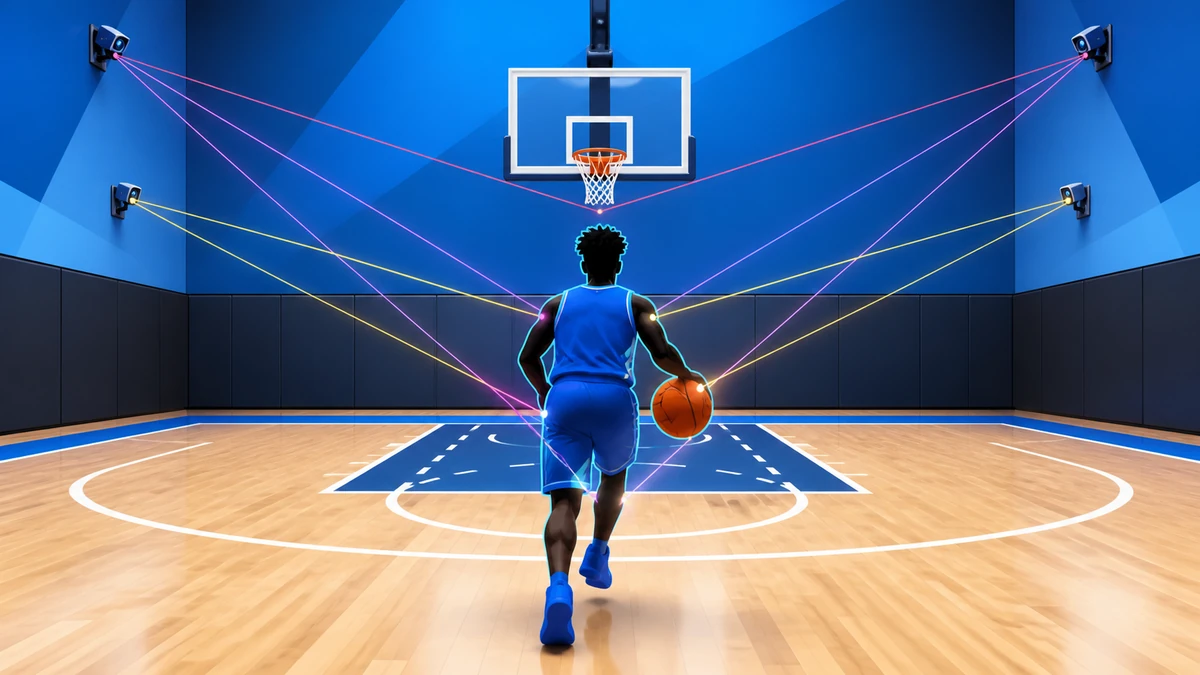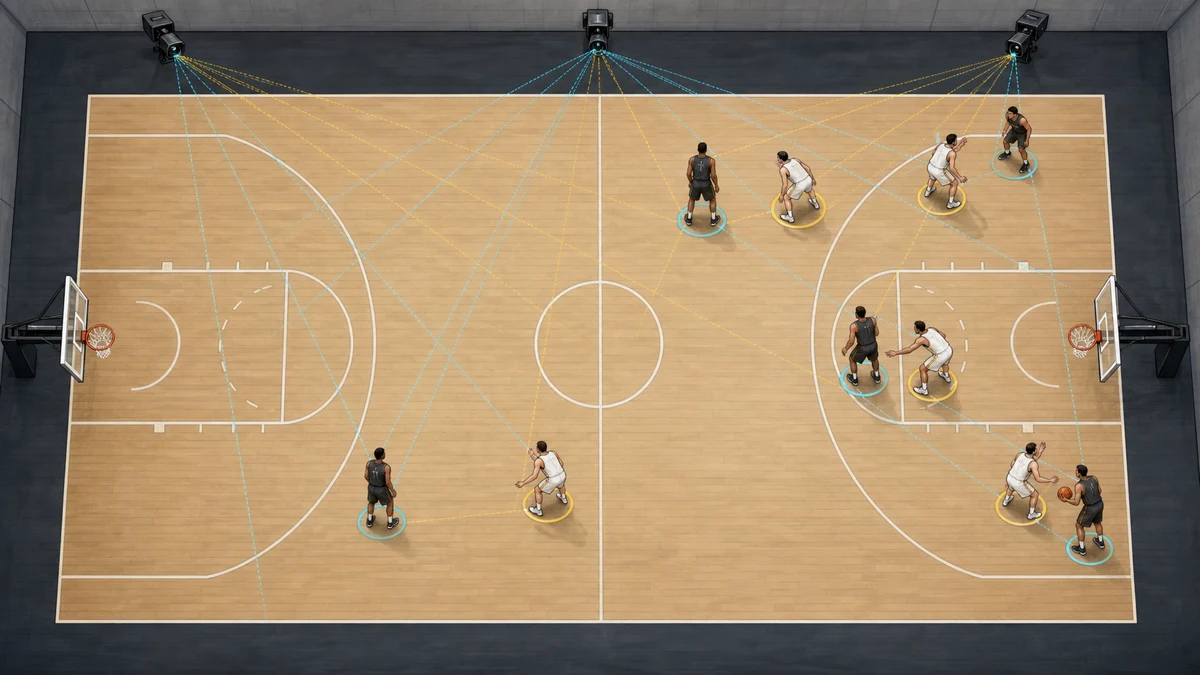

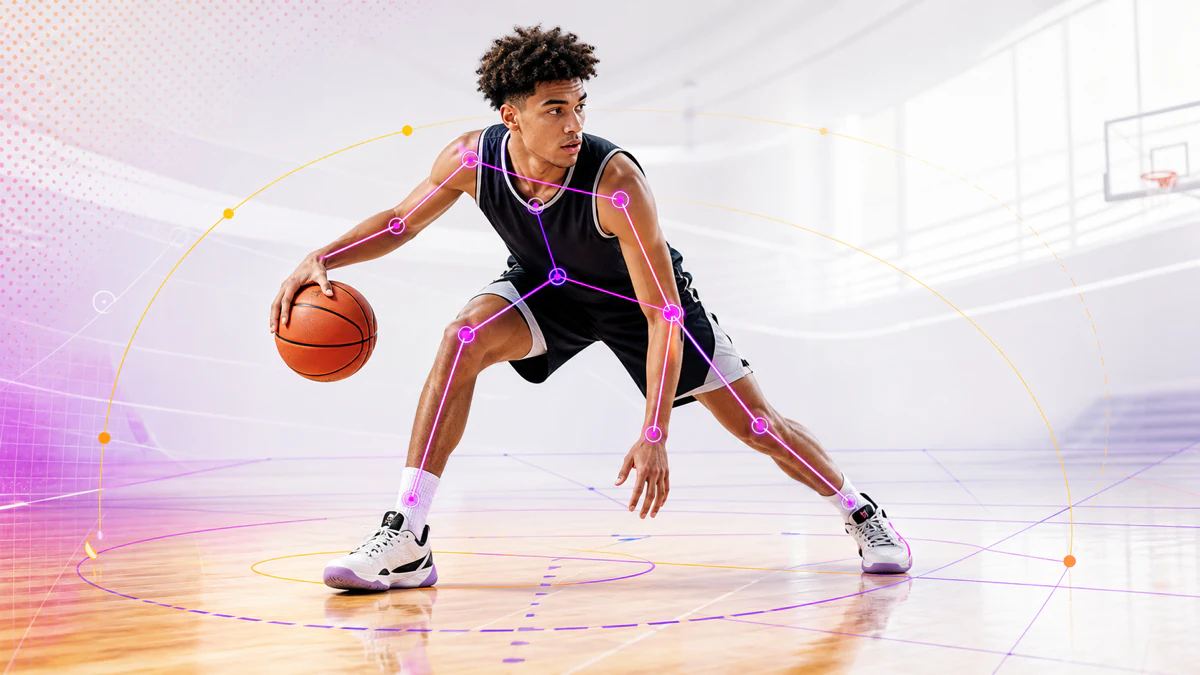
The short version: Basketball computer vision converts video pixels into estimated locations, links them across frames, maps them to the court, and may feed higher-level models. Those outputs are useful evidence—not automatic ground truth.
Key takeaways
- A pose model estimates body landmarks; it does not deliver a coaching verdict by itself.
- Player tracking and ball tracking are separate temporal problems, and both can fail when the view is blocked.
- Court calibration maps image pixels to court coordinates, so registration errors flow into later measurements.
- Advanced basketball metrics combine tracking data with rules, context, and statistical models.
- Independent reference testing matters because a polished overlay can still be inaccurate.
What does basketball computer vision actually see?
Computer vision starts with pixels, not basketball understanding. A pose estimator looks for a person and returns estimated body landmarks such as shoulders, elbows, wrists, hips, knees, and ankles. Google's current pose task defines 33 landmarks and can run on a still image, decoded video, or a live camera stream. That output is a coordinate set with confidence—not a statement that a player's base is balanced, a release is repeatable, or a decision was correct. Basketball meaning arrives only after another layer interprets those estimated locations in context. PoseLandmark — Google AI for Developers PoseLandmarkerOptions — Google AI for Developers basketball player tracking
Video adds a second problem: identity through time. The system must decide whether a detection in the next frame is the same athlete, even while players cross paths, jerseys overlap, or a body disappears behind another player. A published single-camera basketball tracker separates this into a detection step and a tracking step that uses pose and semantic features. Its authors highlight clutter and occlusion on a tight court as unavoidable challenges. In plain language, a clean skeleton in one frame does not guarantee a stable track across the possession. Single-Camera Basketball Tracker through Pose and Semantic Feature Fusion
Why are the ball and the court separate problems?
Ball tracking is not a free by-product of body pose estimation. The basketball is smaller than a player, can move quickly, and is frequently hidden by hands, bodies, or the rim from a single viewpoint. Research on monocular basketball video treats those conditions as core challenges and shows why systems sometimes infer likely ball ownership from player trajectories and where the ball was last visible. That distinction matters: a visible ball location is a measurement from the image, while a location filled in during occlusion is an inference. A responsible interface should not present both with identical certainty. Predicting Ball Ownership in Basketball From a Monocular View AI basketball shot feedback
Next comes court calibration, sometimes called court registration. A camera sees a tilted rectangle with perspective; basketball analysis needs a map from those image pixels to court coordinates. The KaliCalib research framework describes this mapping as a homography used to re-project players or the ball from image space into field space. It also documents practical failure conditions: court lines can be hidden, blurred by camera movement, or confused by different floor designs. If the mapping is off, a player's estimated position, distance, speed, and spacing can all inherit that error. KaliCalib: A Framework for Basketball Court Registration
How do coordinates become basketball metrics?
Once identities and court positions are stable enough, a system can summarize movement over time. The NBA's announced intelligence platform analyzes 29 tracking data points per player, while its Gravity feature processes optical tracking data 60 times per second. Those sampling details describe the input stream, not the final meaning. A position is relatively close to observation; speed is calculated from changing positions; defensive responsibility or shot difficulty requires additional definitions and modeling. Each step moves farther from the original pixels and introduces assumptions that should be documented. NBA and AWS announce a basketball intelligence partnership
| Layer | Example | Question to ask |
|---|---|---|
| Observed or estimated coordinates | Body landmarks, player location, visible ball location | Was the subject in view and was confidence adequate? |
| Derived movement | Speed, acceleration, distance, spacing | Was the time and court calibration stable? |
| Model inference | Defensive assignment, shot difficulty, player gravity | What definition, context, and validation produced the score? |
| Basketball decision | What to coach or practice next | Does video and expert review support the recommendation? |
What does FIBA validate—and why does it matter?
A serious evaluation asks whether the output matches a trusted reference. FIBA's first Tracking Solutions test covered inertial measurement units, local positioning systems, and optical tracking. Its basketball-specific protocols assessed positional accuracy, speed, acceleration and deceleration patterns, jump height, and load index. FIBA also sent wearable devices through a separate safety assessment focused on physical characteristics and impact. That structure is a useful reminder: accuracy, reliability, and safety are different questions, and passing one does not automatically answer the others. FIBA launches Approval Program for Player Tracking Solutions
FIBA's 2026 follow-up made the reference check explicit. Assessors compared the data produced by five systems from four companies with reference values captured during basketball movements and game simulations, then subjected results to reporting and review. For buyers, coaches, and developers, the lesson is practical: ask what a metric was compared against, on which movements, from which camera setup, and under what failure conditions. A demo can show that software runs; a validation report is what begins to show how closely it measures. FIBA takes next step in Tracking Solutions approval process
How should players and coaches read computer-vision feedback?
- Separate what was visible from what was inferred. A hidden ball, blocked wrist, or lost player track should lower confidence in the conclusion.
- Check the camera and court map before trusting distances or spacing. A moving view, missing court lines, or unusual floor design can affect registration.
- Ask for the metric definition. A landmark, a calculated speed, and an AI-generated shot-difficulty score represent different levels of interpretation.
- Look for reference testing that resembles the movement and environment you care about, not only a polished sample clip.
- Use the output to focus a video review and training conversation, then confirm the pattern across more than one rep or angle.
Frequently asked questions
Is pose estimation the same as player tracking?
No. Pose estimation identifies likely body landmarks in an image or frame. Player tracking connects detections through time and tries to preserve each athlete's identity. A single-camera basketball research pipeline explicitly uses pose detection first and then a separate tracking stage, which is why a clean pose overlay can still lose a player when bodies cross or the view is blocked.
Can one phone camera measure a basketball shot perfectly?
No camera setup should be treated as perfect ground truth. From one view, the ball can be small, fast, or hidden, and court geometry can be difficult to recover when lines are blurred or occluded. A phone video can still be useful, but the system should expose uncertainty and the user should check whether the key body, ball, and court features were actually visible.
What is court calibration in basketball video?
Court calibration estimates the camera geometry needed to map a point in the image onto a known location on the court. Research frameworks often represent that relationship with a homography. The mapping lets software express player or ball locations in court space, but an inaccurate registration can distort the distances and movement values calculated afterward.
How can I judge whether a tracking metric is trustworthy?
Start with the validation method. Ask what reference captured the comparison value, which basketball movements were tested, how many camera or wearable setups were included, and how failures were handled. FIBA's approval events illustrate that approach by comparing system output with reference values and reviewing accuracy separately from relevant player-safety questions.