
The short version: Basketball free-viewpoint video captures an event from many fixed cameras, reconstructs enough of the scene in three dimensions, and renders a virtual camera from a selected angle. The NBA's 2026 POV mode was a preview whose people were still prototype animations—not proof of a player-worn camera or a finished consumer product. Deployed replay systems show the idea is real, while live photorealistic delivery remains a demanding capture, compute, and quality-control problem.
Key takeaways
- A player-perspective image can be a synthetic view of real game data rather than footage from a camera on the athlete.
- Capture, calibration, reconstruction, virtual-camera rendering, and delivery are separate stages with separate failure modes.
- The NBA's February 2026 POV demonstration was explicitly a preview, and its public release leaves key architecture and launch details undisclosed.
- Arena free-viewpoint replay is already deployed, but a producer-selected replay and a fan-controlled live POV are different products.
- Trustworthy systems should label reconstructed imagery and expose visual uncertainty instead of making the virtual view look more certain than its inputs.
What does basketball POV mode actually show?
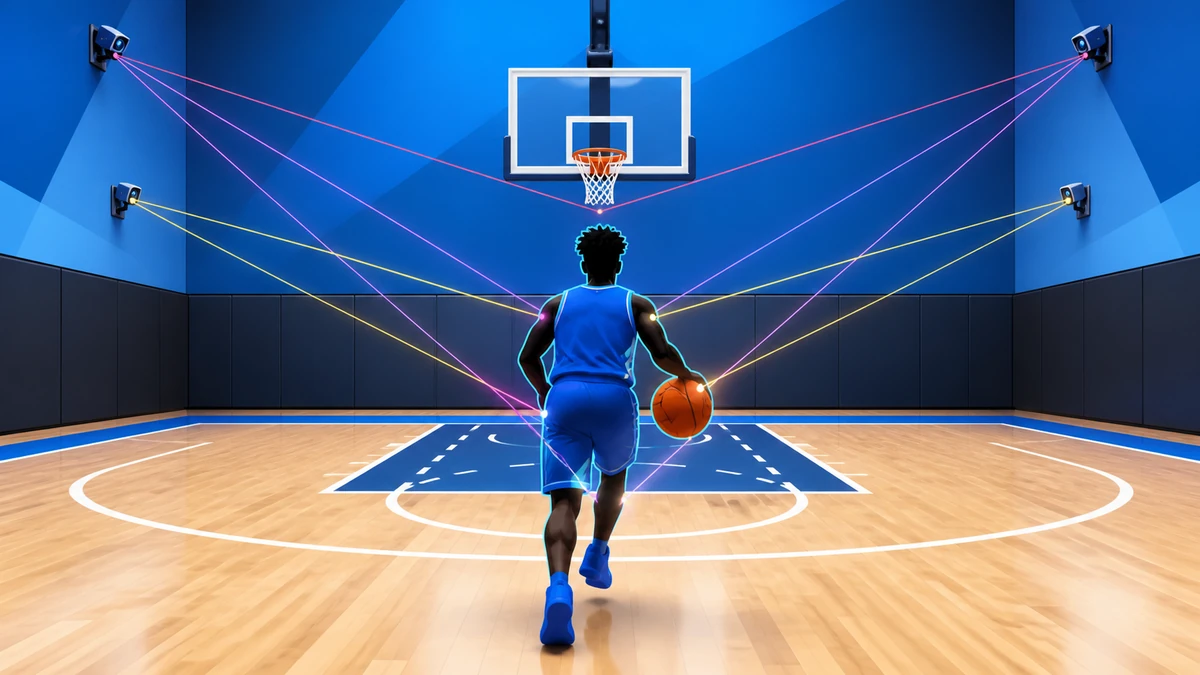
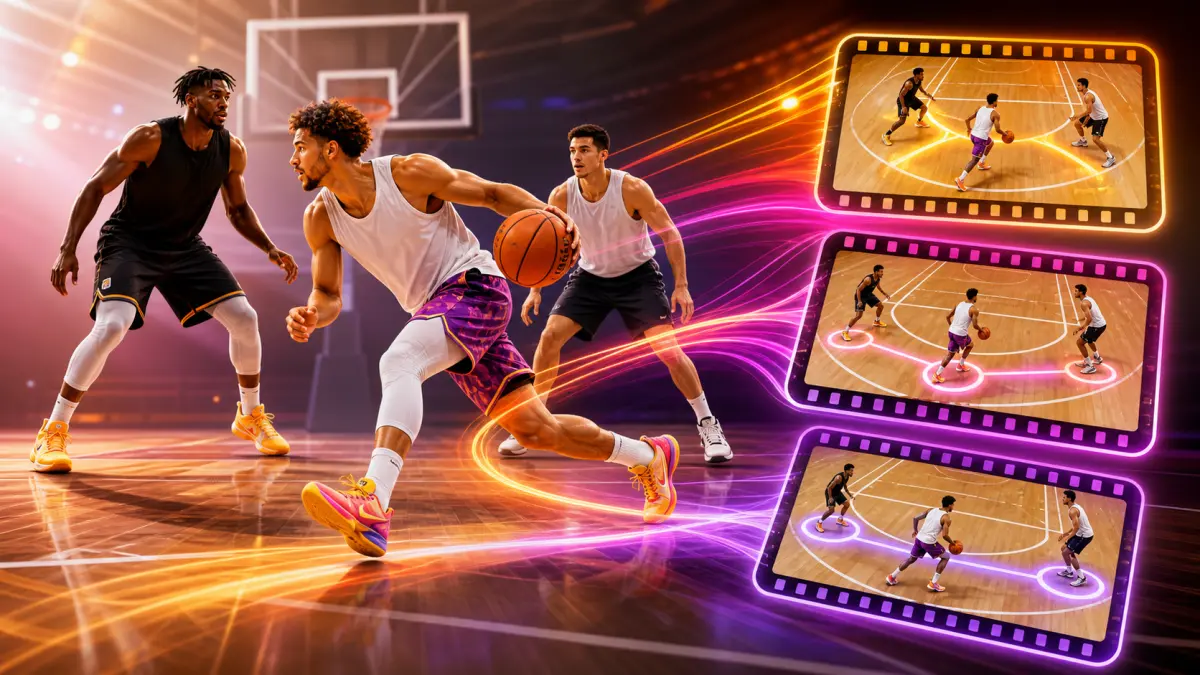
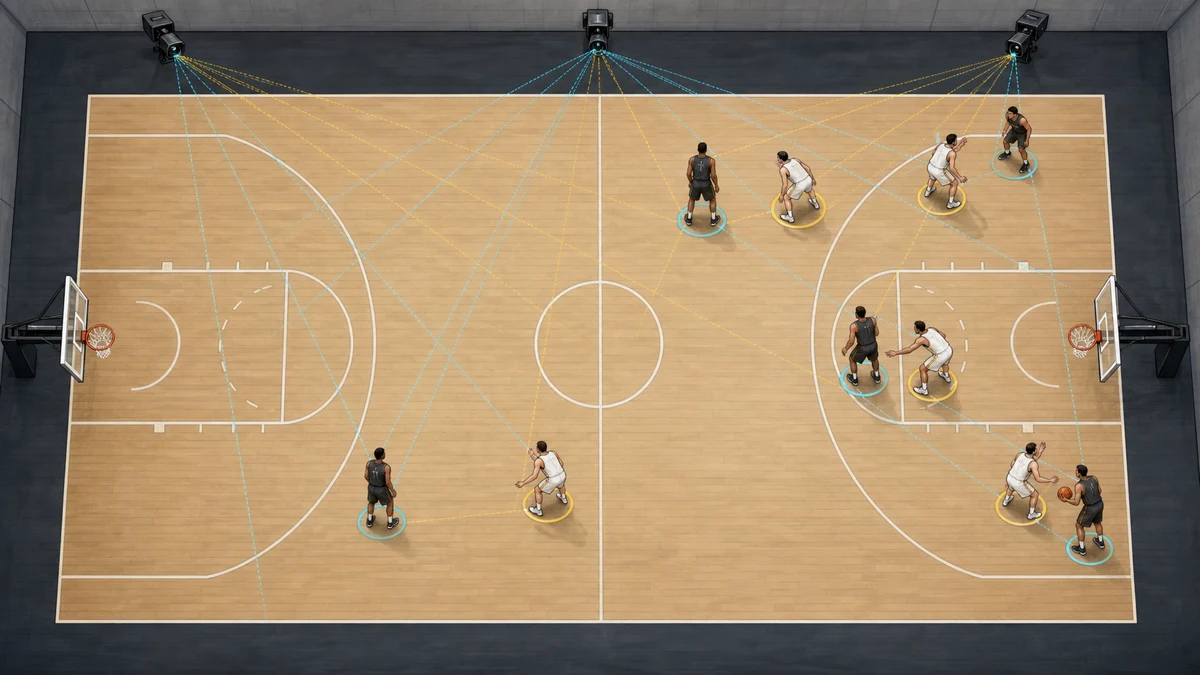
A basketball POV view answers a simple creative request—show the possession from where a player appears to be looking—but the image does not need to come from a camera attached to that player. A free-viewpoint system can observe the game from cameras around the arena, reconstruct a digital scene, place a virtual camera near the player's position, and render a new view. The viewpoint may be player-like; the pixels are generated from a model of the captured event. That distinction should remain visible in product labels, broadcasts, and clips. Canon Volumetric Video System Canon Successfully Livestreams XR Content Using Volumetric Data automated basketball video systems
The NBA previewed an AI-powered POV mode at its February 2026 All-Star Technology Summit. The onstage demonstration revisited the January 29, 2026 Mavericks-Hornets game from the apparent on-court perspectives of Cooper Flagg and Kon Knueppel. The release also supplied the most important caveat: the figures in the demo were prototype animations that the league said would ultimately be replaced by visualizations of the actual players. That is a product preview, not a claim that a hidden player camera recorded the sequence. NBA previews live 'POV mode' at 2026 All-Star Technology Summit
How does free-viewpoint basketball video get built?
| Stage | Job | What can go wrong |
|---|---|---|
| Capture and synchronization | Record the same instant from many arena positions | A body, ball, or rim can be hidden, blurred, or mistimed |
| Calibration | Locate each camera relative to the court and the other cameras | A small geometry error can shift the virtual view |
| Reconstruction | Estimate surfaces, people, ball, and open space as 3D data | Fast motion and overlapping players can leave missing or unstable detail |
| Virtual-camera render | Choose a location, direction, lens, and motion path | An aggressive angle can expose areas the capture did not observe well |
| Delivery | Encode and send replay, video, or interactive XR to a screen | Compute, bandwidth, device support, and latency shape what is practical |
Canon and Cleveland Cavaliers Bring Free Viewpoint Technology to CES
Cleveland's installed C-View example makes the capture scale concrete. The Cavaliers said the arena system used more than 100 4K Canon cameras to record and recreate the action. Canon describes the broader method as turning many camera images into detailed video and 3D data, then letting an operator move a virtual camera where no physical camera stood. In a separate live XR test, Canon generated a point cloud, sent it to a cloud server, rendered the selected viewpoint, and delivered the result to a compatible device. None of those steps is interchangeable with simply switching to another broadcast camera.
Why is a live player-like view harder than a replay?
Replay gives the production system time to choose a stable moment, avoid a weak angle, repair a camera path, and encode one finished shot for everyone. A live interactive product has less room to hide. It may need to update the reconstruction while players overlap, keep the ball coherent through hands and bodies, respond to a user's camera motion, and deliver a new image quickly enough that the view still feels connected to the possession. Canon identifies the immediate processing of enormous data volumes as a central challenge and points to parallel distributed processing as part of the response.
Basketball makes the weak spots easy to notice. As an engineering inference from the multiview reconstruction problem, reviewers should inspect moments when players overlap, the ball changes direction, hands meet the ball, or thin rim and net details cross a crowded background. A convincing view must preserve identity, contact, court lines, and timing at once. If the renderer fills an unseen area poorly, the output may be visually smooth yet wrong. The honest interface treats reconstruction confidence as part of the product, not as a backstage embarrassment.
What is deployed, piloted, and still only previewed?
- Deployed arena capture: Cleveland said C-View was installed and had been piloted for replay highlights, arena screens, and an in-venue VR experience by early 2023.
- Previewed NBA interface: POV mode appeared in a live 2026 summit demo, but the release called its people prototype animations and did not announce a consumer launch date.
- Active pilot path: the NBA selected Peripheral Labs for a six-month Launchpad pilot involving live-sports reconstruction and high-fidelity player and ball tracking. NBA Launchpad announces 5th group of emerging technology companies
Those statuses matter. An installed system proves that arena-scale capture and produced virtual replay can work. A pilot tests whether a newer approach survives the league's requirements. A summit preview communicates a direction. None, by itself, establishes general availability, a specific latency, a photorealistic live result on every play, or permission for viewers to publish the reconstructed feed elsewhere.
Does player tracking automatically create POV video?
Tracking data can help describe where bodies move, but coordinates are not a finished image. The NBA's separately announced AWS analytics platform uses 29 tracking points per player, and its Gravity feature processes optical tracking data 60 times per second. That is useful evidence that detailed movement streams exist for named analytics products. The release does not say those streams power the 2026 POV prototype, so connecting the two as one disclosed pipeline would be speculation. NBA and AWS announce basketball intelligence partnership how basketball computer vision turns pixels into tracking data how live basketball data reaches viewers
A rendered athlete also needs appearance: uniform texture, body surface, lighting, hair, hands, and ball contact from the selected direction. A product may combine multiview images, geometry, tracked identities, learned reconstruction, and conventional graphics, but readers should demand a source before assigning that architecture to a named system. The safest explanation is a chain of possible components plus a precise list of what the developer has actually disclosed.
How should viewers and buyers evaluate a free-viewpoint system?
- Ask whether the output is raw camera footage, stitched imagery, a reconstructed virtual view, animation, or a mixture.
- Separate produced replay, near-live replay, and viewer-controlled live delivery; each has a different latency and quality budget.
- Check whether player identity, ball contact, hands, court lines, rim geometry, and hard-to-observe moments remain stable from the chosen angle.
- Look for an explicit preview, pilot, or deployed label and do not convert a demonstration into an availability promise.
- Confirm device requirements and the way prototype, animated, synthetic, or reconstructed imagery will be labeled before distribution.
Frequently asked questions
Is NBA POV mode filmed by a camera on the player?
The NBA's February 2026 release does not say a player wore a camera. It calls the technology AI-powered, describes a player-vantage demonstration, and says the prototype animations will ultimately be replaced with actual-player visualizations. Until the league discloses a capture method, the accurate description is a reconstructed or generated player-like viewpoint—not wearable-camera footage.
What is free-viewpoint video in basketball?
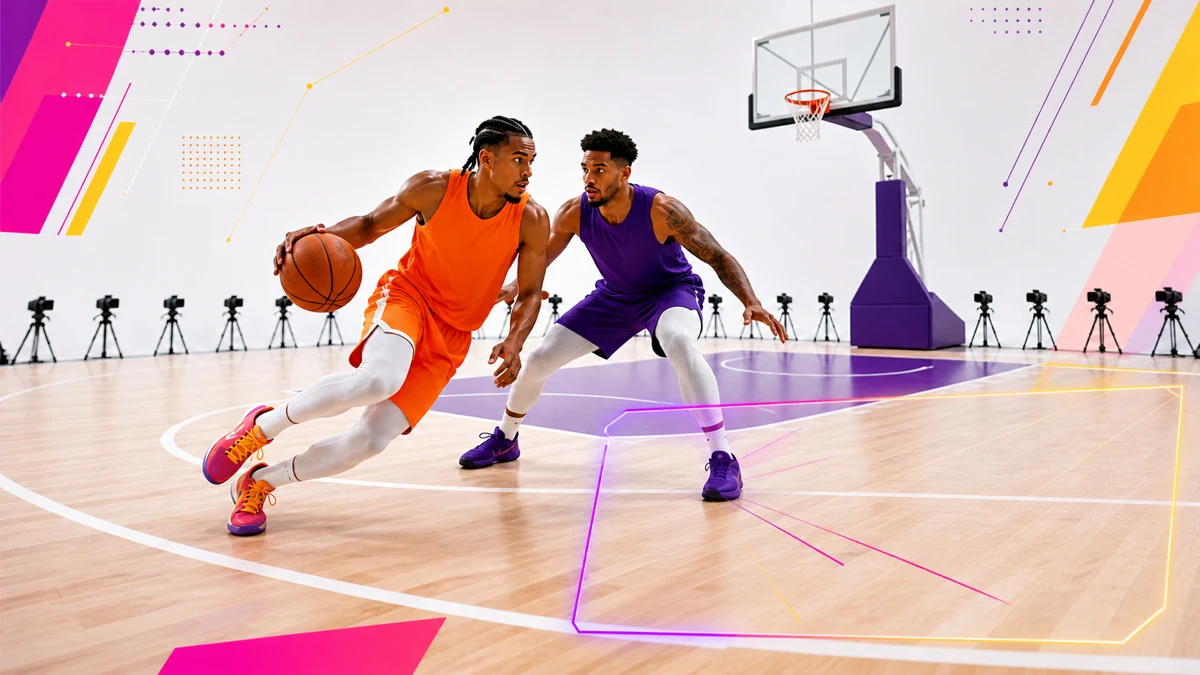
It is video rendered from a virtual camera inside a reconstructed scene. Canon describes using many cameras and image processing to generate 3D data, after which an operator or viewer can select a position and angle that no physical broadcast camera occupied. The final view represents the real event through a computed model of it.
Can fans control the angle during a live game today?
Some technology demonstrations have shown live or interactive viewpoint control, and installed systems support free-viewpoint production. The NBA's 2026 POV release, however, was a preview and did not state a consumer launch date or general availability. Availability must be checked for the specific league, venue, broadcast, device, and event.
Why can a virtual basketball angle look wrong?
The chosen virtual camera may expose a surface or contact moment that the physical cameras did not see clearly. Reconstruction then has less evidence for a hand, ball, jersey edge, or player hidden behind another body. Calibration, synchronization, processing, and compression can add further errors. A smooth result is not proof that every pixel came from a direct observation.