

The short version: In a short tournament camp, prioritize a shared vocabulary, one recognizable offensive framework, an audible transition-defense sequence, and clear restart and substitution responsibilities. Install fewer connected ideas and test whether players can organize themselves during live possessions.
Key takeaways
- Use a short preparation window to reduce confusion before expanding the playbook.
- Establish shared names for floor spots, actions, defensive calls, and restarts.
- Give the offense a recognizable starting shape and a small set of connected decisions.
- Make early transition-defense responsibilities audible and easy to rehearse.
- Adapt camp phases, substitutions, and recovery planning to the available time and tournament context.
A short camp changes the priority
A short tournament camp is not a compressed league season. There is less room for a large playbook, repeated reteaching, or separate solutions for every possible situation. The practical task is to decide what every player must recognize when a possession becomes untidy.
Start with common language, a small offensive framework, audible defensive responsibilities, and clear ownership of restarts and substitutions. The examples below are adaptable planning options, not a required system, camp length, or promise of tournament results.
Create a shared language first
Build the team’s vocabulary before expanding its tactics
Choose one name for each floor spot, action, defensive call, and restart the team will use. Introduce each word on the court: identify the location or responsibility, walk through it, and then use the same call during live play. When players use different terms, pause and settle on one team word before continuing.
Install an offense players can recognize
Swipe sideways to explore the full diagram.
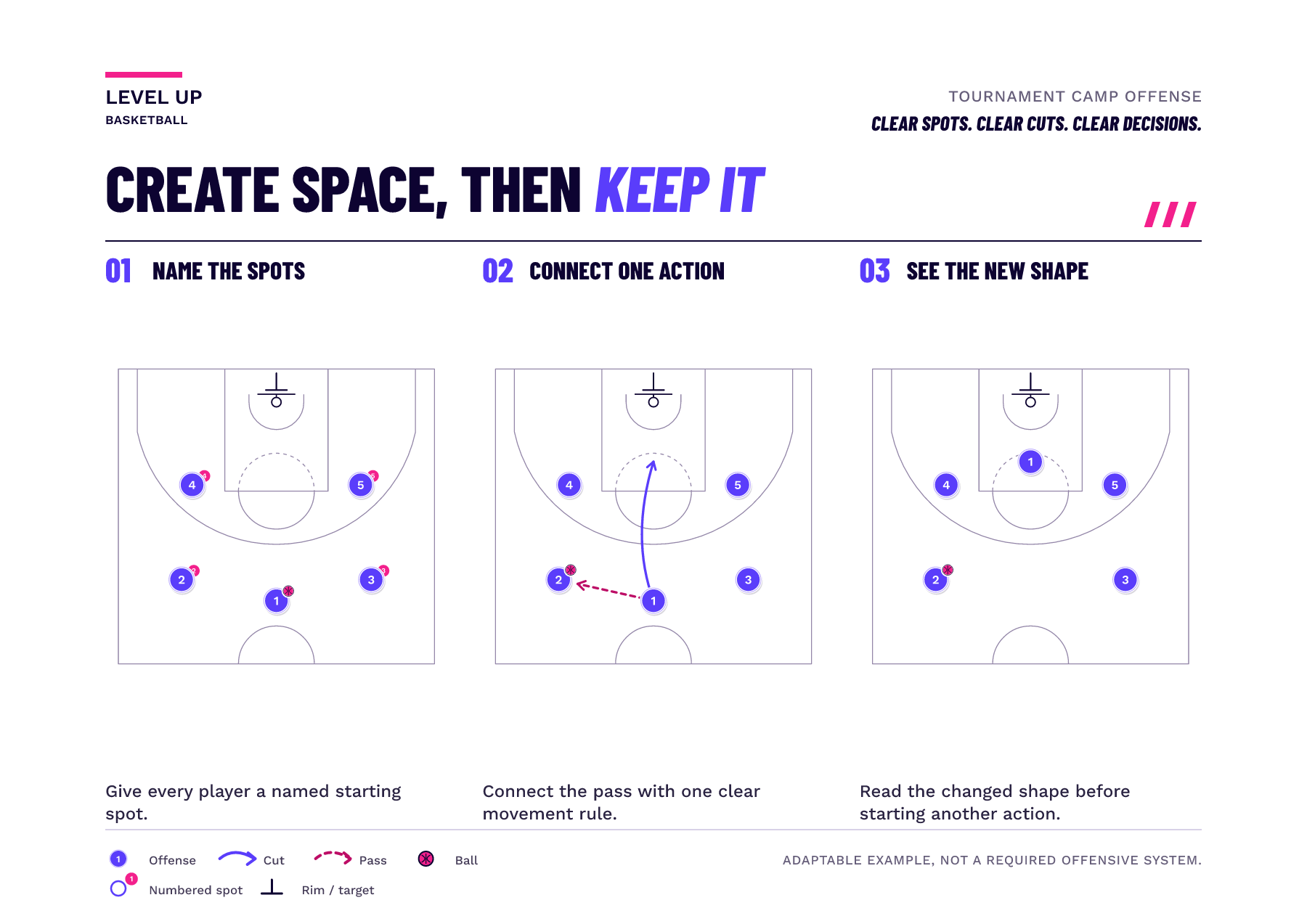
A manageable offense gives players a starting shape and a small set of shared decisions. Five-out, four-out with one interior player, or another familiar alignment can work as the teaching shell. The coach still needs clear answers to four questions: Where do we begin? What follows a pass? What follows penetration? How do we restore the shape when the first action ends?
Treat set plays as extensions of that framework. Reuse the same spot names, actions, and spacing whenever possible. If a branch repeatedly requires a long explanation, simplify it before adding more material.
Make transition defense an audible sequence
Give transition defense an agreed order and an audible vocabulary. One adaptable sequence is to protect the basket, stop the ball, identify immediate threats, and complete the matchups. Rehearse the calls after shots, turnovers, and dead-ball situations so players connect the responsibility with the change of possession.
Swipe sideways to explore the full diagram.
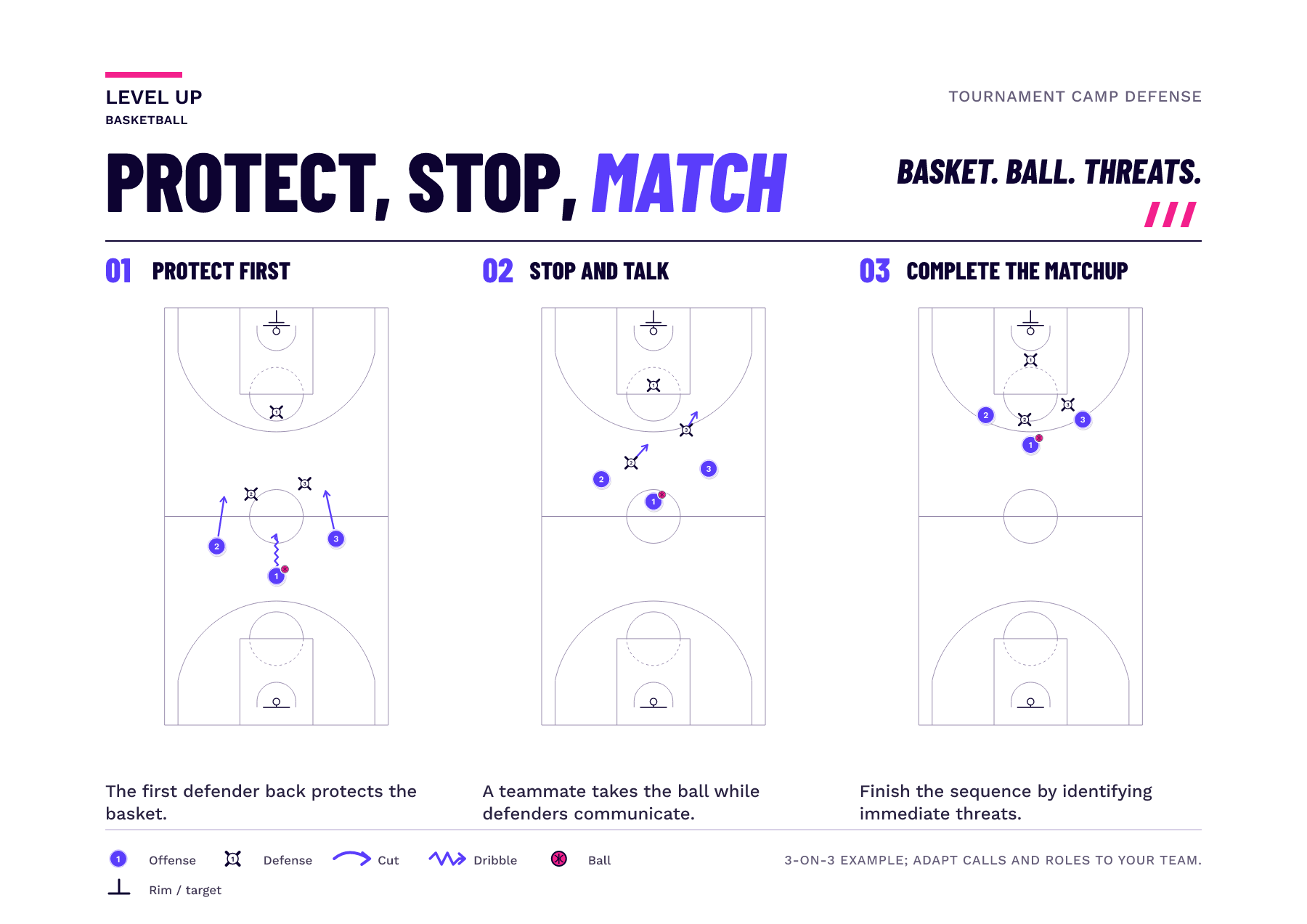
A player is close to a wing runner, but no defender is between the ball and the basket. Which responsibility comes first in this framework?
In this adaptable framework, protect the basket first while teammates take the ball and communicate the immediate threats.
Assign restart and substitution responsibilities
Restarts and substitutions also need shared language. They should not become separate instructions delivered only when the game stops.
- According to the UFBA Basketball Coaches Handbook, remind players of their positions and defensive assignments. Ufba Basketball Coaches Handbook1 1
- According to the UFBA Basketball Coaches Handbook, review press-offense assignments when the opponent is likely to press.
- According to the UFBA Basketball Coaches Handbook, remind players of the team’s general offensive and defensive schemes.
- According to the UFBA Basketball Coaches Handbook, review offensive and defensive fast-break assignments.
- According to the UFBA Basketball Coaches Handbook, review out-of-bounds plays and assignments.
- According to the UFBA Basketball Coaches Handbook, explain how substitutions will be made.
Use camp time to rehearse the team’s answers. Players can walk through who takes the ball out, who uses each restart call, how incoming substitutes receive their assignments, and how the group reorganizes after a dead ball. These are planning questions rather than fixed answers; each team should use its own system and applicable competition procedures.
Organize the camp around decisions
| Camp phase | Primary focus | Check for understanding |
|---|---|---|
| Opening | Names, spots, calls, and roles | Can players identify the same location and responsibility? |
| Build | Base offense, transition defense, and restart rules | Can players connect one phase of play to the next? |
| Live play | Constrained scrimmages using the installed language | Can players organize the possession without a long interruption? |
| Review | Roles, substitutions, and the selected restarts | Can each player state the first responsibility in likely situations? |
Adapt the phases to the preparation window rather than treating them as a required schedule. With several sessions, revisit each phase. With one brief session, combine the opening and build work before a short live test. Use additional time to repeat important decisions instead of automatically adding more plays.
Plan tournament substitutions and recovery without promising a universal rotation. Establish how substitutions will be communicated, identify the combinations the coach wants to observe in camp, and consider the event schedule when distributing practice work. During the tournament, adjust participation through direct communication with players and appropriate staff rather than treating fatigue as a test of toughness.
Measure clarity, not playbook size
The useful measure of a short camp is shared clarity. Players should recognize the team’s words, starting offensive shape, first defensive responsibilities, restart jobs, and substitution process. That does not guarantee a tournament result, but it gives the group a manageable structure to carry into competition.
Was this useful?