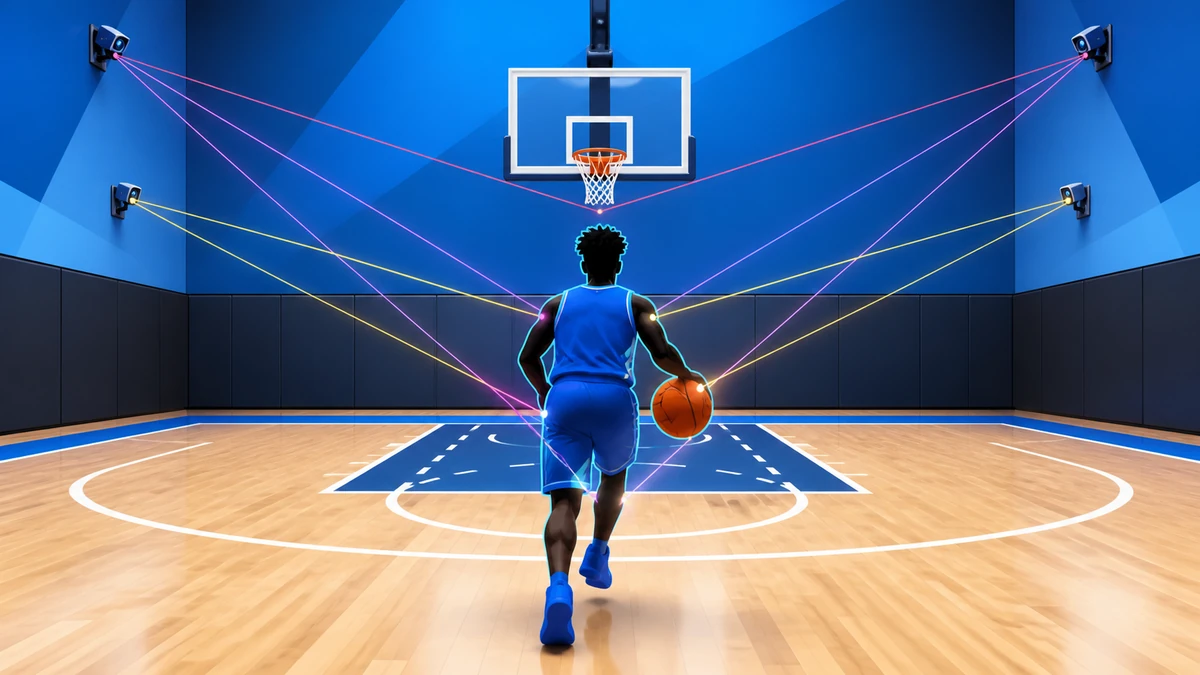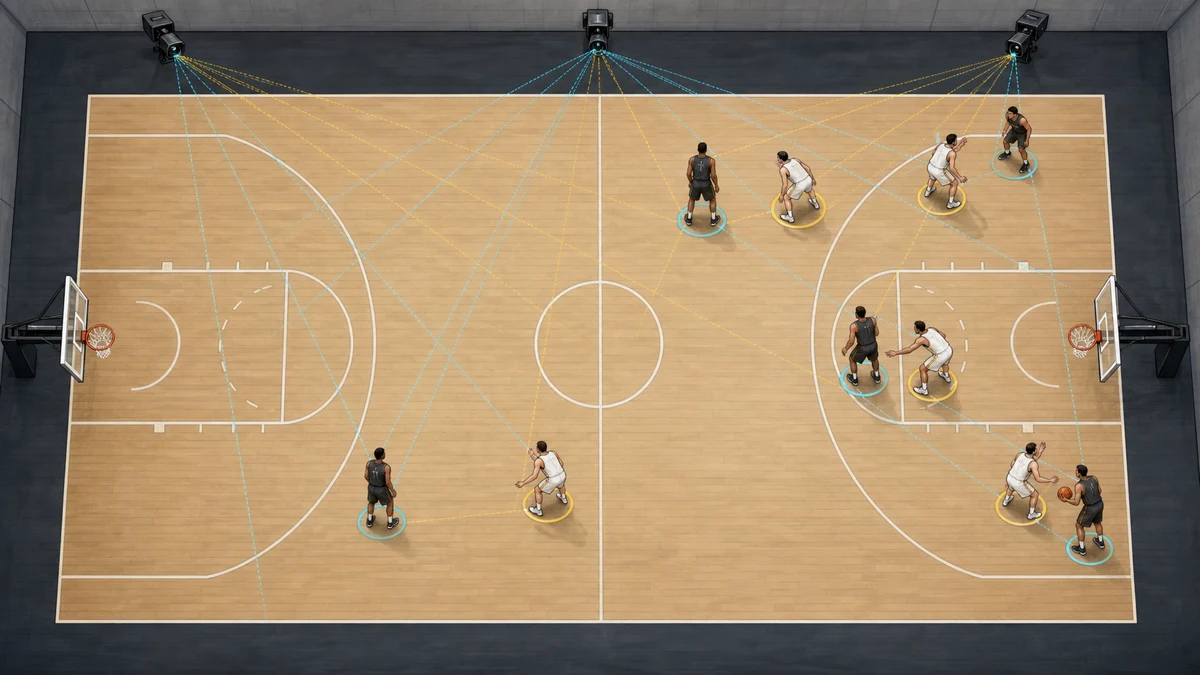


The short version: Basketball live stats begin as game events recorded by trained people or an approved venue system. A live-stat platform applies a shared event model, updates totals, and distributes the record to reports, scoreboards, broadcasts, game centers, and APIs. Each destination may refresh differently, and a later correction must flow from the authoritative record rather than from a fan-facing screen.
Key takeaways
- The courtside statistician records basketball events; the software does not remove every judgment call.
- One event stream can power box scores, play-by-play, arena displays, television graphics, websites, and apps.
- A scoreboard feed, a broadcast overlay, and a public API are separate interfaces with different timing and presentation needs.
- Live and validated post-game data are not always the same endpoint or refresh state.
- When sources disagree, identify the competition's authoritative provider and the latest validated record before calculating anything new.
Where do basketball live stats begin?
The first link in a basketball live-stat chain is usually courtside capture. FIBA describes LiveStats as a Windows application through which statisticians record game statistics and publish them in real time. The person at the laptop is translating the game into structured events: a made shot, a missed attempt, a rebound, an assist, a turnover, a foul, or another action recognized by the competition's statistics rules. The screen makes entry faster, but the basketball observation still comes first. FIBA LiveStats how a separate timing system handles the shot clock
That role is more consequential than typing numbers into a box. FIBA says the collected data serves players, coaches, media, television, and fans; licensed statisticians are required for official FIBA competitions. The Statisticians' Manual then supplies definitions and examples for crediting core events. Whether a pass deserves an assist or which player receives a rebound can require a rule-based judgment, so two unofficial observers can disagree even while watching the same possession. Statisticians FIBA Statisticians' Manual 2024
What happens after a game event is entered?
Once entered, the action becomes part of a time-ordered game record. The platform can update the score, player and team totals, lineups, play-by-play, and reports from that record. This is why one correction can affect several outputs: changing the shooter on a made basket may alter two player lines while leaving the team score unchanged; changing a miss to a make can affect the score, shooting totals, the play sequence, and anything calculated from them. FIBA Live Stat Interface v2 why calculated basketball metrics inherit their source data
FIBA's interface specification makes the payload concrete. An approved venue system can transfer players, statistics, team score, game timing, and the actions scouted in the arena to the Live Stats Integrator. The common interface matters because the capture application and the consumer do not need to be the same product. Providers may structure their systems differently while still supplying data that follows the shared contract. FIBA GDAP Documentation
How does one feed power the venue and the broadcast?
Inside the arena, speed and consistency matter. FIBA LiveStats lists an in-venue feed for scoreboard screens and an interface for television graphics. Those products may display the same score and player totals, but they solve different presentation problems. A scoreboard favors immediate, glanceable information for people in the building. A broadcast system needs graphics that can be selected, styled, and timed for the program. Neither display should become an independent statistics authority simply because viewers see it first. Genius Sports — Data & Video Solutions
| Destination | Typical job | What can differ |
|---|---|---|
| Scoreboard | Show score, clock, fouls, and selected totals in the venue | Hardware interface and update timing |
| Broadcast graphics | Put selected live facts on the video program | Graphic layout, editorial selection, and delay |
| Game Center | Give fans responsive stats and play-by-play | Language, device layout, and refresh behavior |
| Reports | Provide coaches and media a stable game summary | Publication time and validation state |
| API or XML | Let authorized systems consume structured data | Schema, authentication, polling, and caching |
How do websites, apps, and APIs receive the data?
The public experience is another downstream layer. The LiveStats feature set includes a responsive Game Center available in more than 25 languages, reports for coaches and media, Organizer integration, API access, and XML exports. That audience-facing language count is distinct from the eight application languages listed for the courtside software. FIBA's interface documentation says integrated data can support webcasts, mobile apps, third-party API services, and official results, box scores, statistics, and play-by-play. One structured record can therefore appear in many products without every product scraping a scoreboard or recreating the game by hand.
Current GDAP documentation also distinguishes data by phase. FIBA MAP supplies pre-game and post-game competition data, while the LiveStats Integrator supplies live-game data. That separation helps explain why a roster, a live action stream, and a validated final box score may arrive through related but distinct paths. It also prevents a common mistake: treating every response from a basketball data API as an equally live snapshot. how player-tracking data forms a different measurement stream
Why can two live-stat screens disagree?
A short disagreement does not automatically prove that one screen invented a number. One client may poll later, another may cache longer, and a broadcast may add its own production delay. GDAP uses pull rather than push access and tells integrators to plan polling and caching; its example guidance suggests much faster requests for live-game data than for post-game records. A consumer that misses an update or holds an old response can briefly show a different state from the source.
The word live also needs scope. GDAP warns that an API call should not be assumed to return live data unless the documentation explicitly says so; otherwise, it returns validated data. Provider interfaces can also differ in optional fields and object naming while respecting the common format. For an app team, the safe design is to label freshness, retain event identifiers, handle updates idempotently, and avoid presenting a cached response as an official final record.
How are basketball statistics corrected?
Corrections are a normal consequence of combining a fast game with rule-based human judgments. The practical question is not whether a public page can be edited; it is which record the competition recognizes. GDAP's terms say a reported data-quality issue is referred to the data owner, which decides whether to apply a correction. A downstream site should therefore ingest the updated authoritative record and recompute dependent totals, rather than patching one visible number and leaving related fields inconsistent. FIBA GDAP Terms of Services
- Check the game, competition, provider, and timestamp before comparing two feeds.
- Separate a live event stream from a validated post-game response.
- Trace a disputed total back to its component events instead of changing the total alone.
- Expect a correction to propagate to reports, graphics, game centers, and API consumers at different times.
- Do not infer that every league uses FIBA LiveStats or the same provider; confirm the competition's own workflow.
Frequently asked questions
Are basketball live stats fully automated?
Not in the ordinary FIBA LiveStats workflow described here. A statistician records the actions through software using the Statistics Manual. Other competitions may add automated capture or another approved provider, but a polished live display does not by itself prove that every underlying event was machine-generated.
Is the arena scoreboard the official source?
It is an important venue output, not necessarily the master statistical record. FIBA lists the scoreboard as one interface fed by LiveStats, alongside reports, TV graphics, the Game Center, APIs, and XML. For a disputed player statistic, use the competition's designated official data source and latest validated record.
Why is the box score in another app a few seconds behind?
The app may be polling, caching, processing, or rendering on a different cadence. GDAP explicitly uses pull access and asks consumers to define a polling-and-caching strategy. Network delivery and each product's own refresh cycle can add more delay after the courtside action is entered.
Does the LiveStats app itself support more than 25 languages?
Do not combine two separate product claims. FIBA says the public Game Center is available in more than 25 languages, while the LiveStats application page lists eight application languages. The audience-facing site and the courtside software are different interfaces.