
The short version: A basketball shot clock follows possession and rule events, not simply the game clock. Operators start it on defined live-ball triggers, preserve or reset it according to the play, and rely on linked displays, horns, lights, officials, and replay when the visible number needs verification.
Key takeaways
- The clock usually begins with a new live-ball possession; a throw-in starts it when a player legally touches the ball on court.
- In the NBA, 24 seconds generally follows a change of possession, while 14 seconds commonly follows an offensive rebound or listed frontcourt retention event.
- A legal attempt must leave the hand before expiration and then touch the rim.
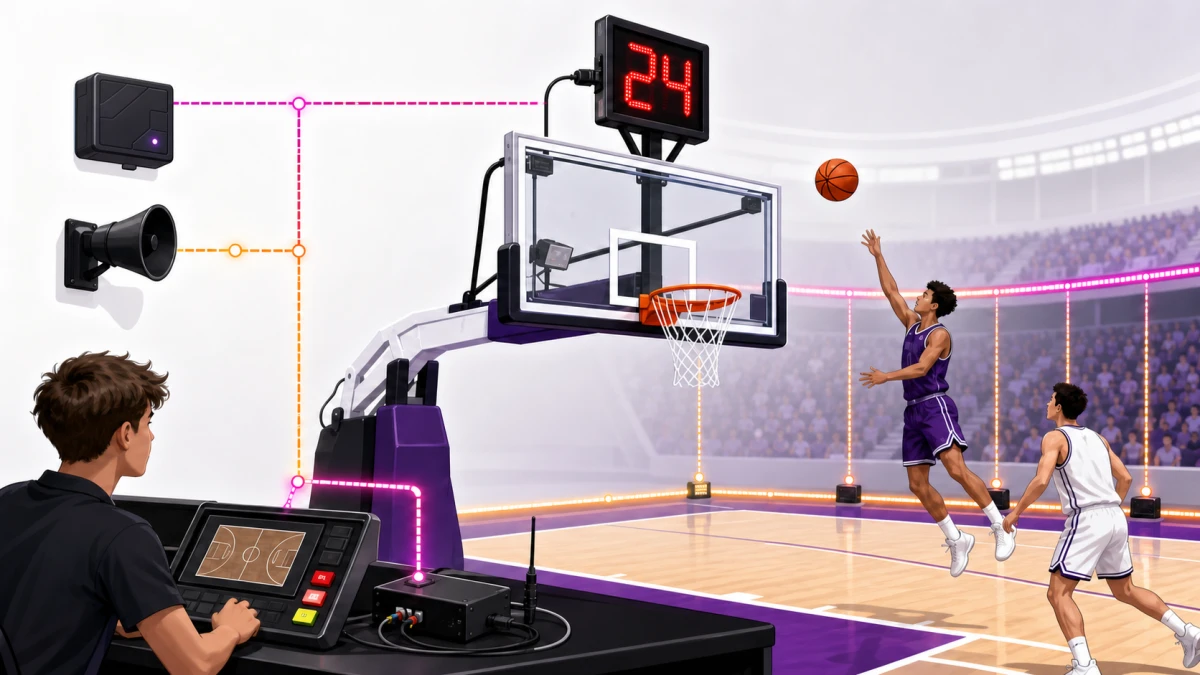
- The display, horn, backboard lights, game-clock interface, and operator controls are separate parts with defined behavior.
- Replay can correct certain expiration or rim-touch questions, but only through the review process and timing windows in the applicable rules.
What is a basketball shot-clock system?
The shot clock is not just a red number counting down above the backboard. NBA Rule 7 defines it as the device that measures how long the team possessing the ball has to attempt a field goal. Rule 2 then assigns a trained scorer's-table timer specifically to operate it, separate from the timer running the game clock. The rules decide what the time means; the operator applies those decisions; the control unit sends the state; and the arena hardware makes the state visible and audible. NBA Rule No. 7 — Shot Clock NBA Rule No. 2 — Duties of the Officials basketball instant-replay technology
FIBA's Level 1 equipment standard exposes that architecture. It calls for a separate control unit for the shot-clock operator, a digital countdown display, and a very loud automatic end signal. A production system therefore needs more than a screen that can show two digits: the controls, signal path, mounting, visibility, timing states, and connection to the game clock all have to work together under pressure. FIBA Official Basketball Rules 2024 — Basketball Equipment how basketball technology turns signals into useful information
When does the countdown start—and what counts as a timely shot?
Under the NBA rule, a new possession starts a new shot-clock period. On a throw-in, the operator starts the countdown when the ball is legally touched by a player on the court. After a jump ball or a missed free throw, the trigger is possession rather than the first random touch. Those distinctions explain why the game clock and shot clock may not begin on precisely the same basketball event even though both displays are visible at once.
Beating the visible zero requires two things in the NBA. The ball must leave the shooter's hand before expiration, and after release it must contact the basket ring. A ball still in the hand at expiration is late. A desperate release before zero that misses the rim is not a legal attempt for this purpose. If the defense only bats the ball loose without gaining possession, the offense's clock continues; team possession ends when the ball hits its offensive rim or the opponent actually gains possession.
Why does the clock reset to 24, 14, or neither?
Think in terms of who owns the next advantage. In the NBA, a genuine change of possession ordinarily produces 24 seconds. Listed personal fouls or violations that send the ball to the backcourt also produce 24. If the same offense controls the ball after its missed field goal or live missed free throw touched the rim, the rule uses 14 instead. That shorter reset recognizes a fresh offensive opportunity without treating the sequence like a full change of possession.
| NBA situation | Clock administration | Operator's question |
|---|---|---|
| Opponent gains possession | Reset to 24 | Was there a real change of possession? |
| Offense controls after its miss touched the rim | Reset to 14 | Did the same offense retain the new opportunity? |
| Listed defensive frontcourt foul or violation | Keep the interrupted time or set 14, whichever is greater | Where is the inbound and what did the clock show? |
| Defense last touched before out of bounds without gaining possession | Keep the unexpired time | Did possession ever change? |
| Attempt misses the rim | No reset for the miss itself | Did the ball actually touch the ring? |
That table is an NBA map, not a universal youth-tournament shortcut. FIBA equipment also supports 24- and 14-second starts, but competition rules govern when each button is correct. An operator should never infer a reset from the crowd's reaction or from seeing the ball near the rim. The ruling, possession, court location, remaining display, and competition rule must agree before the next live ball.
What do tenths, horns, and backboard lights communicate?
Display precision differs by ruleset. The NBA adds tenths at 4.9 seconds. FIBA Level 1 equipment shows tenths only during the last five seconds. The shared design goal is legibility when the final interval matters, but spectators should not turn a photograph of one display into the rule for another league. The authoritative question remains whether the attempt satisfied that competition's timing rule.
FIBA's equipment standard keeps period expiration and shot-clock expiration distinguishable. The red perimeter strip is assigned to the game-clock signal at the end of a quarter or overtime, while a separate yellow strip at the top marks the shot-clock signal. The standard also calls for distinct, very loud sound signals. Color and sound are redundant cues for players, officials, table staff, broadcasters, and spectators—not permission to ignore the officials when a timing sequence is disputed.
How does the shot clock connect to the game clock?
At FIBA Level 1, stopping the game clock also stops the shot clock. Starting the game clock, however, merely makes it possible to start the shot clock manually. That asymmetry is important: a whistle should freeze both running timers, but the shot clock still has to follow possession-specific triggers. The two clocks are coordinated, not interchangeable copies of one timer.
The operator's required states reflect real officiating needs. FIBA equipment must start from 24 or 14, stop while preserving the remaining value, restart from that stopped value, and blank the display when necessary. A clean arena workflow makes the current state obvious at the table before the referee hands the ball to the inbounder. That reduces preventable corrections after play resumes.
What happens when the clock or reset is wrong?
Hardware failure does not erase the timing duty. NBA Rule 2 supplies the official timer and shot-clock operator with digital stopwatches for failures involving the official timeout clock, game clock, or clocks above the backboards. The fallback is deliberately plain: trained people retain a separate way to measure time while the crew manages the interruption and restoration of normal equipment.
Replay is a correction layer, not a continuous replacement operator. NBA Rule 13 allows review of defined questions such as whether a made field goal left the hand before shot-clock expiration or whether a called foul preceded expiration. A separate rim-touch review can lead the Replay Center to adjust the game clock, shot clock, score, and possession. Each review has triggering and timing rules, so a disagreement cannot be reopened indefinitely after the game has moved on. NBA Rule No. 13 — Instant Replay
A practical pregame check for operators and coaches
- Confirm the competition rulebook and the events that produce 24, 14, the interrupted value, or a blank display.
- Test each operator state: start, stop, preserve, restart, 24, 14, and blank.
- Verify that a game-clock stop also stops the shot clock, then test the correct manual start behavior.
- Check that period and shot-clock lights and sounds are distinct and visible or audible from the court.
- Keep the approved failure timing equipment at the table and review the competition's correction protocol.
- For FIBA-level procurement, verify the product and approval level in the official equipment catalogue. FIBA Approved Basketball Equipment — Shot Clocks
Frequently asked questions
Does the shot clock start when the inbounder releases the pass?
Not in the NBA. On a throw-in, it starts when a player on the court legally touches the ball. The release from the inbounder's hands and the legal on-court touch are separate events, which is why the operator watches the receiving action rather than guessing from the pass.
Is every rim touch a 14-second reset?
No. In the NBA, the 14-second offensive-rebound rule depends on the same offense becoming first to possess after its unsuccessful field goal or live free throw contacted the ring. A rim touch alone does not answer who gains possession or whether another listed administration applies.
Does the horn decide whether a shot counts?
The governing timing test decides it. Under NBA Rule 7, the ball must leave the hand before expiration and then touch the ring. The automatic signal and lights communicate expiration, while officials and, where permitted, replay resolve a close or disputed sequence.
Are NBA and FIBA shot-clock displays identical?
No. One visible difference is when tenths appear: the NBA specifies 4.9 seconds, while FIBA Level 1 equipment displays tenths during the final five seconds. Their equipment and administration also live inside different rulebooks, so use the rules assigned to the competition.