
The short version: Instant replay in basketball operates under strict rules, specific triggers, and human-in-the-loop protocols. It is designed to correct specific errors, not to eliminate human judgment.
Key takeaways
- Replay operates within a highly restricted framework of specific triggers and strict windows of reviewability.
- In the NBA, instant replay is automatically triggered for end-of-period field goals or fouls with no time remaining, and officials can also review potential flagrant fouls.
- A Coach's Challenge in the NBA is limited to fouls, out-of-bounds, and goaltending, with timeout risks.
- FIBA's 2026 rules, effective Oct 1, 2026, expand IRS reviews for goaltending and late-game throw-in fouls.
The Technical Chain of Custody and Replay Systems
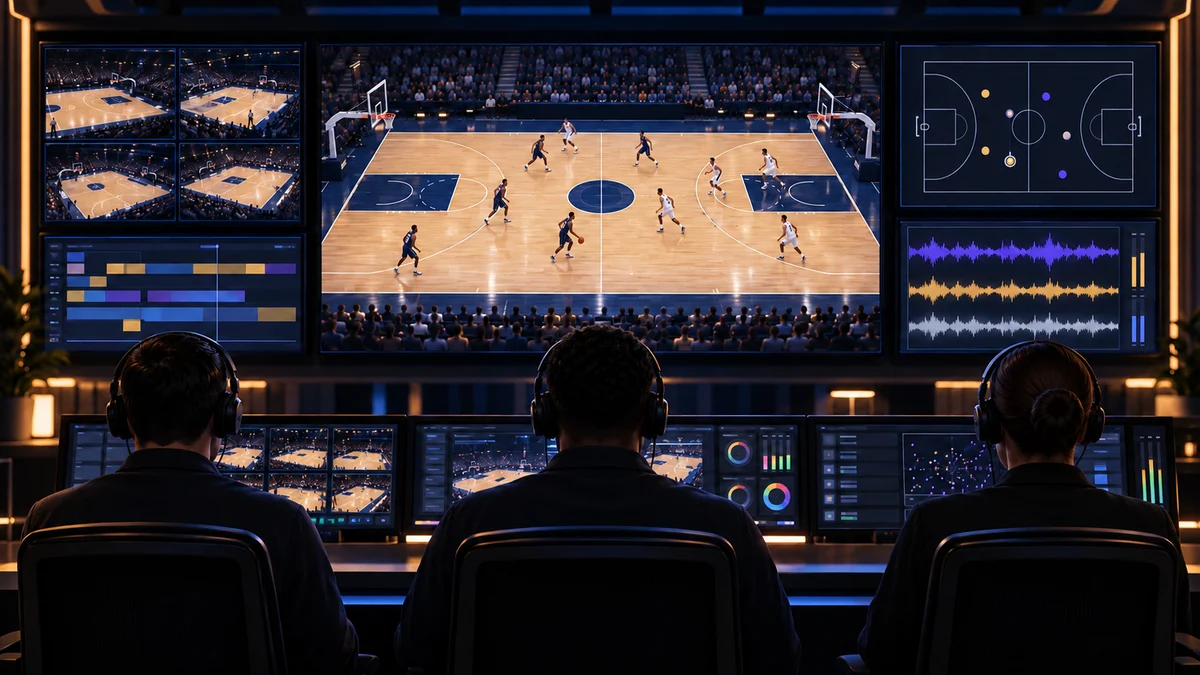
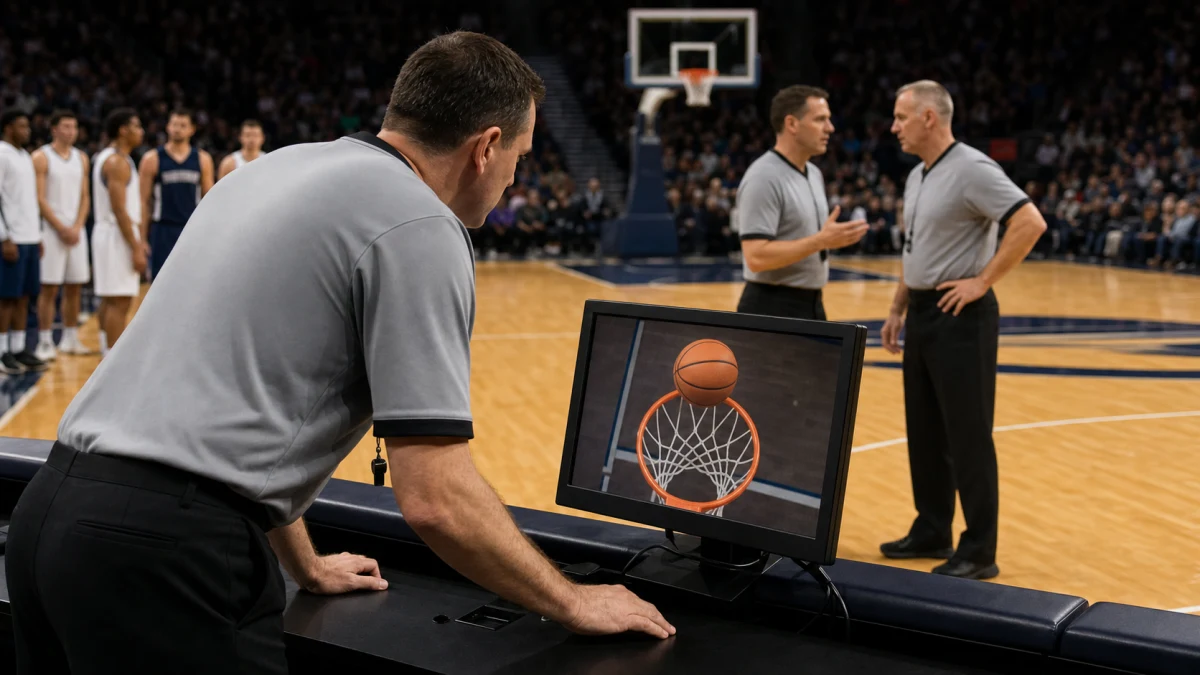
In professional basketball, the technical chain of custody is designed to maintain operational continuity even when primary systems fail. Under official league protocols, if the primary NBA replay system is not functioning properly or is completely unavailable, officials on the court will use the nearest courtside broadcast production TV monitor available to conduct their review. Furthermore, to address precise timing discrepancies, specific rules govern clock malfunctions where the game clocks start early, start late, or freeze entirely. In these specific timing scenarios, the Replay Center Official will use the digital clock located directly in the Replay Center to make the final ruling. This technical protocol ensures that critical timing decisions are resolved using dedicated, synchronized technology rather than relying solely on standard arena displays. RULE NO. 13: Instant Replay | NBA Official
In the context of automated basketball video technology, NBA replay reviews should generally be conducted within two minutes, though discretion can be used to extend this period under unusual circumstances. This protocol ensures that while most reviews are completed swiftly, complex or unprecedented situations can still be evaluated thoroughly without being cut short by an arbitrary time limit. By structuring reviews this way, the league aims to correct clear errors while minimizing the disruption to the players' rhythm and the fans' experience on the court and in the stands alike.
Official-Initiated Review Triggers
Officials cannot initiate a replay review at their own whim; instead, they must rely on highly specific, rule-defined triggers. In the NBA, instant replay will be triggered automatically for a field goal made with no time remaining on the clock (0:00) at the end of any period. This ensures that last-second shots are evaluated with greater accuracy to determine if they were released in time. Similarly, NBA instant replay is triggered when a personal or non-personal foul is called with no time remaining on the clock (0:00) at the end of any period. These automatic triggers restrict the use of replay to critical, game-defining moments, preventing unnecessary interruptions during the rest of the game and keeping the focus on active play.
Beyond end-of-period situations, officials are permitted to initiate reviews to assess the severity of physical contact and ensure player safety. Specifically, NBA officials can trigger instant replay if they are not reasonably certain whether a personal foul called at any time during a game met the criteria for a flagrant foul. This allows the officiating crew to examine the contact from multiple angles to determine if it was unnecessary or excessive. By restricting this trigger to called personal fouls where flagrant criteria are uncertain, the rules prevent referees from reviewing every standard foul, thereby preserving the flow of the game while still providing a technological safety net for high-intensity physical plays.
Coach's Challenges in the NBA
The Coach's Challenge introduces a high-stakes strategic element to professional basketball, forcing coaching staffs to carefully consider when to question an official's call. In the NBA, each team is entitled to exactly one Coach's Challenge per game, and is awarded a second Challenge if the first one is successful. This limitation makes the timing of a challenge critical. Coaches must be highly selective, reserving their challenges for pivotal moments where they are confident the call will be overturned, rather than risking their challenge on a marginal play early in the game. By restricting the number of challenges, the league balances the opportunity for teams to correct errors with the need to maintain a continuous, fast-paced game. RULE NO. 14 – Coach’s Challenge | NBA Official
To prevent coaches from challenging every whistle, the rules strictly limit the types of plays that can be reviewed. An NBA Coach's Challenge can only be utilized to trigger review of three specific events: a called personal foul charged to its own team, a called out-of-bounds violation where its own team was not awarded possession, or a called goaltending and interference violation. No other on-court events can be challenged by a coach. This narrow scope ensures that challenges are focused on objective, high-impact plays, preventing teams from using the challenge system to disrupt the game's rhythm or contest subjective judgment calls that fall outside these three categories.
FIBA's 2026 Rule Changes and the Instant Replay System
International basketball is also evolving its use of technology to ensure fair play during critical moments of competition. The new edition of the FIBA Official Basketball Rules 2026 will come into effect on October 1, 2026. These upcoming rules represent a significant update to the international game, expanding the specific situations where officials can utilize video review. By establishing a clear effective date, FIBA allows national federations, coaches, and players ample time to study and adapt to these technological adjustments before they are implemented in official tournaments worldwide. FIBA Official Basketball Rules Changes 2026 summary now available | About FIBA
According to the FIBA Official Basketball Rules Changes 2026 summary now available | About FIBA, FIBA approved rules changes for 2026 that allow the use of the Instant Replay System (IRS) to review a goaltending or basket interference violation, after a foul has been committed, at any time of the game. Furthermore, as detailed in the FIBA Official Basketball Rules Changes 2026 summary now available | About FIBA, FIBA's 2026 rules changes allow the use of the Instant Replay System (IRS) to review whether the ball was still in the hands of the thrower-in at the moment a defensive foul was committed during a throw-in situation in the last 2 minutes of the fourth quarter and in each overtime. These targeted updates address high-stakes moments in international play.
Technical and Structural Limits of Replay
Despite the advanced technology available in modern arenas, instant replay operates under strict structural and temporal limitations to preserve the integrity of the game. For example, NBA instant replay will not be used to check a successful basket at the end of a period if the throw-in, free throw attempt, or jump ball started with .2 or .1 on the game clock. Additionally, there are strict windows of reviewability for coaches. In the last two minutes of the fourth period and the last two minutes of any overtime, an NBA team can no longer use a Coach's Challenge to review a called goaltending or basket interference violation. These restrictions prevent unnecessary delays on plays where physical limits or game context make reviews impractical.
Another fundamental limit of replay is the high standard of proof required to alter any on-court decision. To overturn a challenged event in the NBA, there must be clear and conclusive visual evidence that the initial adjudication of that aspect of the play was incorrect. If the video footage is inconclusive or does not provide definitive proof, the original call on the floor must stand. This standard acknowledges that video angles can sometimes be obstructed or ambiguous, and it prevents officials from making subjective guesses based on incomplete visual data. Consequently, replay is not designed to re-referee the entire game, but rather to correct obvious, indisputable errors.
What this means for players and coaches
For players, coaches, and teams, mastering the precise rules and limits of instant replay is a vital component of game preparation, much like understanding basketball advanced stats. Under official NBA rules, if a Coach's Challenge is unsuccessful, the challenging team loses its timeout. This specific penalty forces teams to develop clear protocols for when to risk a challenge, particularly in close late-game situations where timeouts are incredibly valuable. While video technology is a powerful tool, it operates within a highly restricted legal framework on the court. Understanding these boundaries allows teams to make faster, more informed decisions under pressure, turning a complex rulebook into a strategic advantage during close games.