
The short version: A stagger screen uses two off-ball screeners set at different depths along one route so a cutter can rub off both. The cutter reads each screen fresh and can curl, come straight to the perimeter, or reject to the basket; the screeners can slip or pop; and the defense has to chase, bump, or switch. Treat it as a family of reads rather than a single play, and remember teams use their own names and rules for it.
Key takeaways
- A stagger screen is two off-ball screens set back-to-back along one route for the same cutter.
- The cutter makes a fresh read at each screen and can curl, come straight for a shot, or reject to the basket.
- The screeners have choices too, including slipping to the rim or popping to the perimeter.
- Defenses answer by chasing the cutter, bumping with the screeners' defenders, or switching, each with a trade-off.
- It is a read-based family of actions, and teams use different names, entries, and defensive rules for it.
What a stagger screen is
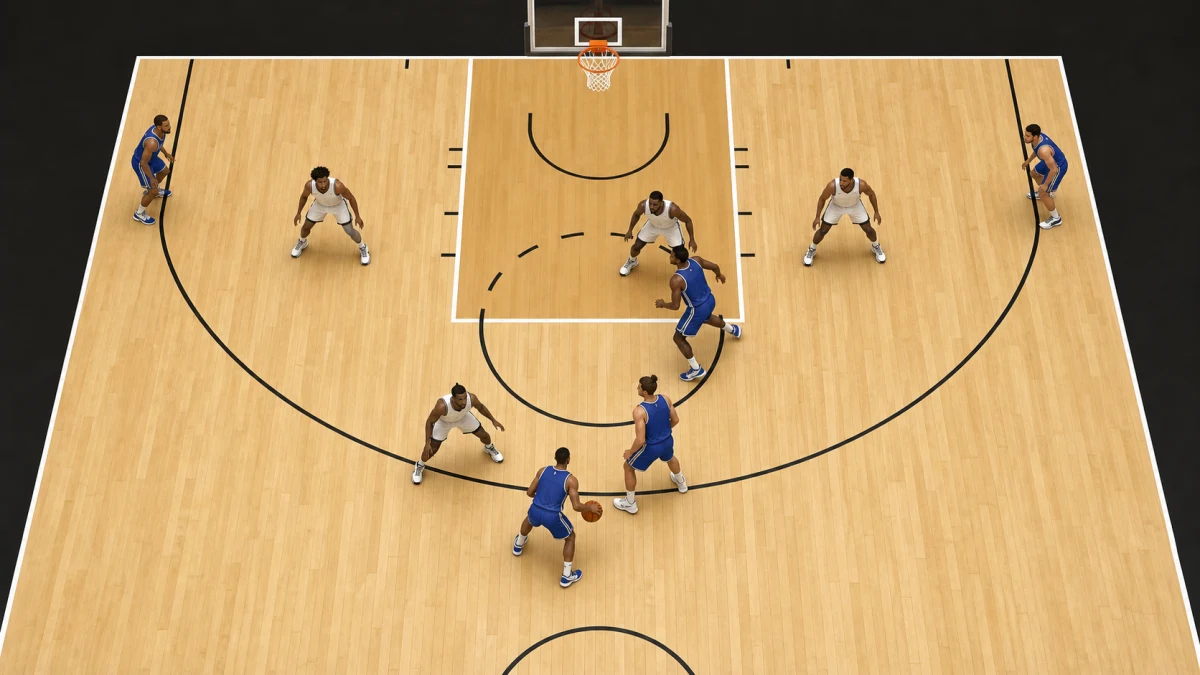
A stagger screen is an off-ball action in which two offensive players set a series of screens for the same cutter, one after the other, along the cutter's path. Instead of a single wall to run off, the cutter gets two, set at slightly different spots. The usual goal is to free a shooter or a scorer moving away from the ball, but the same structure can spring a driver or a playmaker into space. Different programs call it different things and attach their own entries and counters, so treat the name loosely and watch the movement itself. Hoop Student: Basketball Stagger Screen off-ball screens
The detail that makes a stagger different from one big double screen is depth. The two screeners are set at different depths along the same route, so the cutter changes angle as they clear the first screen and head toward the second. That forces the defender to navigate one screen and then another rather than fighting through a single point, and the small angle change between the two is where the separation is created. Elite Hoops: Every Type of Basketball Screen Explained
The cutter's reads
The cutter is not running a fixed route. The right habit is to make a fresh read at each screen, because curling the first screen does not mean the second screen has to be used. What the defender does decides the cut, and the cutter simply takes whatever the coverage gives.
- Come off straight for a shot when the defender trails and there is space at the catch, using the screens to get open on the perimeter.
- Curl to the basket when the defender chases tightly over the top, which is a natural counter when the coverage crowds the cutter.
- Reject the screens and cut back to the basket when a defender jumps early to jam the path, taking the empty space behind the action.
Because the read resets at each screen, a cutter can curl the first and still come off the second differently, or reject the whole thing if the defense overplays it. Teaching the reads rather than a single script is what makes the action hard to guard, since the defender never knows which of the choices is coming.
What the screeners are doing
The screeners are live options, not furniture. As the defense reacts to the cutter, a screener can slip to the basket while the other pops out to the perimeter, which turns one action into several threats at once. If the defenders guarding the screeners step up to help on the cutter, the slip and the pop are open almost immediately.
Personnel and order matter as well. If a post defender ends up switching onto the cutter after the second screen, it can create a mismatch the offense wants, which is why the post player is often placed as the second screener. Setting the screens at good angles and reading whether to slip, pop, or hold is the screener's version of the same fresh-read discipline the cutter uses.
How defenses guard the stagger
Defending a stagger is a team task, not a one-on-one fight, and official coaching manuals treat screening and defending screens as coordinated team skills taught across levels. The cutter's defender usually chases over the top and tries to stay attached, while the defenders guarding the screeners decide how much to help without giving up their own assignments. The whole coverage depends on communication, because two screens mean two chances to lose the cutter. FIBA World Association of Basketball Coaches (WABC) Coaching Manuals
- Chase and trail: the cutter's defender fights over both screens; it stays home on shooters but risks a curl if the defender falls behind.
- Bump and recover: a screener's defender briefly steps into the cutter's path to slow the curl, then recovers, which protects the rim but can free the slip or pop.
- Switch: passing the cutter off between defenders removes the chase, but it invites the mismatch the offense is often hunting when a post ends up on a smaller cutter.
Every answer trades one risk for another, so good defenses pick a rule and communicate it rather than improvising twice per possession. That is also why the offense reads the coverage instead of forcing a script: the correct cut is simply the one the chosen defense leaves open.
How to study and use the stagger
Treat the stagger as a read-based family of actions rather than a single play call. When you watch film, follow three things on each rep: the depth and angle of the two screens, the cut the cutter chose, and how the defense tried to cover it. Over a few clips the patterns become obvious, and you start to see why a curl beat one coverage and a reject beat another. film-study habits
The action only works with room to operate, and good spacing between players is treated as one of the most important aspects of any offense, so the stagger should be run inside a spaced floor rather than a crowd. Build it up the way any read is taught: walk through the two screens, add a live defender on the cutter, then let the screeners slip and pop against real help so the reads become instinctive. offensive spacing
Frequently asked questions
What is a stagger screen in basketball?
A stagger screen is an off-ball action in which two offensive players set a series of screens for the same cutter, one after another along the cutter's path. Instead of running off a single screen, the cutter clears two set at different depths, which forces the defender to fight through one and then the other. Teams use it mostly to free a shooter or scorer moving away from the ball, and they attach their own names and entries to it.
How does the cutter read a stagger screen?
The cutter makes a fresh read at each screen rather than running a fixed route, so curling the first does not mean the second has to be used. If the defender trails, the cutter can come straight off for a shot; if the defender chases tightly, a curl to the basket is the counter; and if a defender jumps early to jam the path, the cutter can reject the screens and cut to the rim. The coverage decides the cut.
How do defenses guard a stagger screen?
Guarding it is a coordinated team job that official coaching manuals teach alongside other screen defense. The cutter's defender usually chases over both screens, the screeners' defenders can bump the curl and recover, or the defense can switch. Each choice trades one risk for another, and switching in particular can hand the offense a mismatch, so communication is what holds the coverage together.
Why do teams put a big as the second screener?
Order is a deliberate choice. If a post defender ends up switching onto the cutter after the second screen, it creates the kind of mismatch the offense is hunting, so the post is often placed as the second screener. It also lets that screener pop or roll into space while a teammate slips, giving the action several threats at once and making the switch even more costly for the defense.