
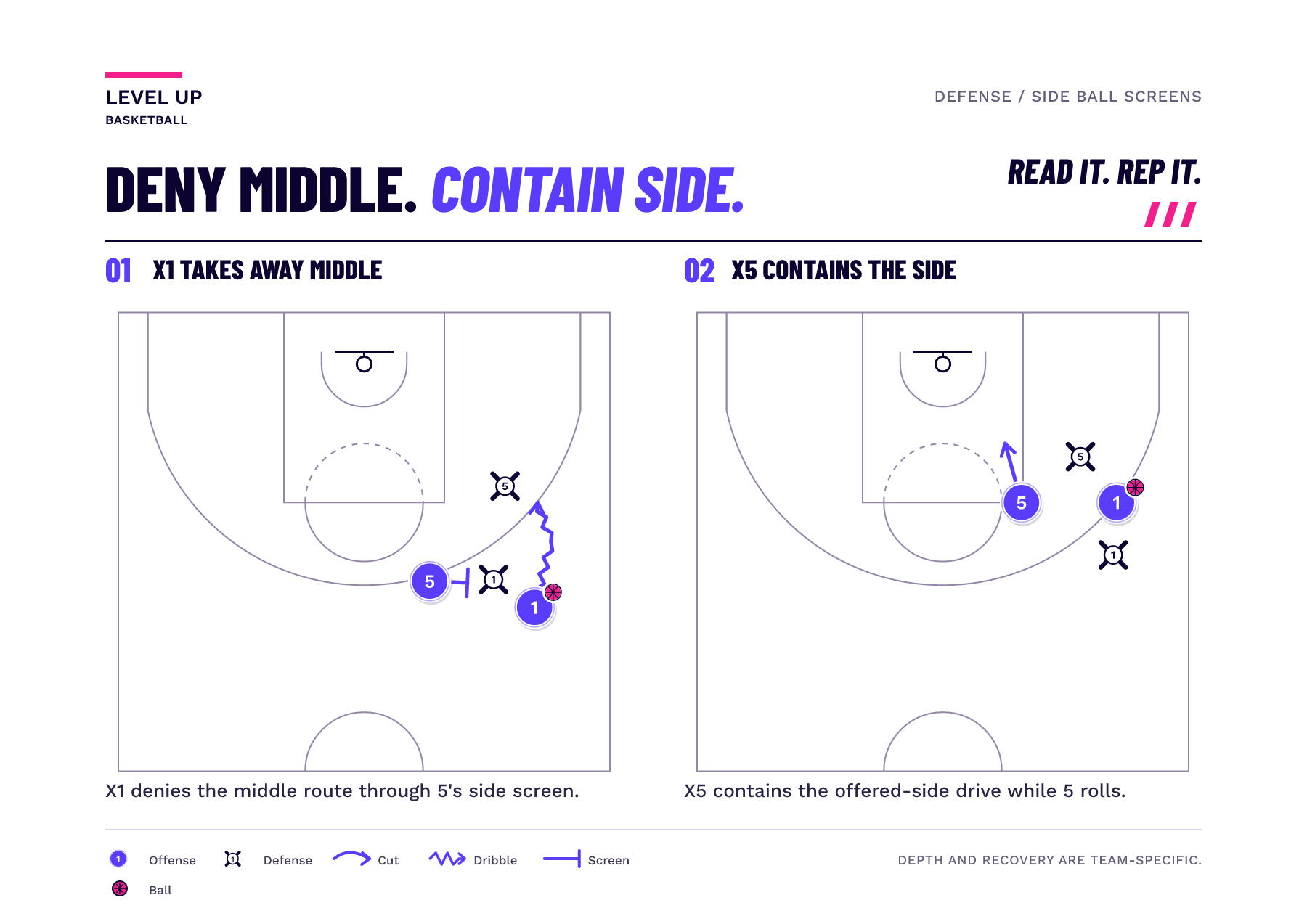
The short version: ICE is a side pick-and-roll coverage that tries to keep the ballhandler from using the screen toward the middle. The on-ball defender denies that route while the screener's defender contains the drive on the side. The rest of the defense must still account for the roll and passes. Teams may use names such as down or push, but the exact positioning and recovery rules depend on the scheme.
Key takeaways
- Identify the side ball screen first; the word ICE alone does not tell you every defender's positioning.
- The guard denies the middle route, while the screener's defender takes responsibility for containment.
- Judge the coverage before the shot result: direction, containment, passing window, then recovery.
- A flipped screen, a more central catch or a shooting screener can change the problem.
- Ask your coach for the team's exact call and adjustments instead of treating every version as identical.
ICE starts by denying one route
ICE tells the ballhandler that the middle route off a side screen should not be available. In the basic picture, the guard gets to the screen side of the ballhandler and the screener's defender is responsible for containing the drive toward the side. WABC describes this family as ICE or Push. It is a coordinated choice about where the offense is being directed, not merely a guard standing at an unusual angle. WABC Level 3 Coaches Manual — Advanced Pick and Roll NBA Film Study — Warriors' Defense in Game 3
Keep the label attached to the action. A possession beginning on the wing does not automatically involve ICE, and a defender facing sideways does not prove the call. Look for the approaching screener, the guard's relationship to that screen and the second defender's response. Our guide to pick-and-roll coverages puts this option beside the other common defensive choices. pick-and-roll coverages
Swipe sideways to explore the full diagram.
The guard's job: close the middle door
NBA film analysis describes the key guard position as getting between ballhandler and screener to deny the middle. Use that as the identifying feature, not a rule that every player must copy the same foot angle or distance.
For your own film review, freeze the play before screen contact. Can the ballhandler still dribble across the guard's front toward the screen? If the answer is yes, note that opening before judging the big defender. If the screen has not yet arrived, watch whether the guard establishes the intended position early enough for the call to have meaning. These are observation prompts, not universal grading thresholds.
Do not turn the coverage into a permission slip to stop defending. After directing the ball, the guard still needs a team-defined recovery responsibility. Ask your coach what that responsibility is when the ballhandler retreats, passes or changes direction. A one-word call cannot replace those shared instructions. NBA Power Rankings Notebook — Defensive changes
The screener's defender: contain, then solve the next problem
The second defender makes the direction useful. If the guard sends the ball toward the side while nobody is prepared to contain it, the defense has offered space rather than created a working coverage. The precise depth depends on the team's plan and the players involved; ICE does not supply a universal distance from the screen.
A useful review frame shows the ball, the screener and both defenders at once. Pause when the ballhandler takes the offered route. Note who is closest to the drive, where the screener moves and which pass becomes available. Then let the clip run. Do the defenders complete the responsibility they appeared to be exchanging, or do both follow the same threat?
Treat those notes as questions for the team, not verdicts from a still image. A teammate may be expected to cover a passing lane outside the crop. Before calling an individual late or out of position, establish what the entire group was trying to do.
The other players change the coverage
NBA's analysis of pick-and-roll defense distinguishes containing the drive from helping at the nail. That help can leave another offensive player open. Include the off-ball defenders when you examine the coverage, rather than looking only at the first two players.
When you review a possession, draw in the off-ball players instead of leaving them outside the story. Is there someone in the nearby corner? Is the screener rolling into occupied space or into a clear lane? Which receiver is the ballhandler looking at? Record what is visible and leave the unseen assignment as a question. Our offensive-spacing explainer is useful background for reading that wider picture. offensive-spacing explainer
This also explains why two possessions with the same coverage can demand different decisions. Compare the locations of the other players before assuming the defenders executed inconsistently. A useful comparison holds the action and spacing in view, rather than treating the final shot as the only evidence.
How an offense can change the problem
There are several distinct adjustments: a shooting screener can become a passing option; the catch can move nearer the middle; or the offense can flip or reject the screen. NBA film studies discuss those responses. None guarantees a scoring chance. NBA Film Study — Sixers-Hawks Game 7 NBA Film Study — Actions to Watch in the 2023 Playoffs
WABC also identifies a step-up or flat-screen angle as a response when the defense is pushing the ball toward the side. Focus on what changes geometrically: the screen may no longer present the same route that the guard was denying. The defense needs an answer to the new picture, not just a louder repetition of the original call.
For an original comparison exercise, watch a possession twice. On the first pass, describe the initial route in ordinary words: toward the middle or toward the side. On the second, identify the first event that changes the picture. It might be a new screen angle, a different catch location or a screener moving into space. Write down that event before reviewing the shot. This keeps your explanation tied to what you actually saw.
A practical four-frame review
Use four checkpoints: before the screen, as the ball takes a direction, when a pass or drive becomes available, and after the defense recovers. At each checkpoint, write one observation and one unresolved question. For example: the guard is between ball and screener; who is assigned to the rolling player? The purpose is to make the team's explanation easier to follow, not to produce a score for defensive quality.
If you take the concept to the court, agree on the call and responsibilities with your coach before adding speed. Begin with a walk-through of the positions and ask what changes when the screen changes. Keep a tactics explanation separate from your individual skill practice; understanding a label is not proof that a player can execute every version of the coverage.
Frequently asked questions
Are ICE and Push always the same coverage?
WABC uses ICE or Push for a defense directing the dribbler toward the side while the screen defender contains penetration. Do not assume that a label supplies every assignment. Ask your coach what the call means for each defender and the next action.
Does ICE mean giving up the baseline?
No. It directs the ball away from the middle while assigning a defender to contain the offered route. If you see the ballhandler travel along the side, check that second defender's responsibility before deciding whether the intended coverage worked.
Is a made shot proof that ICE failed?
No single result explains the whole possession. Review whether the defense established its intended direction, contained the drive and handled the next action. A team can execute a plan and still concede a shot; judging that plan requires the team context.
Was this useful?