
The short version: FIBA assesses named movement and load metrics in basketball-specific test protocols. NIST distinguishes accuracy measures and calls for explicit uncertainty.
Key takeaways
- FIBA’s protocols replicated basketball-specific movements and game actions.
- FIBA listed positional accuracy, speed, acceleration and deceleration, jump height, and load index.
- FIBA’s Level 1 catalogue lists wearable and optical tracking solutions.
- NIST distinguishes benchmark accuracy from generalized accuracy.
- NIST says uncertainty depends on the stated accuracy estimand and evaluation method.
How does FIBA document basketball tracking test events?
FIBA has launched an Approval Program for Tracking Solutions through the FIBA Equipment & Venue Centre. FIBA says the program is intended to drive innovation and ensure safety and consistency across basketball. The Centre manages FIBA Approval, which provides technology providers a pathway to demonstrate that their solutions meet FIBA requirements for use in basketball. FIBA also describes the Centre as a global platform for testing and innovation related to basketball equipment and software. FIBA launches Approval Program for Player Tracking Solutions and holds inaugural test event | About FIBA FIBA takes next step in Tracking Solutions approval process ahead of Women's World Cup in Berlin | About FIBA Technology industry leaders join FIBA Equipment & Venue Centre's Approved Software program | About FIBA
FIBA held its first Tracking Solutions Test Event in Leiria, Portugal, at the Pavilhao do Lis. FIBA reports that its 2026 test event ran from June 3 through June 5 at the Maverik Center in Salt Lake City, USA, home of the Salt Lake City Stars, the NBA G League affiliate of the Utah Jazz. FIBA says five systems across four companies were assessed during that three-day event.
FIBA says it concluded its second Tracking Solutions test event to expand the range of approved solutions available to national teams at the FIBA Women’s Basketball World Cup 2026 in Berlin. FIBA also stated that the September 2026 showpiece event in Germany would be the first major FIBA tournament to feature the technology after an update to the FIBA Internal Regulations.
Which technologies and protocol scope does FIBA name?
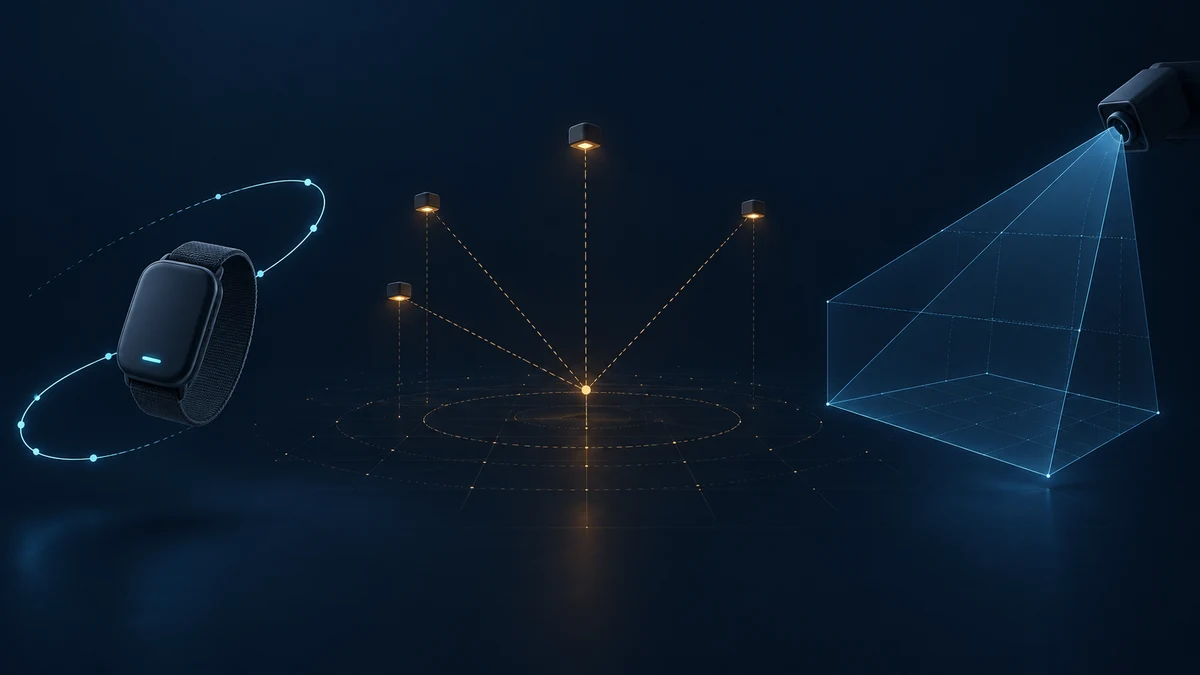
At FIBA’s test event, the evaluated tracking solutions included inertial measurement units, local positioning systems, and optical tracking technologies. FIBA says its testing protocols replicated basketball-specific movements and game actions while assessing a range of key performance metrics. The record identifies the technology categories and the stated movement-and-action scope of the protocols.
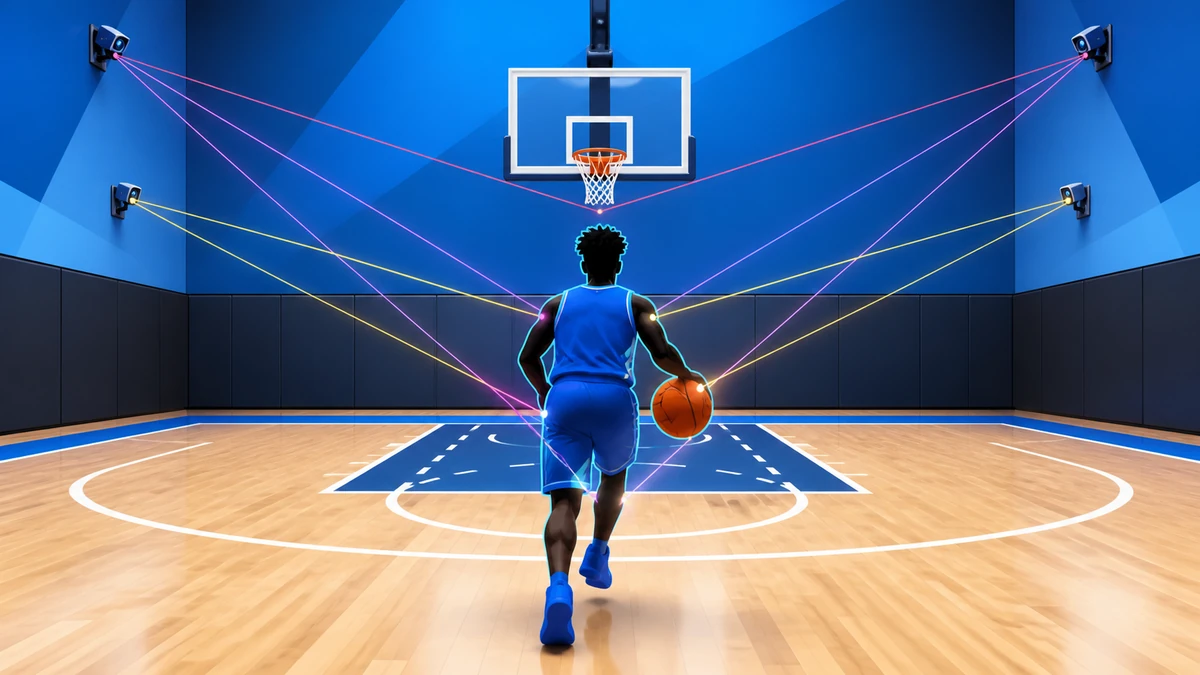
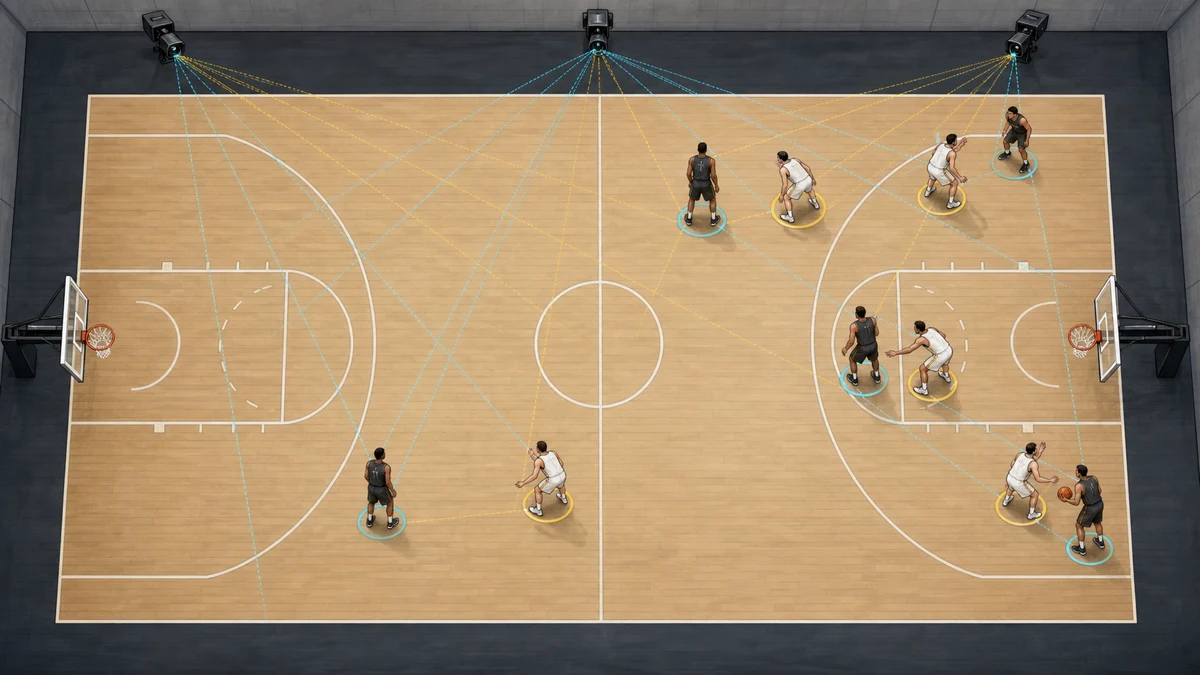
The FIBA record describes tracking solutions as wearable devices worn by players and camera-based optical solutions installed around the court. FIBA says the solutions capture player-movement data for insights including player positioning, speed, movement intensity, jumping activity, and overall physical load. The two forms of solution described in the record are player-worn devices and camera-based optical systems around the court. player-movement data
FIBA also announced that it would facilitate an Automated Video Solutions test event later in 2026. FIBA said that event would assess camera-based systems that support automated game recording, production, and analysis. camera-based systems
Which measurement categories and wearable conditions does FIBA list?
| FIBA inaugural Tracking Solutions Test Event: measurement category | Term listed by FIBA |
|---|---|
| FIBA inaugural test event — Position | FIBA — Positional accuracy |
| FIBA inaugural test event — Speed | FIBA — Speed |
| FIBA inaugural test event — Change of pace | FIBA — Acceleration and deceleration patterns |
| FIBA inaugural test event — Jumping | FIBA — Jump height |
| FIBA inaugural test event — Load | FIBA — Load index |
FIBA said that, following the test event, Sports Labs would carry out a laboratory-based safety assessment of wearable devices. FIBA said the assessment would focus on device size, shape, weight, and performance under impact. This safety assessment is described separately from the listed movement and performance metrics. wearable devices
Under the updated Book 2, Competitions, Article 86 regulation, FIBA says FIBA Approved wearable tracking solutions may be used in FIBA competitions when they are worn safely in the specified mounting position. FIBA’s statement conditions competition use on that specified mounting position and safe wear.
Which named tracking solutions does FIBA list for Level 1?
| FIBA catalogue provider | Solution | Category | Licence and competition level |
|---|---|---|---|
| FIBA catalogue: Catapult Sports Ltd | Vector T7 (ClearSky LPS) | Wearable category 1 | TS-221-01; Level 1 |
| FIBA catalogue: Genius Sports | Genius IQ Positional Tracking System (Live/Post-match) | Optical | TS-008-01; Level 1 |
| FIBA catalogue: Genius Sports | Genius IQ Skeletal Tracking System (Live/Post-match) | Optical | TS-008-02; Level 1 |
| FIBA catalogue: Hudl, Inc. | Titan 3 | Wearable category 1 | TS-228-01; Level 1 |
| FIBA catalogue: KINEXON Sports | KINEXON PERFORM LPS | Wearable category 1 | TS-208-01; Level 1 |
| FIBA catalogue: KINEXON Sports | KINEXON PERFORM IMU | Wearable category 2 | TS-208-02; Level 1 |
| FIBA catalogue: Genius Sports | Genius IQ Auto-Eventing Solution | Optical | TS-008-03; Level 1 |
| FIBA catalogue: Genius Sports | Genius IQ Live Augmentation | Optical | TS-008-04; Level 1 |
Tracking Solutions - FIBA Equipment & Venue Centre | About FIBA
How does NIST define accuracy measures and uncertainty?
NIST AI 800-3 formally defines two distinct measures of performance: benchmark accuracy and generalized accuracy. NIST presents these as separate measures corresponding to separate evaluation questions. The terminology is part of NIST’s evaluation framework, rather than a FIBA basketball-tracking test result. New Report: Expanding the AI Evaluation Toolbox with Statistical Models | NIST
NIST says there is no one-size-fits-all formula for quantifying performance in an evaluation. It says an evaluator must determine the method used to compute performance statistics and describe uncertainty on the basis of evaluation goals and benchmark data. NIST also says that explicitly defining the selected accuracy measure permits clearer articulation of results and uncertainty, and that different accuracy estimands require different estimation methods to quantify uncertainty properly.
NIST says evaluators often estimate accuracy with regression-free methods, particularly by calculating accuracy as the grand mean of question scores. In its discussion of LLM performance, NIST says generalized linear mixed models can, in many cases, quantify measurement uncertainty more precisely than some current techniques. NIST says GLMMs can produce explanatory statistics about benchmark composition and performance, including latent capability measures and benchmark-question difficulties. It also says GLMMs rely on more assumptions about benchmark data than regression-free methods, while providing some means of checking those assumptions.
How should published provider and program statements be attributed?
FIBA says its Approved Software program, launched in 2021, aims to connect approved software with stakeholders throughout the FIBA Family. FIBA identifies those stakeholders as players, coaches, team managers, referees and officials, competition organizers, and National Federations. The program concerns approved software across that stated stakeholder group.
FIBA says Second Spectrum provides tracking solutions through advanced machine learning and computer vision to capture basketball metrics such as player speeds, distances, and defensive impact. FIBA says KINEXON data solutions offer advanced performance analytics to uncover specific insights and turn data into trackable, tangible actions on and off the court. FIBA also says Sportzcast’s data technology captures and distributes live scoreboard data in real time.
According to Providing Basketball Analytics for FIBA | KINEXON SPORTS, its player-tracking technology calculates athletes’ metrics for performance profiling and loads. The same source says live data and metrics can be visualized on its basketball analytics platform, which is compatible with most devices and computers and offers metrics tailored to individual needs. Providing Basketball Analytics for FIBA | KINEXON SPORTS
KINEXON Sports and the Paris-based data company SkillCorner say they have a strategic partnership to launch a next-generation performance analytics product for NCAA basketball programs. KINEXON Sports also says its PERFORM LPS solution will provide real-time data to support Unrivaled and its coaches with analytical insights.
Frequently asked questions
Which movements and metrics did FIBA test?
FIBA says its protocols replicated basketball-specific movements and game actions. The organization lists positional accuracy, speed, acceleration and deceleration patterns, jump height, and load index among the key performance metrics assessed. FIBA also says the evaluated solutions included inertial measurement units, local positioning systems, and optical tracking technologies.
Can approved wearables be used in FIBA competitions?
FIBA says FIBA Approved wearable tracking solutions may be used under Book 2, Competitions, Article 86, when they are worn safely in the specified mounting position. In the approval work following the test event, FIBA said Sports Labs would assess wearable-device size, shape, weight, and performance under impact.
What are NIST’s two accuracy measures?
NIST AI 800-3 defines benchmark accuracy and generalized accuracy as distinct measures of performance. NIST says an evaluator should explicitly define the measure used so results and uncertainty can be articulated clearly. It also says different accuracy estimands require different estimation methods for proper uncertainty quantification.
What does a Level 1 catalogue listing identify?
FIBA’s public Tracking Solutions catalogue identifies Catapult Sports Ltd’s Vector T7 (ClearSky LPS) as a wearable category 1 solution licensed under TS-221-01 for Level 1 competition. Its entry states the provider, product, category, licence, and competition level.
Frequently asked questions
Which movements and metrics did FIBA test?
FIBA says its protocols replicated basketball-specific movements and game actions. The organization lists positional accuracy, speed, acceleration and deceleration patterns, jump height, and load index among the key performance metrics assessed. FIBA also says the evaluated solutions included inertial measurement units, local positioning systems, and optical tracking technologies.
Can approved wearables be used in FIBA competitions?
FIBA says FIBA Approved wearable tracking solutions may be used under Book 2, Competitions, Article 86, when they are worn safely in the specified mounting position. In the approval work following the test event, FIBA said Sports Labs would assess wearable-device size, shape, weight, and performance under impact.
What are NIST’s two accuracy measures?
NIST AI 800-3 defines benchmark accuracy and generalized accuracy as distinct measures of performance. NIST says an evaluator should explicitly define the measure used so results and uncertainty can be articulated clearly. It also says different accuracy estimands require different estimation methods for proper uncertainty quantification.
What does a Level 1 catalogue listing identify?
FIBA’s public Tracking Solutions catalogue identifies Catapult Sports Ltd’s Vector T7 (ClearSky LPS) as a wearable category 1 solution licensed under TS-221-01 for Level 1 competition. Its entry states the provider, product, category, licence, and competition level.