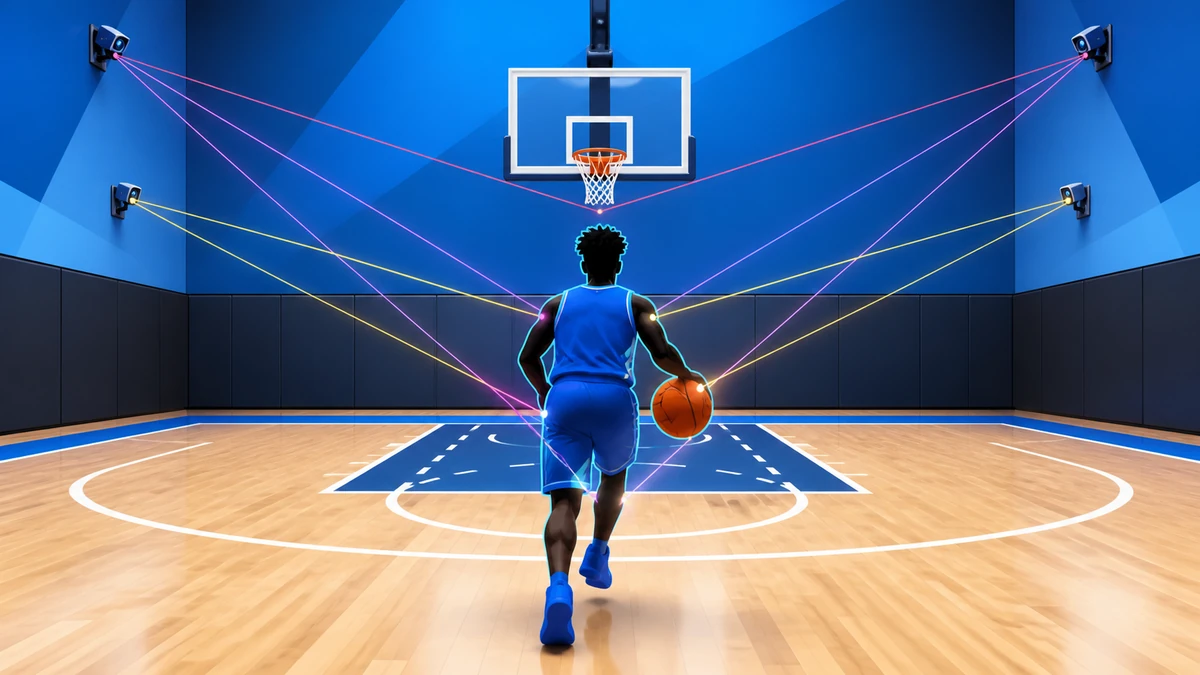

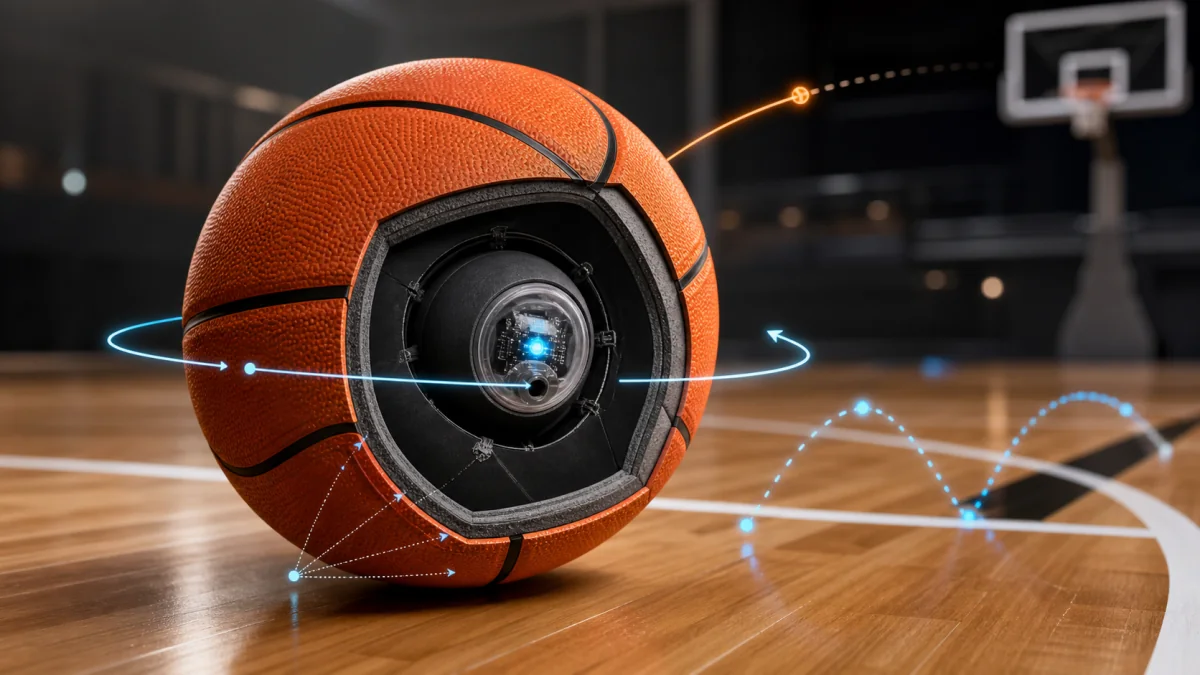
The short version: While manufacturers market 'AI-powered coaching,' a smart basketball is fundamentally a highly calibrated physics package. Its value lies not in magic coaching advice, but in its ability to capture raw inertial data (spin, launch angle, and velocity) through an invisible in-valve sensor without compromising the physical integrity and feel of a standard game ball.
Key takeaways
- In-Valve Integration: Modern smart balls hide micro-sensors inside the air valve to preserve the ball's official weight, balance, and bounce.
- Physics Over Magic: Sensors measure raw inertial data (spin rate, launch angle, and velocity) rather than subjective "mechanics."
- The Measurement Chain: Data is captured by Inertial Measurement Units (IMUs) and sent via Bluetooth to your phone, which processes the algorithms.
- Key Limitations: These balls cannot track court position on their own and have a finite lifespan due to non-replaceable batteries.
The Physics of the Bounce: How Smart Balls Actually Measure Data
For years, the sports technology market has promised "smart" coaching through connected devices. However, a smart basketball is not a sentient coach; it is a highly calibrated physics package. The magic happens inside the bladder of the ball, specifically integrated into the inflation valve. By placing the sensor inside the valve, manufacturers can introduce tracking technology without altering the structural integrity of the ball.
The core of this technology relies on an Inertial Measurement Unit (IMU). This tiny chip contains micro-accelerometers and gyroscopes. When you dribble, pass, or shoot, the IMU detects changes in linear acceleration and angular velocity across multiple axes. This raw inertial data is then transmitted via Bluetooth to a connected smartphone or tablet, where proprietary algorithms translate the electrical signals into recognizable basketball metrics.
To understand what these sensors can do, it helps to look at the global standards. Organizations like FIBA's Equipment & Venue Centre set global quality standards for basketball equipment, including balls, data, tracking, and automated video technologies. As technology has advanced, FIBA's digital catalogue has categorized its quality program into 18 hardware and seven software product categories, paving the way for standardized testing of connected sports equipment.
The Spalding and SportIQ Integration
A major milestone in this space is the launch of the premium Spalding Smart Basketball, built on the iconic TF-1000 indoor game ball platform. The TF-1000 is a legendary name in basketball; according to Spalding, the TF-1000 platform is used in approximately 40% of competitive basketball games in the United States and serves as the official high school game ball in 19 states.
This new ball is powered by SportIQ's patented in-valve sensor technology. The integration is designed to be invisible. The Spalding Smart Basketball tracks shots using an invisible sensor integrated directly into the ball, preserving the authentic bounce, weight, and feel players expect from a premium indoor basketball. This development follows SportIQ's selection for the NBA Launchpad accelerator program in 2025, where its technology has been explored for future use cases related to officiating, analytics, and fan engagement.
What a Smart Basketball Can (and Cannot) Measure
When evaluating a smart basketball, it is vital to separate verified sensor capabilities from manufacturer marketing. Let's break down what the sensors actually measure versus what the software infers.
1. Shot Arc and Launch Angle
The sensor measures the precise angle at which the ball leaves your hand. Research indicates that the ideal shot arc for a basketball is between 45 and 55 degrees. If your launch angle is too flat, the entry angle into the hoop suffers; shots with an entry angle below 40 degrees are statistically more likely to rim out. Smart basketballs, along with wearable sensors and camera-based apps, track shot arc in real time to help players find their optimal trajectory.
2. Spin Rate (Backspin)
Gyroscopes inside the IMU measure the rotational speed of the ball in revolutions per minute (RPM). Proper backspin stabilizes the ball in flight and creates a "soft" touch off the rim, increasing the chance of a friendly bounce.
3. Release Velocity and Quickness
By measuring the rapid acceleration of the ball during the shooting motion, the sensor can calculate how quickly the ball leaves your hand (release time) and the initial velocity of the shot.
However, there are clear limits to what a ball-only sensor can do. It cannot see your body. While SportIQ claims its connected app analyzes shooting data in real time to provide feedback on shot arc, release angle, consistency, and mechanics, the ball itself cannot actually see your elbow alignment, knee bend, or footwork. Any feedback on "mechanics" is an algorithmic inference based on how the ball rotates and accelerates, not direct observation of your body.
How the Ball Distinguishes a Pass, Dribble, and Shot
A common question from players and coaches is: How does the ball know I shot instead of just passing or dribbling?
The answer lies in signature acceleration profiles. Each basketball action has a distinct physical "fingerprint" that the IMU detects:
- A Dribble: Features a rapid downward acceleration, a sudden high-G impact (hitting the floor), and a rapid upward rebound.
- A Pass: Features a strong horizontal acceleration followed by a period of relatively low-G flight, ending in a sudden catch impact.
- A Shot: Features a smooth upward acceleration, a high-spin release, and a long, parabolic flight path (zero-G or freefall state) before hitting the rim, backboard, or net.
The mobile app's software uses machine learning models trained on millions of historical actions to categorize these events in real time. For instance, SportIQ claims its technology has tracked more than 40 million basketball shots globally, providing a massive dataset to refine these recognition algorithms.
Comparing Smart Balls, Wearables, and Camera Apps
If you are looking to invest in shooting technology, you have three main options: smart basketballs, wearable wrist sensors, and camera-based mobile apps. Here is how they compare:
| Technology Type | Key Metrics Captured | Primary Limitation | Best For |
|---|---|---|---|
| Smart Basketball (e.g., Spalding Smart Ball) | Precise ball spin (RPM), launch angle, release velocity, dribble intensity. | No spatial tracking (cannot tell where on the court you shot from without a phone camera). | Serious shooters looking for exact ball-rotation and flight physics. |
| Wearable Sensors (e.g., wristbands) | Release angle, arc height, and follow-through. | Cannot measure actual ball spin or ball-handling metrics. | Players focusing purely on their physical arm mechanics and follow-through. |
| Camera-Based Apps (e.g., HomeCourt) | Shot location mapping, make/miss detection, release time, shot arc. | Requires a tripod, clear lighting, and cannot measure precise ball spin (RPM). | Players who want automated shot charts and spatial tracking without buying new hardware. |
What This Means for Players, Parents, and Coaches
Before buying a smart basketball, it is important to understand the practical realities of owning and training with one. These devices are highly specialized tools, and they come with specific limitations:
- Battery Life and Lifespan: Because the sensor is sealed inside the ball to maintain balance, the battery cannot be replaced or plugged in. Instead, smart balls use "wake-on-shake" or "wake-on-spin" mechanisms to save power. Once the internal battery dies (typically after a specified number of hours of active use or a couple of years of storage), the ball becomes a standard basketball.
- Indoor vs. Outdoor Durability: Premium smart balls like the Spalding TF-1000 smart ball are made of high-end composite leather designed strictly for indoor hardwood. Using them on concrete or asphalt will quickly ruin the outer cover and can damage the internal sensor package over time.
- No Spatial Tracking Alone: A smart ball does not have GPS or local positioning. It knows how it was shot, but not where. To get a complete shot chart showing your hot spots on the floor, you must pair the ball with its companion mobile app, which uses your phone's camera to track your physical location on the court.
- Make/Miss Detection: While the ball's algorithms can estimate a make or miss based on the vibration profile of hitting the net versus hitting the rim, absolute accuracy usually requires the phone's camera to visually confirm whether the ball went through the hoop.
The Bottom Line: Is It Worth It?
If you are a parent or coach looking for a magic tool that will instantly fix a player's shot, a smart basketball is not a shortcut. However, if you are a dedicated player looking to build a highly consistent, repeatable release, the real-time feedback on spin rate and launch angle is incredibly valuable. By focusing on the raw physics of the ball rather than marketing hype, you can use these connected sensors to build the perfect, high-arc shot that translates directly to game-day success.