

The short version: A switch exchanges two defensive assignments. Check the switching agreement and early call, follow both defenders through the exchange, then review the new matchups, help decisions and rebound. Describe the observable breakdown before calling a switch lazy.
Key takeaways
- Judge both new assignments; following only the ball can hide the missed exchange.
- Separate a late call, an execution gap and a difficult mismatch so the correction fits the problem.
- Evaluate help against the team's stated agreement and continue review through the rebound.
Start with the two assignments
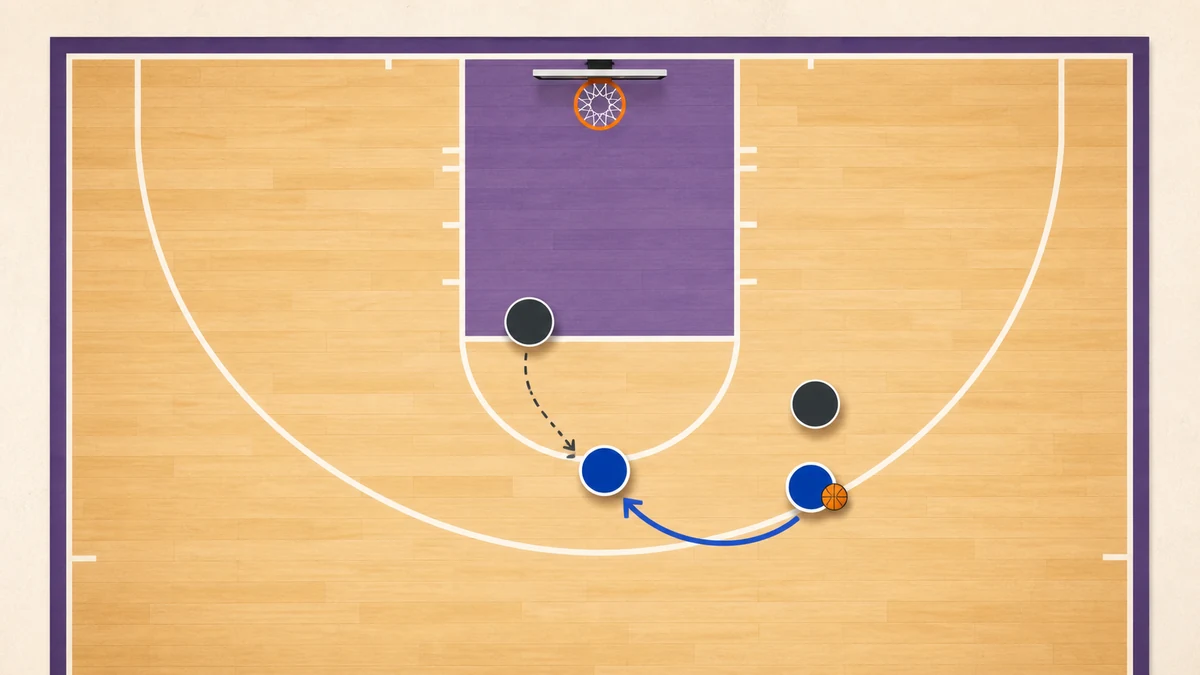
A switch means two defenders exchange responsibility for their offensive players. To evaluate it, follow both assignments: who takes the player using the screen, and who takes the screener? A useful film review starts before the exchange and continues through the shot and rebound. The final make or miss alone does not tell you whether the assignments were handled well. WABC Coaching Level Manuals Level 1 English
First establish the team's switching agreement. The WABC manual describes switching as most common between similar offensive players, while noting that teams may switch all screens late in the shot clock. Selective switching limits which exchanges are allowed. For example, a hypothetical team calling “one through four” should define exactly which players that includes and what happens when the fifth defender is involved. Switching every screen is a broader agreement, not permission to stop checking assignments.
Before and during: connect the call to the exchange
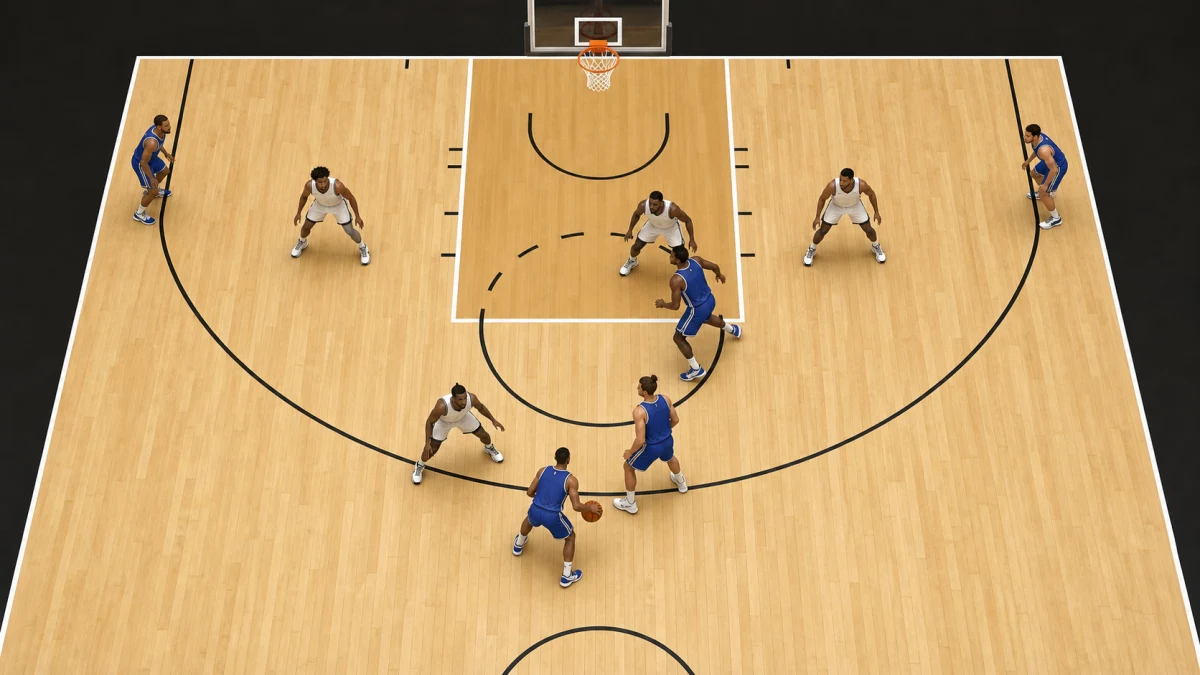
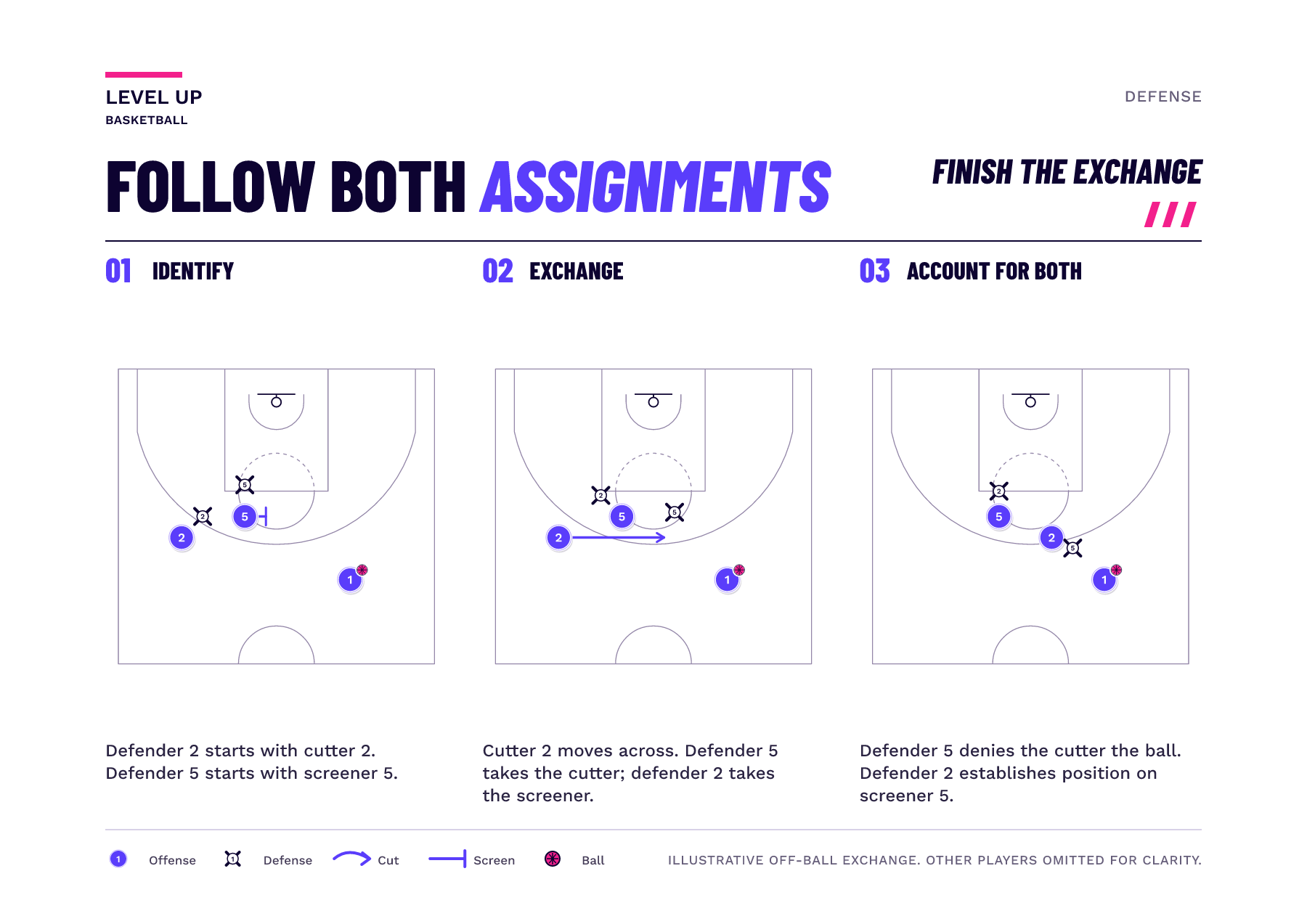
The communication standard is early and loud, before the screen occurs. Useful calls include “switch,” “stay,” “ball” and a direction such as “switch left.” Agree on their meanings in practice. Then watch whether the movement matches the call. Coaches Clipboard emphasizes a tight exchange, maintaining contact with the offensive players, avoiding gaps and staying in a defensive stance afterward. That does not establish a universal requirement for the defenders to touch each other. In the WABC off-ball example, the screener's original defender moves aggressively to deny the cutter the ball; the cutter's original defender moves quickly into position to defend the screener. Basketball Switching Defense
Swipe sideways to explore the full diagram.
Afterward: account for mismatches, help and the rebound
After the exchange, treat the assignment as a new matchup. Ask what the offensive player can threaten from that position, rather than mentally waiting to recover the original opponent. Coaches Clipboard emphasizes helpside support when mismatches occur and switching back at the earliest opportunity. For review, distinguish a mismatch from an unguarded player: a smaller defender assigned to a post player presents a different problem from two defenders following the ball while the screener is free.
One mismatch-management term is a scram switch. Coaches Clipboard describes an occasional professional-level exchange in which an adjacent defensive post takes over a big post player from a guard while the entry pass is in the air, and the guard moves out. Treat that description as a specific coordinated action, not a general instruction to abandon a difficult matchup. When discussing it on film, identify the incoming defender, the outgoing defender and the assignment that still needs coverage.
For the other defenders, write down the team's actual help agreement before assigning blame. Who is responsible for helping on the drive or post catch? Which offensive player would that helper leave, and who accounts for that player? The switch itself does not answer those questions. Continue the clip through the rebound and ask players to name their responsibilities under the team's rebounding plan. This makes the review about the whole possession, rather than only the two defenders nearest the screen.
Review the decision before judging the result
- Agreement: Was this screen supposed to trigger a switch under our plan?
- Communication: Was the call loud and early, before the screen, and did both defenders act on the same message?
- Starting picture: Before the exchange, can each defender name both offensive players and the new assignment?
- Cutter responsibility: In an off-ball switch, did the screener's original defender move to deny the cutter the ball?
- Screener responsibility: Did the other defender quickly establish position to guard the screener?
- Exchange quality: Where did a gap appear, and did either defender rise out of the defensive stance or relax after switching?
- New matchup: Did each defender take responsibility for the new opponent?
- Help: Under our plan, who was available to help, and what assignment would that help expose?
- Mismatch decision: If we attempted another exchange, can we identify every resulting assignment and the moment one became unclear?
- Finish: At the shot, did each defender know the rebounding responsibility, and who ultimately secured possession?
Replace “lazy switch” with a description you can act on: “The call came after the screen,” “Both defenders followed the cutter,” or “We stopped tracking the screener.” These are hypothetical review statements, not diagnoses of a particular player. Pause before the problem, let the players explain their assignments, then replay through the finish. Without usable audio, mark communication as unknown rather than deciding that nobody called.
Take one review question back to practice
As an adaptable coaching exercise, choose one film moment and recreate its starting assignments in a two-on-two walkthrough. Ask each defender to name the original opponent and the intended new opponent before rehearsing the exchange. Then discuss the same picture with the rest of the defense: where would each player be, what help does the team expect, and what happens when a shot goes up? Keep the practice question tied to the specific breakdown you observed.
Was this useful?