
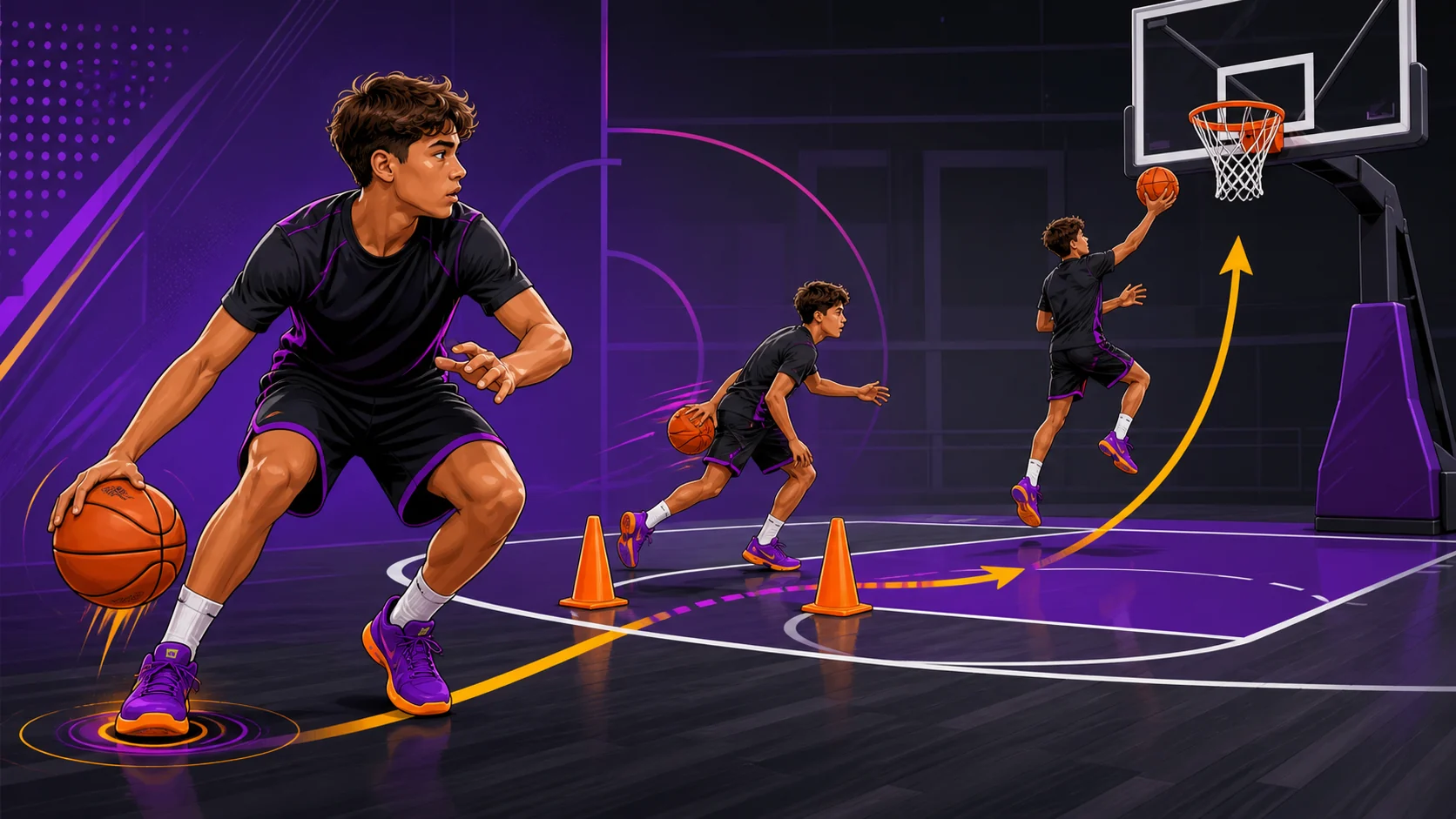
The short version: Train your weak hand in a sequence: control the ball first, then move with it, then pass and finish from it, then use it against a defender. Keep the dominant hand in the session too. The goal is not a magic number of dribbles or a promise of ambidexterity. The goal is a repeatable decision: see space, protect the ball, and use the off hand when the game asks for it.
Key takeaways
- Weak-hand work transfers best when it progresses from control to movement to a basketball decision.
- Stationary work is a useful starting point, but it is not the finish line.
- Use the same skill in more than one context: dribble, pass, finish, and escape pressure.
- Track observable outcomes such as body position, ball security, passing target, finishing choice, and decision quality.
- Keep the dominant hand active so the off hand becomes an option inside a complete game, not an isolated trick.
What does a useful weak hand look like?
A useful weak hand is not merely the hand that can bounce a ball in place. It is the hand you can trust when a defender takes away the first side, when a closeout sends you left, or when the finish needs to come from the far side of the rim. That trust is built from several connected skills: controlling the dribble at different heights, keeping the body between the ball and pressure, changing pace, delivering a pass on time, and finishing without needing a last-second switch back to the preferred hand.
USA Basketball frames development around mastery rather than a player's age alone, and separates ball handling and dribbling, passing and receiving, shooting, footwork and body control, and team concepts into distinct skill areas. That is a useful way to plan weak-hand work: the hand is not one isolated category. It has to appear in several parts of the game. USA Basketball Player Development Curriculum Ball-handling drills
Start with control, but give it a purpose
Begin in an athletic stance with the ball on the weak-hand side. Use low, middle, and higher dribble heights so the hand learns to adjust without the torso rising out of position. Add simple hand changes only when the ball stays inside the player's frame and the eyes can leave the ball. The purpose is not to collect rep counts. It is to establish a controllable starting position before movement makes the task harder.
One useful check is simple: can the player keep the ball on the weak-hand side while changing height, changing stance, and looking at a target in front of them? If the answer is no, make the task easier. Shorten the work period, reduce the speed, or remove a change of direction. If the answer is yes, add a meaningful variable rather than just more volume: a visual cue, a cone gate, a partner's hand, or a target pass.
The Jr. NBA's starter practice plans use low, middle, and high stationary crossovers and suggest adding one, two, or three dribbles as players improve. That is a sound progression idea: change one constraint at a time so the player can tell what caused the ball to escape. Jr. NBA Starter Practice Plans
Move the weak hand into space
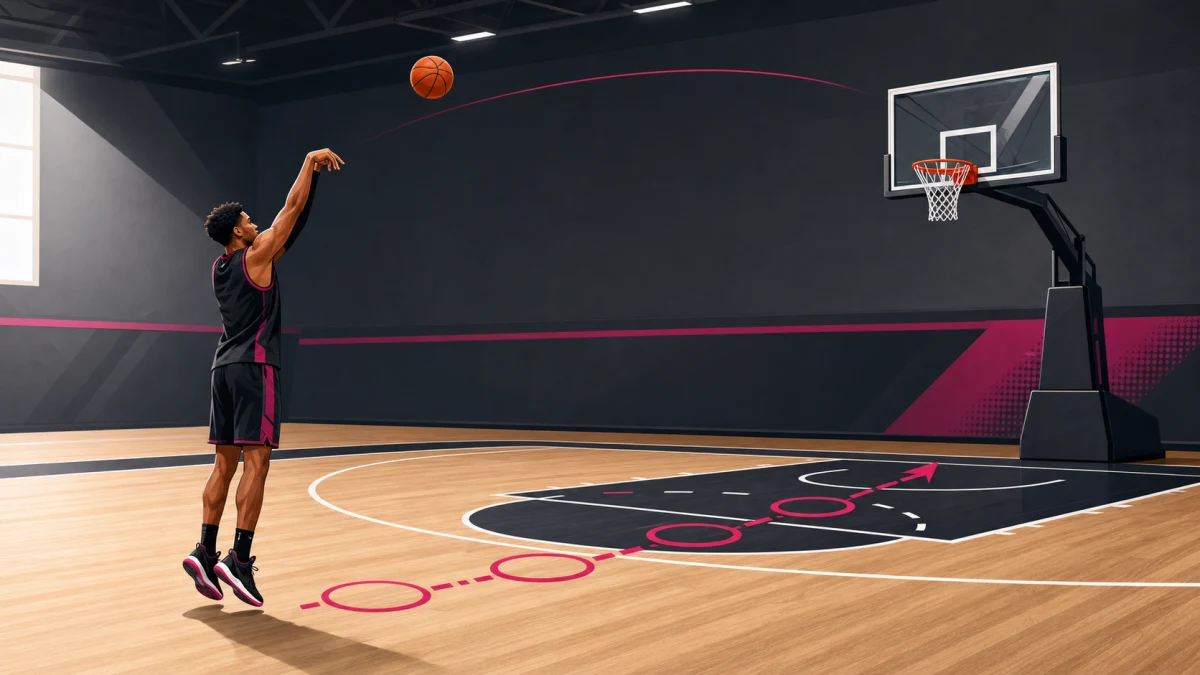
Once control is reliable, the next question is whether the player can carry the weak hand through a real basketball path. Use a short lane, a change-of-direction gate, or a defender's closeout angle. Drive with the off hand, stop on balance, and leave with a pass or a finish. The drill should give the dribble a job: get past a line, create a passing angle, reach the paint, or escape pressure.
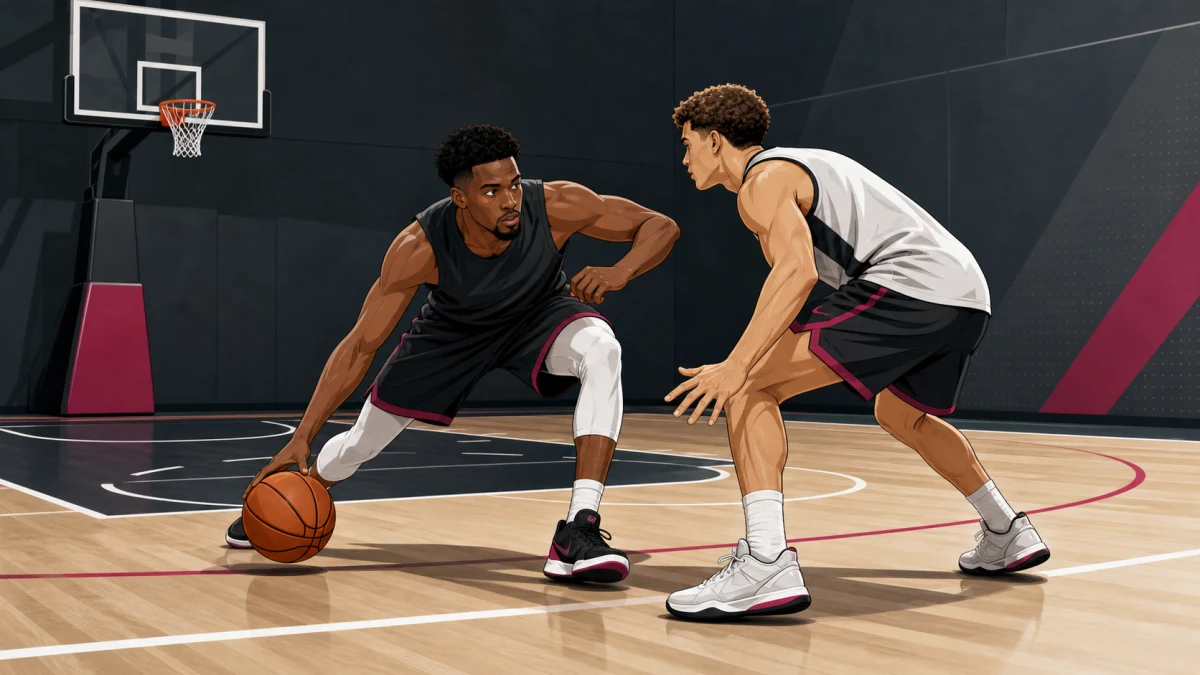
Keep the constraints honest. A cone can teach a route, but it does not react. A live defender changes the timing, the angle, and the amount of protection needed. Start with a guided defender who shades the strong hand and gives the weak-hand lane. Later, let the defender choose. The player must then identify the available side instead of performing a preselected move. How to progress drills for game transfer
Add passing and finishing before calling the skill game-ready
A player who can dribble left but cannot pass left is still predictable. Build a small menu after the drive: a one-hand push pass to a wing target, a two-hand jump-stop pass after the weak-hand dribble, a kick-out after help appears, or a pocket of space for a simple finish. Keep the pass target visible early. Then make the target appear later so the player has to look up before deciding.
Finishing deserves the same treatment. Work on a weak-hand layup from a calm approach, then from a change of pace, then after a body-to-body line or a pad held at safe contact distance. The key is not to manufacture a perfect mirror image of every dominant-hand finish. It is to build comfortable solutions that match the player's balance, angle, and available space.
Jr. NBA guidance for high school players makes the same broad progression: use stationary control and dribbling work, progress to moving ball handling, then put the player in real situations with a defender. It also names two-ball work as an optional challenge. That supports using tools as a bridge, not treating them as proof of game transfer. Jr. NBA ball-handling guidance
A practical session structure
Use a short cycle that keeps the work specific without turning it into a one-hand-only practice. Start with controlled weak-hand ball work. Move into a route that requires a weak-hand drive. Add a pass or finish. Finish with a small-sided read in which the defender can take away either side. Between blocks, reset the same standard: athletic stance, eyes up when possible, ball protected, and a clear reason for each dribble.
- Control: weak-hand dribble at varied heights while maintaining posture and a target focus.
- Movement: attack a gate or lane with a pace change, then stop under balance.
- Connection: turn the drive into an on-time pass or an appropriate finish.
- Read: let a defender shade, recover, or choose a side so the player must respond.
- Review: note one observable issue for the next session, such as losing body protection, looking down too long, or missing the passing window.
That last step matters. A plan should not be judged only by whether it was completed. Review one or two clips, ask what the defender showed, and identify whether the player used the weak hand because it was open or because the drill demanded it. Weak-hand dribbling workout
How should coaches and players measure progress?
Use a small scorecard built from actions you can see. Did the player keep the ball away from the defender? Did they arrive on balance? Did they recognize the open pass? Did the weak-hand finish use the available angle? Did the choice stay calm after a mistake? Those observations are more useful than a universal countdown because they connect the session to the next decision.
For a player, the standard can be: complete the controlled task cleanly, then earn the right to add speed or pressure. For a coach, it can be: make the task more game-like only when the player can explain the read and execute it at the current level. Improvement is rarely a straight line. The weak hand will look less reliable when the defender, pace, or fatigue increases. That is information, not failure.
Frequently asked questions
Should I use only my weak hand during a whole workout?
Usually no. A focused weak-hand block is useful, but players need both hands, both sides of the court, passing, finishing, and reads. Keep the dominant hand in the session so the weak hand becomes a real option.
When should I move from cones to a defender?
Move when the player can control the current route with posture, ball protection, and enough visual awareness to make added pressure informative. Start with guided pressure, then add freer choices.
Do two-ball drills automatically improve game ball handling?
No. Two-ball work can challenge coordination and rhythm, but it does not prove game transfer by itself. Follow it with moving, passing, finishing, and defender-based tasks that force the player to keep vision, protect the ball, and make a basketball decision.