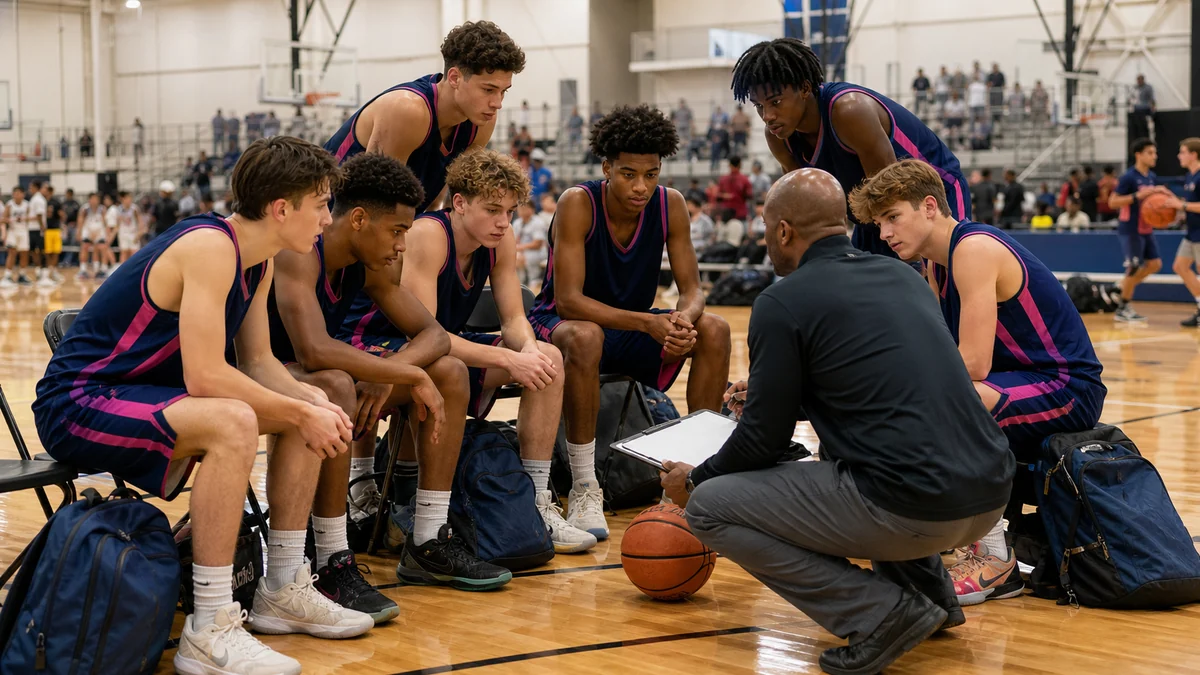

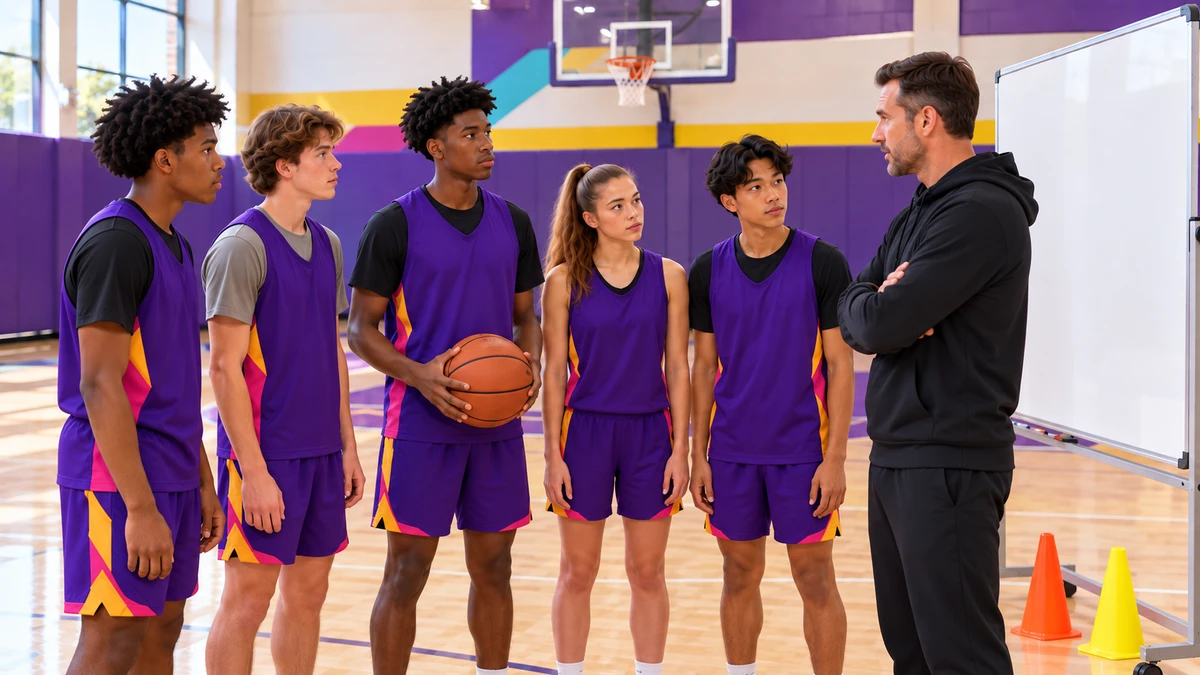
The short version: There is no universal in-season basketball practice template. Use the game calendar, team priorities, available court time, and player feedback to decide what to teach, review, and rehearse. NFHS recommends posted daily plans with clear time-based segments. Keep recovery and participation decisions with the school's qualified staff; a weekly plan is not a medical prescription or a promise of game results.
Key takeaways
- Build the week's practice goals from the next opponent, the last game's repeatable problems, and the team's available time.
- Post a short daily plan with clear five-to-15-minute segments so players know the purpose and rotation before practice starts.
- Use film, self-scouting, and player questions to turn broad concerns into one observable basketball priority.
- Leave return-to-play, injury, and individual recovery decisions to the school's qualified medical and athletic staff.
What an in-season practice plan is meant to solve
An in-season high school basketball practice plan is not a list of favorite drills pasted onto a calendar. It is a short decision system for the days between games. The team has limited court time, classes, travel, scouting information, and a previous game that left useful evidence. A good plan helps the staff decide what must be taught, what must be rehearsed, and what can wait. It gives players a clear answer when they walk in: what are we trying to do better today, and where in practice will we work on it? NFHS: Coaches Creating Meaningful Practices to Achieve Success USA Basketball Coaching Guide For All Levels high school basketball environment
Start with the actual week rather than an ideal one. List the game dates, travel, available gym windows, opponent tendencies the staff intends to address, and the two or three moments from the last game that repeated. Then name one daily purpose in plain language: protect the paint in transition, handle late-clock pressure, finish possessions with a box-out, or improve the first pass against a trap. The plan is not a promise that the next game will go well. It is a way to make the next practice more intentional and instructional, which is the standard NFHS highlights for meaningful practices.
Build the week from the game calendar
A one-game week and a two-game week do not need the same menu. In a one-game week, a staff may have room to teach a new coverage, revisit a technical detail, and create several competitive reads around the next opponent. In a two-game week, the staff may choose fewer priorities and make the practice language more compact. The point is not to assign a universal intensity label to every day. The point is to match the basketball task to the time the team genuinely has, then make the emphasis visible to the players.
- After a game, identify a small number of repeatable possessions or actions to review instead of replaying every mistake.
- Use the first available teaching window for the one or two reads, techniques, or communication problems that matter most for the next opponent.
- Before the next game, rehearse the game situations players are likely to see and restate the team's decision rules in the language used all week.
- Route pain, illness, injury, return-to-participation, and individualized recovery decisions to the school's qualified athletic, medical, and coaching staff.
This approach keeps the coaching plan in its lane. A basketball plan can sequence teaching, film, skill work, and game scenarios. It should not present itself as a medical protocol or tell a player to override school policy. If a player reports pain, unusual symptoms, or an injury concern, follow the school process and involve the people responsible for that decision. Clear scope makes the weekly plan safer and more useful: basketball staff can plan basketball, while qualified professionals handle health and clearance decisions.
Post the daily plan before practice starts
NFHS recommends posted daily practice plans that make coach expectations visible and break practice into time-based segments. That is especially valuable in season, when players may be shifting from class, treatment, film, or a prior game into a busy gym. A posted plan does not have to expose every tactical detail. It should state the focus, the order of work, the rotation or group, and the finish condition for each major block. Players spend less time asking where to go and more time preparing for the next action. basketball workouts
- Opening: name the day’s basketball priority and connect it to a game possession, film clip, or opponent action.
- Teaching block: isolate the footwork, communication, or read that must improve before players face a live decision.
- Decision block: put the teaching point into a small-sided or team scenario with a scoring rule that exposes the intended choice.
- Review block: ask players to name the cue, show the response once more, and state the next game situation where it applies.
Five-to-15-minute segments are a useful planning range from NFHS, not a stopwatch rule for every team. A difficult teaching point may need more time; an efficient group may move on sooner. The test is whether the segment has an observable purpose. Replace vague labels such as “defense” with a statement players can recognize on the court: tag the roller before the pass, call the exchange early, or finish every stop with a rebound. That gives coaches a cleaner way to decide whether the group can progress.
Choose priorities from evidence, not panic
The loudest moment from a loss is not always the next practice priority. Use film, charting, assistant observations, and player self-scouting to find what repeated. For example, three transition baskets may come from three different errors: an unbalanced shot, a missed floor-balance assignment, or a late first communication. A useful plan names the earliest controllable action. That turns “we need to play harder in transition” into a task the team can rehearse: identify the rim runner, stop the ball, or find the next matchup.
NFHS specifically points to player self-scouting and reflective meetings as ways for coaches to learn where athletes feel unprepared. Use that input with, not instead of, staff judgment. A short player question can be high value: “When the low defender tags early, which pass is our first look?” The coach can then answer, build a controlled rep, and see whether the group recognizes the same read in live play. That sequence is more productive than asking players to solve a whole season in one conversation. basketball development path
Rehearse game scenarios with a clear response
Scenario work is where a weekly plan becomes basketball rather than a sequence of isolated drills. NFHS recommends devoting attention to situations athletes may encounter and describes sudden-change moments as a chance to learn a response without panic. In basketball, that might be an offensive rebound that becomes an immediate defensive transition, a broken press entry, a late-clock scramble, a foul-trouble substitution, or a missed rotation that requires the next player to cover. Set the starting picture, the rule, and the first response you expect to hear or see.
Do not add a scenario just because it looks competitive. Choose the situations that connect to the day’s priority and score them in a way that rewards the intended behavior. If the emphasis is defensive communication, give the defense a point only when the call is early and the coverage is completed. If the emphasis is late-clock offense, begin with a realistic clock and require the group to move into its finish action without stopping. The plan stays honest when every constraint is tied to the decision the team is trying to improve.
A one-page weekly planning checklist
- Write the game dates, travel, court access, school obligations, and the realistic number of team practice windows.
- Select one or two basketball priorities from staff review, film, and player feedback rather than adding every recent mistake.
- Post the daily purpose, segment order, groups, and rotation before the first drill begins.
- Put the day’s teaching point into at least one game situation where the response can be heard or seen.
- Close with a brief review: what was the cue, where will it appear in a game, and what will be revisited next time?
- Follow school policy and qualified staff for any health, injury, or participation decision.
Frequently asked questions
How long should an in-season basketball practice be?
There is no universal duration. Use the actual school schedule, game calendar, facilities, team needs, and staff direction. NFHS recommends planning meaningful segments, often in a five-to-15-minute range, so players understand the focus and rotation. That guidance is about structure, not a medical or workload prescription.
What should a coach put on a basketball practice plan?
Put the day’s priority, the sequence of segments, groups or stations, the game scenario to rehearse, and the final review cue. A player should be able to tell what the team is emphasizing before the first drill and where that emphasis appears later in practice.
Should players help plan team practice?
Players can supply useful self-scouting and describe where they feel unprepared. The coaching staff still owns the practice plan and must account for the whole team, rules, safety, and the game calendar. Use player input to sharpen questions and priorities, not to replace coaching judgment.
Does an in-season practice plan guarantee better game results?
No. A structured plan can make teaching and rehearsal clearer, but it cannot guarantee readiness, playing time, health, or a game result. Keep the plan focused on observable basketball decisions and use the school’s qualified staff for health and participation questions.