
The short version: A team enters the bonus after reaching the foul threshold set by its rulebook. The threshold and free-throw penalty vary by competition, so players should confirm the format and read the team-foul count rather than relying on one memorized number.
Key takeaways
- NBA and FIBA games use quarter-based team-foul counts, but their late-period and overtime details differ.
- NCAA men's basketball uses halves and keeps the one-and-one at the seventh team foul before the two-shot bonus at the tenth.
- NCAA women's and NFHS basketball use quarter-based bonus structures and do not follow the NCAA men's sequence.
- Shooting, offensive, technical, flagrant, and other special fouls can carry penalties outside the ordinary bonus rule.
- The practical habit is simple: identify the rule set, check the scoreboard, and ask which foul and penalty were actually called.
What the bonus means in basketball
The bonus is the point at which a team's accumulated fouls change the penalty for an ordinary defensive foul. Instead of another sideline or baseline throw-in, the offended team may shoot free throws. In the NBA, the ordinary quarter penalty begins after four common team fouls, although the final two minutes have a separate trigger. NBA Rule No. 12: Fouls and Penalties violations and foul penalties
That definition is portable, but the number is not. FIBA also uses a quarter-based count and places a team in the penalty after four team fouls. NCAA men's basketball uses halves and a one-and-one stage. The correct answer therefore starts with the competition, not with a universal slogan. FIBA Official Basketball Rules 2024
Bonus thresholds by rule set
| Competition | Count period | First bonus penalty | Later stage |
|---|---|---|---|
| NBA | Each quarter | Fifth common team foul; late-period provision applies | Two free throws for the ordinary non-shooting penalty |
| FIBA | Each quarter | After four team fouls | Two free throws on later qualifying player personal fouls |
| NCAA men | Each half | One-and-one on the seventh team foul | Two free throws on the tenth team foul |
| NCAA women | Each quarter | No one-and-one | Two free throws on the fifth team foul |
| NFHS | Each quarter | No one-and-one | Two free throws on the fifth team foul |
2025-26 NCAA/NFHS Major Basketball Rules Differences
For college games, use the rulebook for the season being played. The NCAA identifies its 2025-26 men's rulebook as the current championship rules resource, and its official comparison sheet is the clearest quick reference for the bonus differences among NCAA men, NCAA women, and NFHS basketball. NCAA Men's Basketball Playing Rules
Why the same fifth foul can produce different outcomes
Under FIBA rules, once four team fouls have been committed in a quarter, the next qualifying player personal foul on a non-shooter is penalized with two free throws. Team fouls in overtime are treated as part of the fourth-quarter count, so the displayed total remains important after regulation.
NBA overtime is handled differently: the first three common team fouls ordinarily lead to possession rather than the penalty, and later common fouls trigger free throws. This is why a player should not carry a FIBA fourth-quarter assumption into an NBA overtime situation.
The NBA's last-two-minute rule creates another common surprise. A team that has not used its normal quota may commit one common team foul in the final two minutes without the penalty; the next qualifying foul can then produce free throws even when the scoreboard total looks lower than five.
Which fouls count toward the team total
Do not assume every whistle adds the same kind of team foul. In the NBA, an ordinary offensive foul does not add to the team total and does not create bonus free throws. Punching and flagrant offensive fouls are explicit exceptions, so the scorer's signal and the announced foul type matter. offensive violations
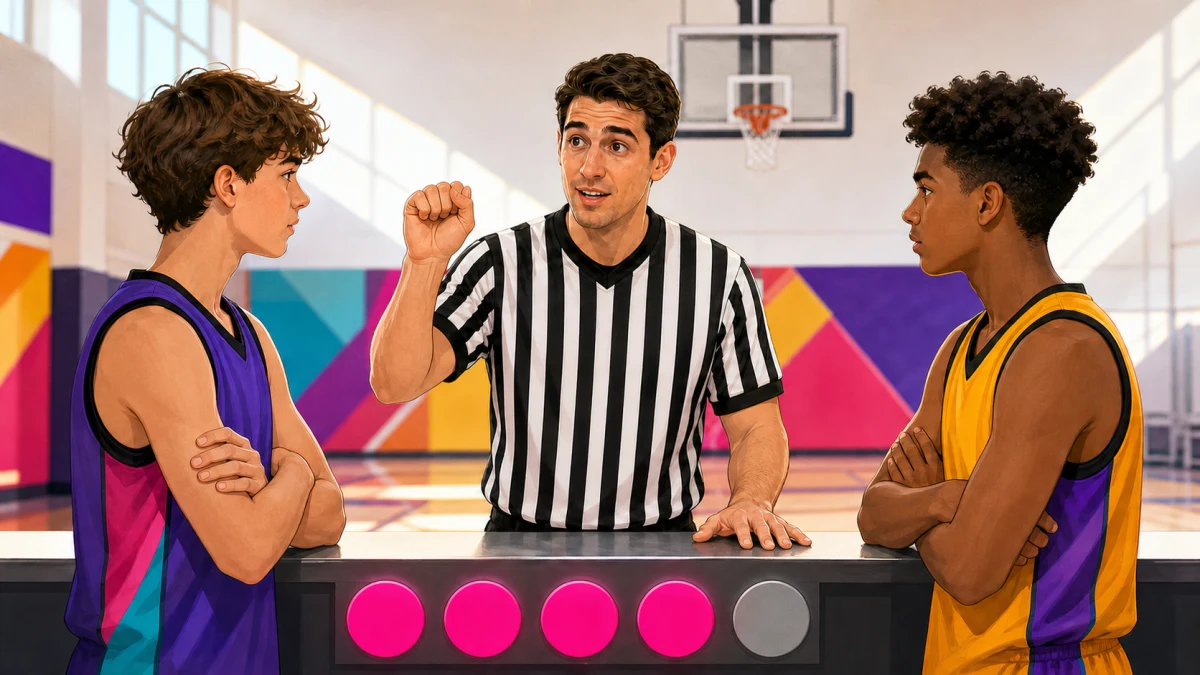
FIBA defines a team foul as a player personal, technical, unsportsmanlike, or disqualifying foul. Fouls charged to bench personnel or arising from special situations can be recorded differently. That distinction is a good reason to follow the official scorer instead of trying to reconstruct the count from memory.
The bonus governs a common non-shooting foul; it does not erase the penalty attached to the play itself. A shooting foul, technical foul, flagrant foul, clear-path foul, or another special category can award free throws or possession under its own rule before the ordinary team-foul sequence is considered. possession and throw-in rules
How players should read a bonus situation
- Identify the competition rule set before the game: NBA, FIBA, NCAA men, NCAA women, NFHS, or a local modification.
- Check whether the count resets by quarter or by half, and note how overtime is handled.
- Read both the team-foul indicator and the foul type announced by the official or scorer.
- Ask whether the player was shooting, because a shooting-foul penalty does not depend on waiting for the ordinary bonus.
The useful basketball-IQ question is not only, 'Are we in the bonus?' It is, 'Which rule set, which foul, and which penalty applies to this play?'
Use the rule to make better decisions
Late in a period, the foul count changes risk. Ball handlers can attack legal advantages without hunting dangerous contact, defenders can avoid reaching when their team is already in the penalty, and coaches can rehearse end-of-period situations with the correct rule set. Build the habit in film review, then reproduce the clock, score, and foul context in practice.
Frequently asked questions
How many fouls put a team in the bonus in basketball?
It depends on the competition. In the NBA and FIBA, the ordinary quarter penalty follows four team fouls, so the next qualifying foul is commonly described as putting the opponent at the line. NCAA men's basketball uses a one-and-one on the seventh team foul and two free throws on the tenth. Always confirm the event's rulebook.
What is the double bonus in basketball?
In NCAA men's basketball, the double bonus means two free throws beginning with the tenth team foul of the half. The term is less useful in NBA or FIBA games because those formats do not use the NCAA men's one-and-one progression. Say the exact penalty when clarity matters: one-and-one, two shots, or possession under a special-foul rule.
Do offensive fouls count toward the bonus?
Not always. Under NBA rules, an ordinary offensive foul does not add a team foul and does not award penalty free throws, while punching and flagrant offensive fouls are exceptions. Other competitions classify fouls differently. The safe approach is to use the governing rulebook and the official scorer's team-foul count rather than assume every offensive whistle is identical.
Do team fouls reset in overtime?
The overtime treatment changes by rule set. The NBA ordinarily allows three common team fouls in an overtime before later common fouls trigger the penalty. FIBA carries overtime team fouls into the fourth-quarter count. College and local formats have their own provisions, so coaches should teach the overtime rule that applies to the actual competition.