
The short version: Basketball officiating technology is currently a decision-support system. Cameras and replay tools can capture and reconstruct events, but the governing rules still assign reviewable decisions to game officials and replay personnel. Automated out-of-bounds or goaltending support is a stated future possibility, not a claim that software now calls the whole game.
Key takeaways
- NBA optical tracking can build three-dimensional player and ball data, but tracking data is not itself a ruling.
- The NBA Replay Center connects arenas and supports a defined set of review triggers rather than reviewing every possession.
- Coach's Challenges are limited to specific call types and preserve an official decision process.
- Referee headsets reduce communication friction between the court and Replay Center; they do not transfer rule authority to an algorithm.
- The credible near-term path is narrower automation for measurable events, with officials retaining context and accountability.
Automated officiating is a stack, not a robot referee
The NBA already has several layers that people casually group under automated officiating: three-dimensional optical tracking, centralized replay, enumerated review triggers, Coach's Challenges, and direct communication between court officials and the Replay Center. Together they can make evidence faster and more precise. They do not amount to software independently calling every possession. NBA and Sony Hawk-Eye Innovations Tracking Partnership NBA Replay Center NBA Rule No. 14: Coach's Challenge basketball instant replay technology
That distinction matters. A tracking system estimates where players and the ball are in space. A replay system organizes video evidence. A rule defines whether a play is reviewable. An authorized official still applies the rule to the evidence and owns the decision under the current published framework.
Layer one: optical player and ball tracking
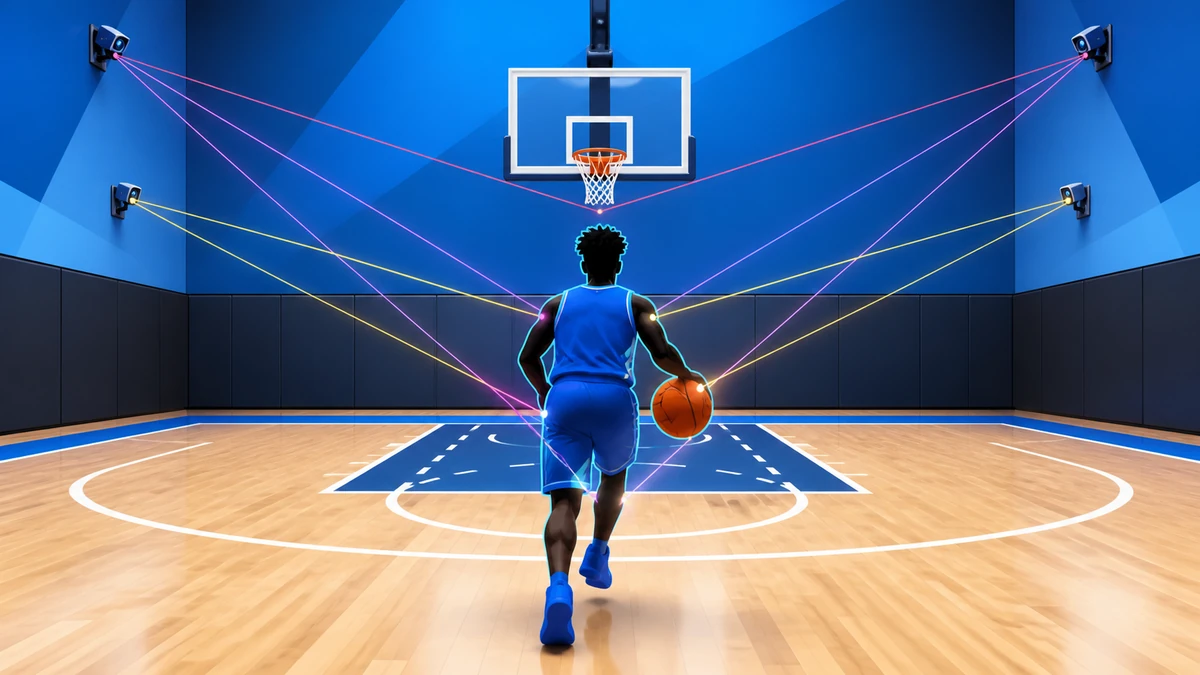
The NBA and Sony's Hawk-Eye Innovations began deploying three-dimensional optical player and ball tracking for the 2023-24 season. Multiple cameras observe the court from different angles, allowing the system to reconstruct movement in a shared coordinate space rather than relying on one broadcast view. basketball player tracking
The partnership also named automated out-of-bounds and goaltending as possible future uses of that data. The word future is the important constraint. A sensor capability can make a boundary event measurable before the competition has approved when, how, and by whom the resulting decision is used.
Layer two: the Replay Center and review triggers
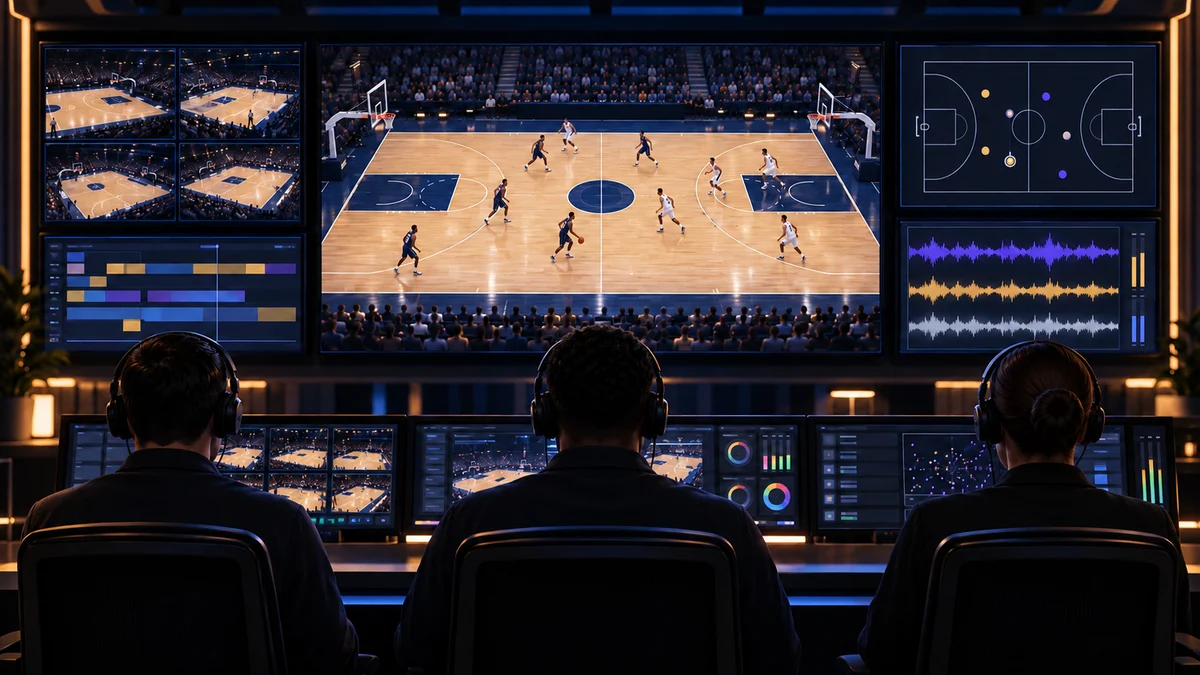
The NBA Replay Center launched for the 2014-15 season and connects to all 30 NBA arenas. That centralized design gives replay officials access to synchronized game feeds and a consistent review environment while the on-court crew remains responsible for administering the game.
Replay is not an unlimited second look at anything interesting. The NBA describes 15 replay triggers. Those triggers define the timing, scoring, possession, foul, and boundary situations that can enter review, which prevents the technology from silently expanding its own authority. NBA Instant Replay Triggers
| System layer | Primary job | What it does not decide alone |
|---|---|---|
| Optical tracking | Measure player and ball location | Which rule and exception apply |
| Replay feeds | Show synchronized visual evidence | Whether every event is reviewable |
| Review trigger | Authorize a defined review | The final ruling |
| Official communication | Move evidence and explanations quickly | Who owns accountability |
Layer three: Coach's Challenges preserve human judgment
An NBA Coach's Challenge is limited to three categories: a called personal foul, an out-of-bounds call, or a goaltending or basket-interference call. That scope is an important product requirement. The review tool must know not only what the cameras captured, but also whether the rule permits a challenge at that moment.
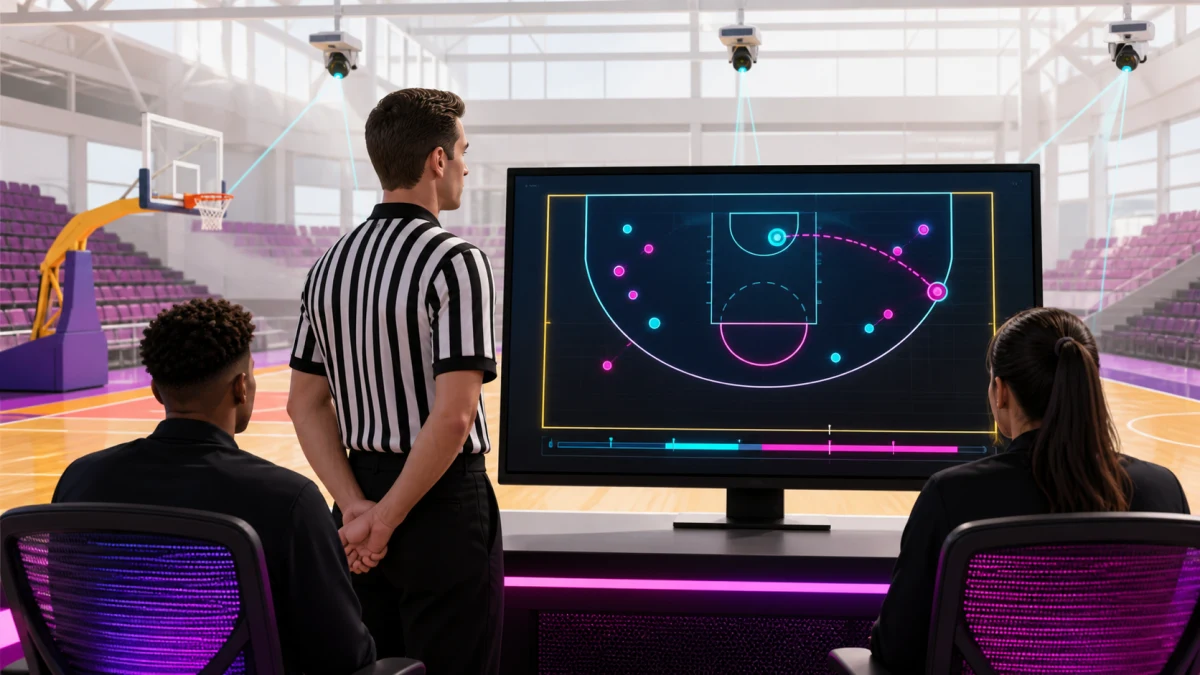
The rule assigns the final decision to the crew chief after consultation with the replay official. Technology can surface frames, angles, timing, and tracking evidence, but the published process still has a named human decision maker who can interpret the play and communicate the ruling.
Referee headsets shorten that communication loop. The NBA began phased headset use on November 1, 2025 for communication with the Replay Center, with later phases designed to support communication among game officials as well. The headset is infrastructure for a faster review, not evidence that an algorithm has become the referee. NBA Referee Headset Communication To Begin Nov. 1
What could be automated next
Out-of-bounds and goaltending are credible early candidates because the NBA-Sony announcement names them directly. Both can sometimes be framed as a measurable event: where the ball was relative to a boundary, who touched it last, or where it was relative to the rim and its flight when contact occurred.
Measurement is still only one part of a valid call. The event must be captured accurately, the replay trigger must authorize review, and the correct rule and exception must apply to the game context. Occlusion, uncertain possession, simultaneous contact, clock state, and rule-specific judgment can turn a clean coordinate into a hard officiating problem. computer vision in basketball
The best officiating automation does not hide uncertainty. It narrows the question, shows the evidence, and makes the accountable decision easier to explain.
A practical standard for trustworthy officiating technology
- Separate raw measurement from the rule decision so users can inspect both.
- State exactly which game events and review triggers the system supports.
- Show uncertainty or missing views instead of presenting a weak estimate as certainty.
- Keep an accountable official in the decision path until the rulebook explicitly authorizes a different process.
- Preserve a replayable evidence trail for explanation, correction, and system evaluation.
The same design principle applies beyond officiating. In an AI basketball coach, pose or ball tracking should support an understandable observation rather than produce unexplained certainty. Players and coaches need to see what was measured, what the system inferred, and what action follows.
Frequently asked questions
Does the NBA use automated officiating?
The NBA uses technologies that support officiating, including optical tracking, centralized replay, defined review triggers, Coach's Challenges, and referee communication with the Replay Center. Current published rules still assign reviewed-play decisions to officials. It is more accurate to call the system assisted or technology-enabled officiating than to say software independently officiates every possession.
Can cameras automatically call a basketball out of bounds?
Optical tracking can help determine where the ball and players were, and the NBA-Sony partnership specifically identifies automated out-of-bounds support as a possible future use. A competition still needs an approved rule workflow for confidence, last-touch questions, timing, exceptions, review eligibility, and who confirms the outcome before that becomes a dependable game call.
Who makes the final decision on an NBA Coach's Challenge?
The crew chief makes the final decision about the reviewed play after consultation with the replay official. The challenge itself is limited to a called personal foul, an out-of-bounds call, or a goaltending or basket-interference call. Video and tracking can improve the evidence, but the rule identifies the official responsible for the ruling.
Which basketball calls are most likely to be automated first?
Out-of-bounds and goaltending are the clearest published candidates because the NBA's tracking partnership names them. Even those calls require more than a coordinate: the system must capture the event, match an authorized review trigger, apply the competition rule, and handle uncertain or obstructed evidence. Narrow decision support is a more credible next step than a fully autonomous referee.