
The short version: IMUs collect motion signals; optical tracking uses cameras. Compare the actual output, calibration, reference measurements, and playing conditions. Laboratory motion capture is not the same setup as every court-tracking installation, and approval of a particular wearable is not permission to use any sensor in a game.
Key takeaways
- Name the basketball question and measured variable before comparing systems.
- Raw motion signals and processed anatomical estimates are different outputs.
- Check the actual optical installation rather than assuming every camera system is a laboratory.
- Evaluate measurement evidence, wearable safety, and mounting requirements separately.
Start with the signal, not the dashboard
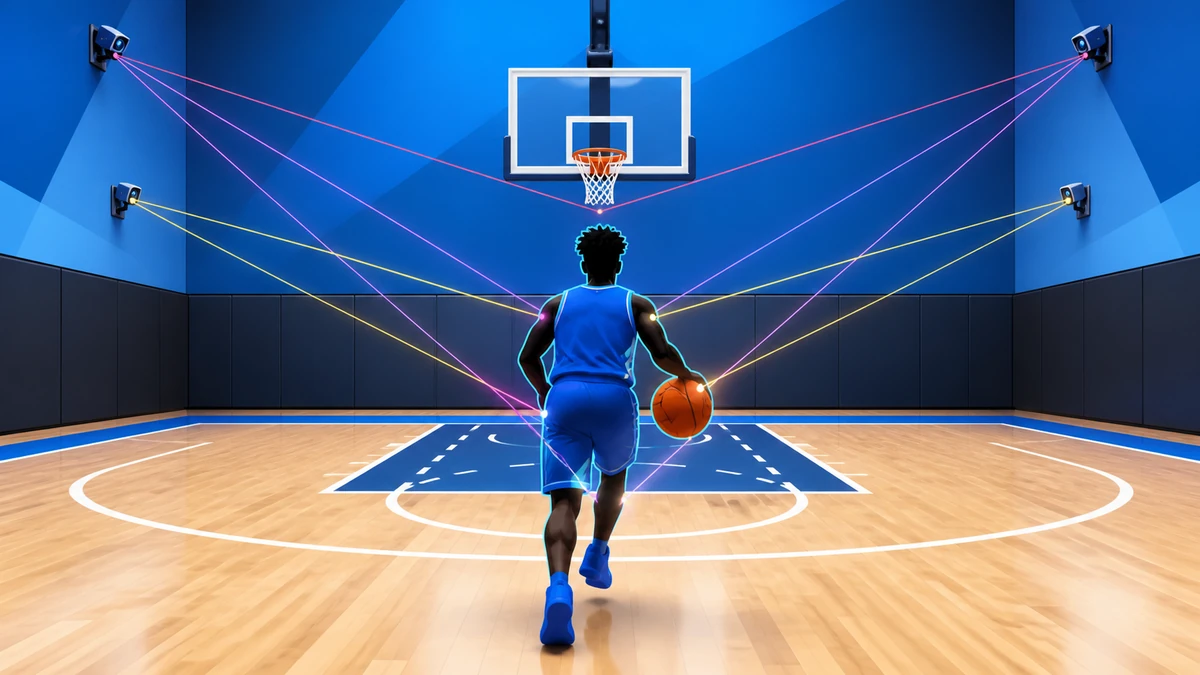
IMU and optical basketball tracking start in different places. An inertial measurement unit is a sensor attached to a device or body segment; its signals include acceleration and rotation. Optical solutions start with cameras observing the court or a movement. FIBA describes player-worn devices and camera-based systems installed around the court as separate forms of tracking. Before comparing the dashboards, ask which signal a system collects and which basketball question you want that signal to help answer. Apple Core Motion framework Inertial Measurement Unit Sensor-to-Segment Calibration Comparison for Sport-Specific Motion Analysis about.fiba.basketball
For example, you might want to examine a body segment’s movement during a defined task, or review player positions across a possession. Write that question before asking a vendor for a demonstration. This is a suggested buying and analysis process, not a claim that either technology answers every version of those questions. Our broader player-tracking explainer introduces the different system families; the comparison here focuses on the measurement chain, setup, and evidence behind the output. player-tracking explainer
What an IMU signal does and does not say
Apple’s Core Motion documentation provides a concrete example for builders. The framework exposes data from available onboard sensors, including accelerometers and gyroscopes, with other hardware such as a magnetometer available on some devices. It distinguishes raw hardware values from processed values and warns that services are not available on every device. That is documentation for Apple’s framework, not a specification for every basketball wearable. Ask the actual supplier which sensors and outputs its product supports.
The raw-versus-processed distinction matters when reading the numbers. Apple explains that raw accelerometer data includes both gravitational acceleration and acceleration from device movement. Obtaining device-specific acceleration requires separating those contributions. Its device-motion service also reports orientation relative to a chosen reference frame. A label such as acceleration or angle is therefore incomplete as a comparison: ask whether the value is raw or processed, which coordinate frame it uses, and what the processing removes. Apple Getting processed device-motion data
Keep device movement separate from a claim about the athlete’s anatomy. A sensor has its own coordinate system, which may not line up with the body segment underneath it. The 2023 study by Ekdahl and colleagues explains sensor-to-segment calibration as the alignment used to express the sensor’s motion in anatomical terms. For a demonstration, ask the operator to show that calibration step and identify the segment being modeled. Do not silently turn the movement of one sensor into a description of every joint.
Optical tracking is a family, not one setup
Camera-based court tracking and laboratory motion capture should not be treated as identical products. In the Ekdahl study, the optical comparison system was used in a research setting. The paper discusses laboratory space, transport limitations, cost, and marker occlusion during dynamic tasks. Those observations concern that setting. They do not establish that every modern markerless basketball installation has the same infrastructure requirements or loses the same information in the same situations.
A different example appears in FIBA’s report from the U19 World Cup in Lausanne. It describes the Dragon optical system using twelve strategically placed iPhones on the main court to support real-time tracking and broadcast overlays such as player speed and shot charts. That is a specific installation, not a universal camera count or an independent accuracy result. Treat the example as evidence of how one court-based system was used, not a guarantee about a camera in another gym. GeniusIQ offering fans a new game-watching experience at FIBA U19 Basketball World Cup | FIBA Basketball
For your own venue discussion, ask the provider to show the intended camera positions, the visible playing area, and what the output looks like when players overlap from a camera’s viewpoint. Ask which portions are observed and which are estimated, and request examples from the kind of basketball you will record. These are evaluation questions, not a statement that a particular product fails them. A polished replay alone need not be the entire demonstration you request.
Compare the same task and the same output
The calibration study compared lower-extremity range of motion from IMUs with an optical system across sports-related tasks. Agreement varied by joint, task, and calibration method. The authors concluded that calibration should be selected with the application’s tasks and variables in mind. That is a narrower finding than saying wearable sensors are either accurate or inaccurate in general. It is also not a validation of every commercial basketball tracking product or every number displayed by one.
A practical comparison sheet can name the task, the reported variable, the reference measurement, the calibration procedure, and the circumstances in which samples are missing. Leave a field for limitations and ask the provider to complete it with evidence. For instance, a joint range-of-motion comparison is not the same question as positional accuracy during a game. FIBA’s test program lists multiple metrics separately, including position, speed, acceleration, jumping and load. Ask for the one relevant to your decision. about.fiba.basketball
Also separate measurement from coaching interpretation. You can ask whether a reported result is a raw sensor value, an estimated movement variable, or an explanation generated from other outputs. Record the answer rather than assuming those layers are interchangeable. Our article on AI shot analysis discusses the wider coaching question. Here, the useful habit is simply to name the output under review and request evidence for that output, rather than accepting a general claim of precise tracking. article on AI shot analysis
Check safety, mounting, and the scope of approval
FIBA’s initial tracking test event included IMUs, local positioning systems, and optical technologies. Its published assessment areas included positional accuracy, speed, acceleration and deceleration, jump height, and a load index. The announcement also described laboratory safety assessment of wearable size, shape, weight, and behavior under impact. Performance testing and physical safety are therefore distinct questions in the program. Do not use a list of measured variables as a substitute for checking how a device is meant to be worn.
In its update, FIBA says its revised competition regulation permits FIBA Approved wearable tracking solutions when they are worn safely in the specified mounting position. The update also describes checking system outputs against reference values during basketball-specific movements and game simulations. Approval belongs to an assessed solution and its conditions of use, not to the word IMU as a whole. Confirm the current approval and the applicable competition rules for the actual device before using it in a game.
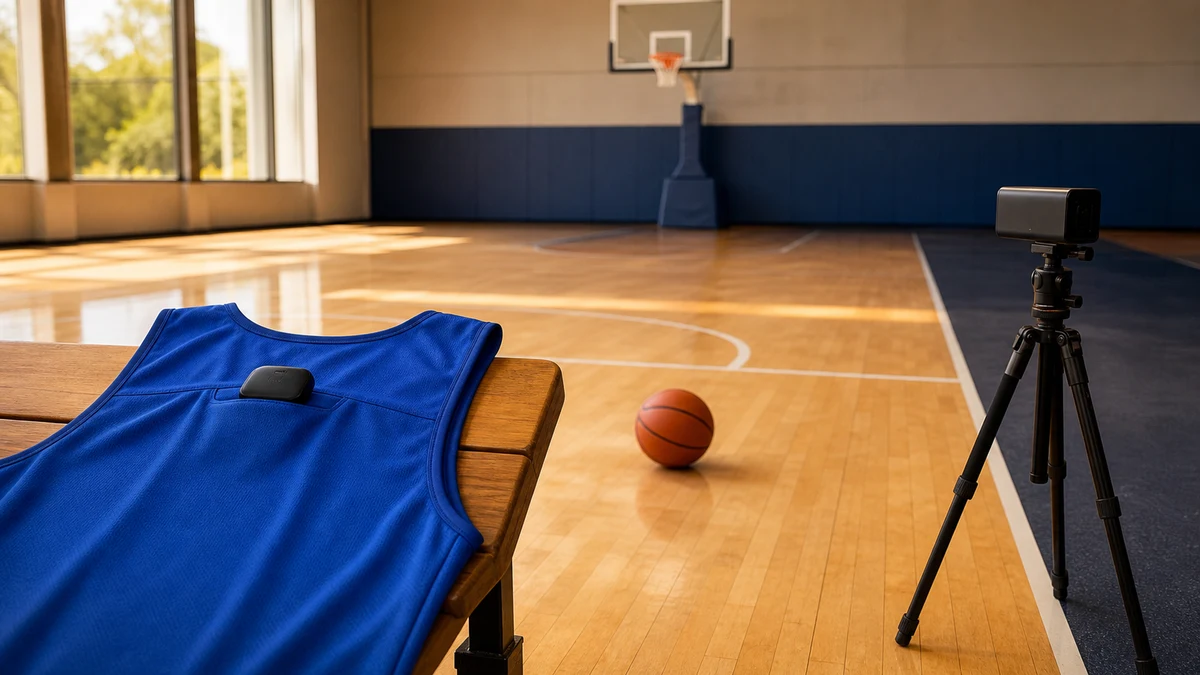
For a practice trial, ask the athlete and operator about fit, mounting, and the steps required before data collection. For a camera system, ask the venue operator to confirm the installation and playing-area arrangements. Put those operational questions beside the measurement evidence rather than assuming one type of setup is effortless. A body-worn sensor and cameras around a court create different arrangements to discuss; the right choice depends on the question and conditions you have actually checked.
Frequently asked questions
Does an IMU directly measure a basketball player’s joint angles?
An IMU provides motion signals in its own reference system. Sensor-to-segment calibration aligns the sensor coordinate system with the anatomical coordinate system. The cited calibration research found that agreement varied across tasks, joints, and calibration methods. Ask which joint variable was validated instead of treating the presence of a sensor as proof of joint-angle accuracy.
Is optical tracking always a laboratory system?
No. The laboratory motion-capture setup discussed in the calibration paper is different from the court installation in FIBA’s U19 example. FIBA described a multi-camera optical system supporting game tracking and broadcasts. Compare the actual installation and intended output, rather than applying one laboratory’s constraints to every camera-based product.
Does FIBA approval mean any wearable can be used in a game?
No. FIBA’s update refers to FIBA Approved wearable solutions, safe use, and the specified mounting position. That is not blanket permission for any sensor. Check the current approval and rules for the actual device and competition, and keep safety evidence separate from the accuracy claim you are evaluating.