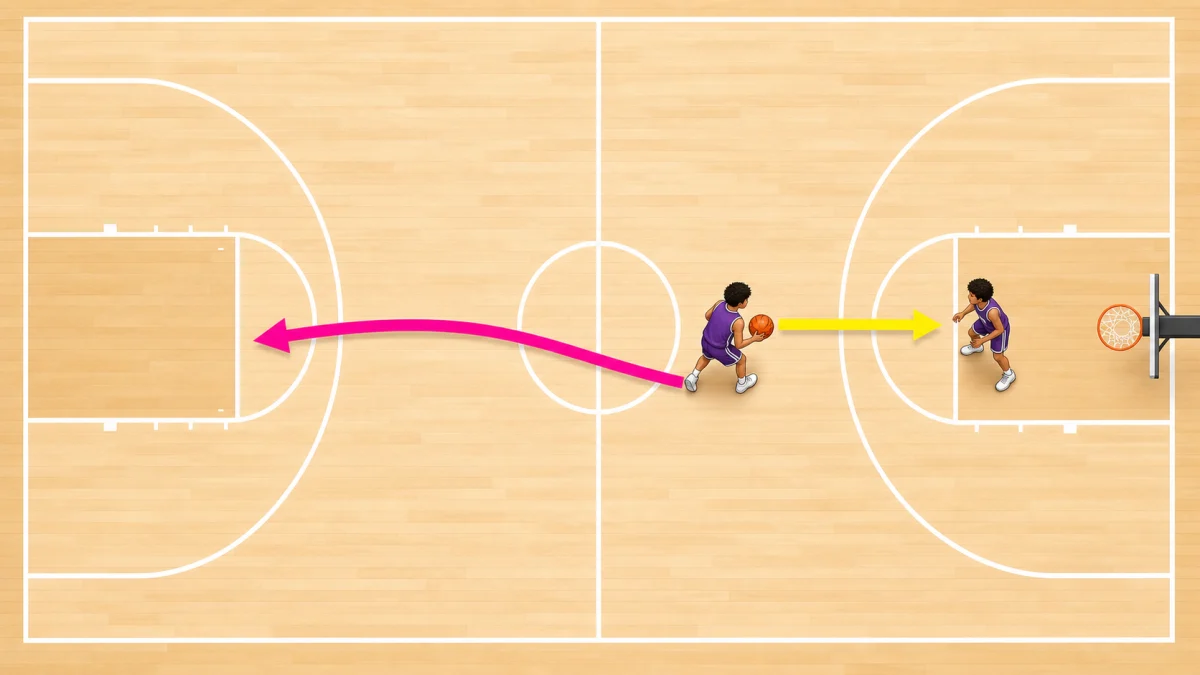


The short version: The World Association of Basketball Coaches (WABC) defines the split line as the imaginary line from basket to basket and uses it as a reference for weak-side help. From your help spot, check that you can see the ball and your player.
Key takeaways
- The side names follow the ball. With the ball on the left wing, the left half is the ball side and the right half is the weak side.
- If you lose sight of the ball handler or your matchup, change your angle or take a small step and check again.
Find the split line from the rims
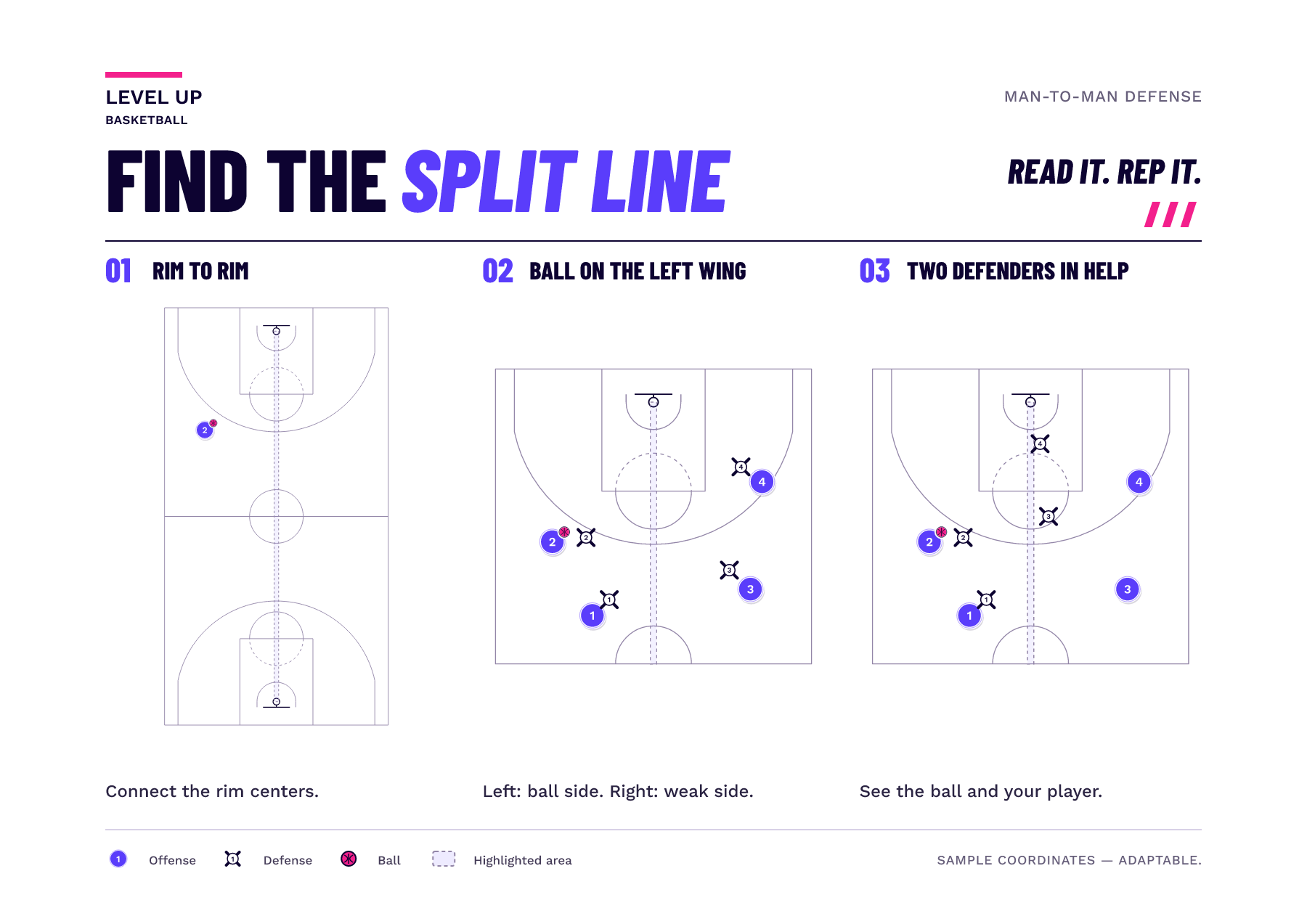
The World Association of Basketball Coaches (WABC) defines the split line as an imaginary line down the middle of the court from basket to basket. Picture a straight line joining the centers of the two rims. On a half-court diagram, trace that same line from the visible rim to the middle of the half-court stripe. WABC Coaching Level Manuals Level 1 English
Read the weak side with the ball on a wing
Freeze the play with Player 2 holding the ball on the left wing and x2 guarding the ball. The left half is the ball side. The right half, where Players 3 and 4 are in this example, is the weak side. Those labels depend on the ball’s location; the split line stays fixed.
In the WABC Level 1 example, x3 and x4 use the split line as a help reference. Watch those two defenders between the half-court panels below: both shade toward the middle. Player 2 still has the ball in the same spot, and x3 and x4 are still responsible for Players 3 and 4, respectively. The nail in basketball
Swipe sideways to explore the full diagram.
Check what you can see from help
The WABC Level 1 manual treats the split line as a thick line so helpers stay active instead of settling on one point. If you’re x3 or x4, try this check: can you see Player 2 and the player you guard while staying ready to move? If either slips out of view, turn a little or shift your feet and check again.
Was this useful?