
The short version: In basketball, the nail is the spot at the exact middle of the free-throw line. It is coaching shorthand, not a separate painted mark or a special rule. Defenses use the nail as a reference for help position and gap support; offenses watch it because a defender stationed there can shrink driving and passing lanes. The correct read always depends on the ball, the assignment, and the team's scheme.
Key takeaways
- The nail is the midpoint of the free-throw line, directly above the center of the lane.
- It is a coaching landmark, not its own rulebook line, circle, or restricted area.
- A defender near the nail can show help against a drive while preserving a route back to an assigned player.
- Offenses can occupy, clear, or screen near the nail to change help-defense decisions and open driving or passing windows.
- Film study should track the nail defender's starting position, vision, first step, and recovery rather than treating the spot as a fixed assignment.
Where is the nail on a basketball court?
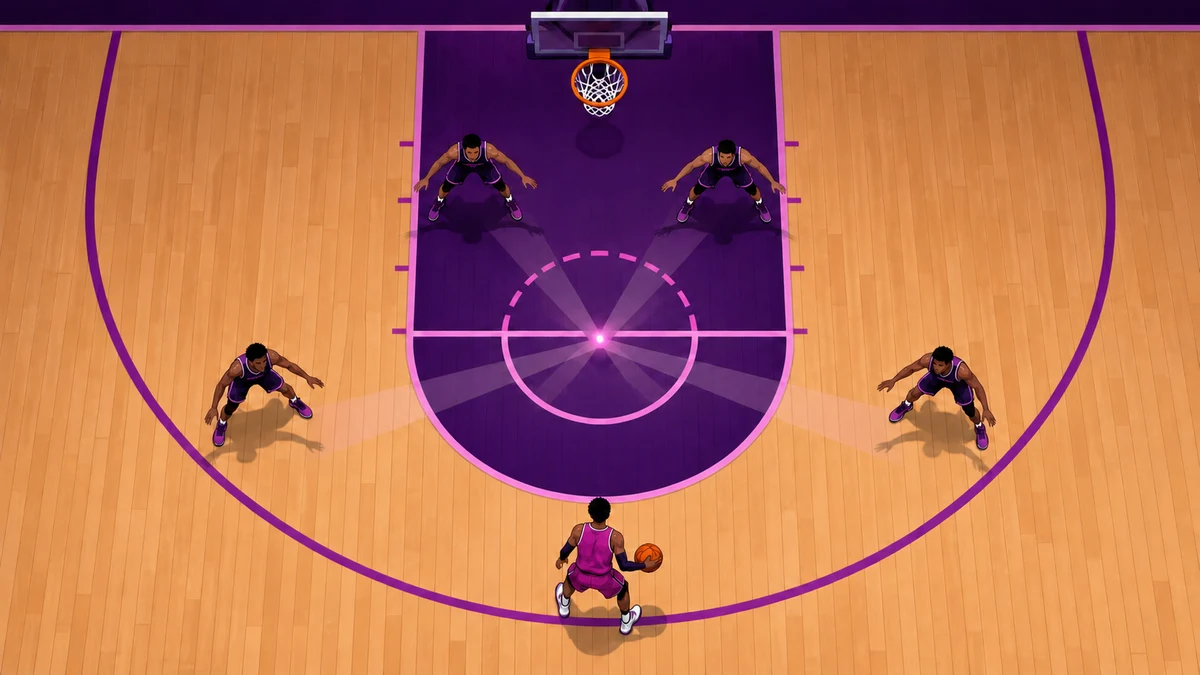
The nail is the exact midpoint of the free-throw line. If you stand behind the top of the key and look toward the basket, trace the free-throw line from one elbow to the other; the nail is the center point between them, directly above the middle of the lane. FIBA's official terminology guide defines the spot this way and illustrates it on a half-court diagram. The name is useful because it turns a small piece of floor into a precise shared reference for players, coaches, broadcasters, and analysts. FIBA Europe Basketball Terminology
Nothing special has to be painted there. The official court marking is the free-throw line: under FIBA dimensions it runs parallel to the endline, measures 3.60 metres, and sits with its far edge 5.80 metres from the inner edge of the endline. The nail is coaching shorthand anchored to the midpoint of that line, not a separate circle, hash mark, restricted area, or rule. A floor may show a screw, seam, logo, or no visible dot at all; the location remains the same. FIBA Official Basketball Rules — Current Edition
Why does the nail matter on defense?
The nail matters because it sits between many common offensive routes: a drive from the wing, a pass across the top, a roll into the lane, a cut from the weak side, or a catch at the free-throw line. A defender who is responsible for help may use the nail as a reference point while seeing both the ball and an assigned player. From there, the defender can show a body in the driving window, stunt toward the ball, tag a cutter or roller, and recover when the pass travels. Those are possible responsibilities, not automatic rules; the exact position and rotation belong to the team's coverage. Jr. NBA — Fundamentals of Stunt and Recover WABC Coach Workbook — Helping Team-mates pick-and-roll coverages
Official WABC help-defense teaching emphasizes anticipation. In one split-line example, defenders begin moving before the ballhandler completes the action: one steps toward the ball and another toward the foul line when a baseline drive appears likely. When a pass looks more likely, they step toward their own players while keeping vision of the ball. The nail is valuable inside that decision process because it provides a repeatable reference, but good defense still depends on awareness, balance, fundamentals, effort, and communication. WABC Coaches Manual Level 1 — Help Defence and Split Line Defence Jr. NBA — Importance of Defense in Basketball
How offenses use the nail to read help and create space
Offenses read the nail because the nearest helper can change the value of a drive. If that defender loads early toward the ball, the lane may narrow while a kick-out, lift, cut, or quick reversal becomes available. If the defender stays attached to a shooter, the ballhandler may have a cleaner gap. The offensive job is not merely to see an open patch of floor; it is to see which defender can reach it, which pass would force the longest recovery, and whether the advantage survives the next rotation. offensive spacing
Teams can also place an offensive player near the nail or move a cutter through it. A flash to the free-throw line can occupy a zone defender, create a high-post catch, or become a screening angle. Clearing the area can remove a defender from the middle. Screening near the nail can alter a helper's path. These actions do not guarantee an advantage, because the defense may switch, deny, bump, zone up, or rotate from another position. The landmark simply makes the tactical question easier to name: who controls the middle, and what must the next defender give up?
How to identify the nail defender on film
- Pause before the advantage begins and locate the midpoint of the free-throw line. Do not wait until the ball reaches the paint.
- Identify the defender nearest that landmark and confirm the defender's actual assignment. A nearby body is not always the designated helper.
- Track vision and stance: can the defender see the ball and the assigned player, and is the body prepared to move in either direction?
- Watch the first step. A step toward the drive, toward the foul line, or back toward the assignment reveals the coverage earlier than the final rotation.
- Finish the possession. Judge the stunt, tag, or help together with the recovery, closeout, rebound, and communication that follow.
Simple ways to coach the nail without freezing the defense
Start with location, then add decisions. Place a floor marker at the midpoint of the free-throw line and ask an off-ball defender to point to the ball and the assignment before moving. Next, create a two-on-two or three-on-three advantage: the ballhandler can drive or pass, and the helper must take an early step, communicate, and recover. Finally, remove the marker. The goal is not to park a player on one dot; it is to build a reference the defender can use while the ball and matchups change. basketball workouts
WABC suggests the width of the backboard as a visual cue for the split-line help area. That cue can keep teaching practical: a young defender does not need to calculate angles in metres. Still, avoid turning the cue into a universal command such as 'always stand on the nail.' Ball location, offensive spacing, shooter quality, driving hand, screen coverage, personnel, and the team's rules can all move the helper. Coach the reason for the position and the recovery route, not only the starting footprint.
Nail, elbow, slot, and restricted area: what is different?
- Nail: the midpoint of the free-throw line.
- Elbows: the two ends of the free-throw line where it meets the lane boundaries; there is one on each side.
- Slots: commonly used coaching references above the arc on either side of the middle; exact language can vary by system.
- Restricted area: the marked semicircle beneath the basket that carries rule-specific meaning; it is not the nail.
The easiest memory test is shape and location. The nail is one point on a horizontal line. The elbows are two points at that line's ends. The slots are perimeter references. The restricted area is a semicircle near the rim. Keeping those landmarks separate makes coaching directions faster and keeps tactical language from being mistaken for a rulebook category.
Frequently asked questions
Is the nail an official basketball court marking?
No separate nail marking is required. FIBA terminology defines the nail as the midpoint of the free-throw line, while the rulebook defines the free-throw line as the actual court marking. Some floors may have a visible seam, screw, logo detail, or training marker near the spot, but those visual details are not what creates the landmark.
Should a help defender always stand on the nail?
No. The nail is a reference, not a universal assignment. WABC's split-line examples show defenders moving in anticipation toward the ball, foul line, or their own players depending on the likely next action. Team rules, ball location, matchups, shooters, screens, and offensive spacing determine the actual help position and recovery route.
What does it mean to drive the nail?
Coaches usually mean attacking toward the middle of the free-throw line or the central lane window. The phrase describes direction and pressure on help defense, not a special scoring rule. As the ball approaches the middle, the offense should read which defender commits, which teammate becomes available, and whether the defense can recover after the next pass.
Why do broadcasters mention a defender at the nail?
The phrase quickly identifies a central help position without describing the entire court. A defender near the midpoint of the free-throw line may be showing help against a drive, tagging an interior action, occupying a passing lane, or preparing to recover. The broadcast description names the location; the game sequence reveals the responsibility.