
The short version: Under NBA Rule 10, a kicked-ball violation requires intentional use of the leg; accidental foot or leg contact is not a violation. The whole leg counts. An offensive violation gives possession to the opponent, while a defensive violation during play leaves the offense with a sideline throw-in. Shot-clock settings and FIBA, NCAA and NFHS procedures are not covered here.
Key takeaways
- Under NBA Rule 10, accidental foot or leg contact is not a kicked-ball violation.
- The NBA restriction covers intentional use of any part of the leg, including the knee and thigh.
- An NBA offensive violation loses possession; a defensive violation during play gives the offense a sideline restart with a specified location limit.
- Use the applicable competition’s official provisions for shot-clock settings; this article does not establish them.
A ball hitting a shoe is not an automatic violation
A pass hits a defender’s shoe. Is that automatically a kicked ball? Under NBA Rule 10, Section IV, the answer is no: intentional use of the leg is a violation; the ball accidentally striking the foot or leg is not. The useful question is what the player did with the leg, not simply whether contact happened. RULE NO. 10: Violations and Penalties | NBA Official
The explanations below use the NBA rule. They do not establish FIBA, college or high-school restart and shot-clock procedures; those require their own complete official provisions.
Intent matters—and the whole leg counts
NBA Rule 10, Section IV states: “Kicking the ball or striking it with any part of the leg is a violation when it is an intentional act.” It then distinguishes accidental contact: “The ball accidentally striking the foot, the leg or fist is not a violation.”
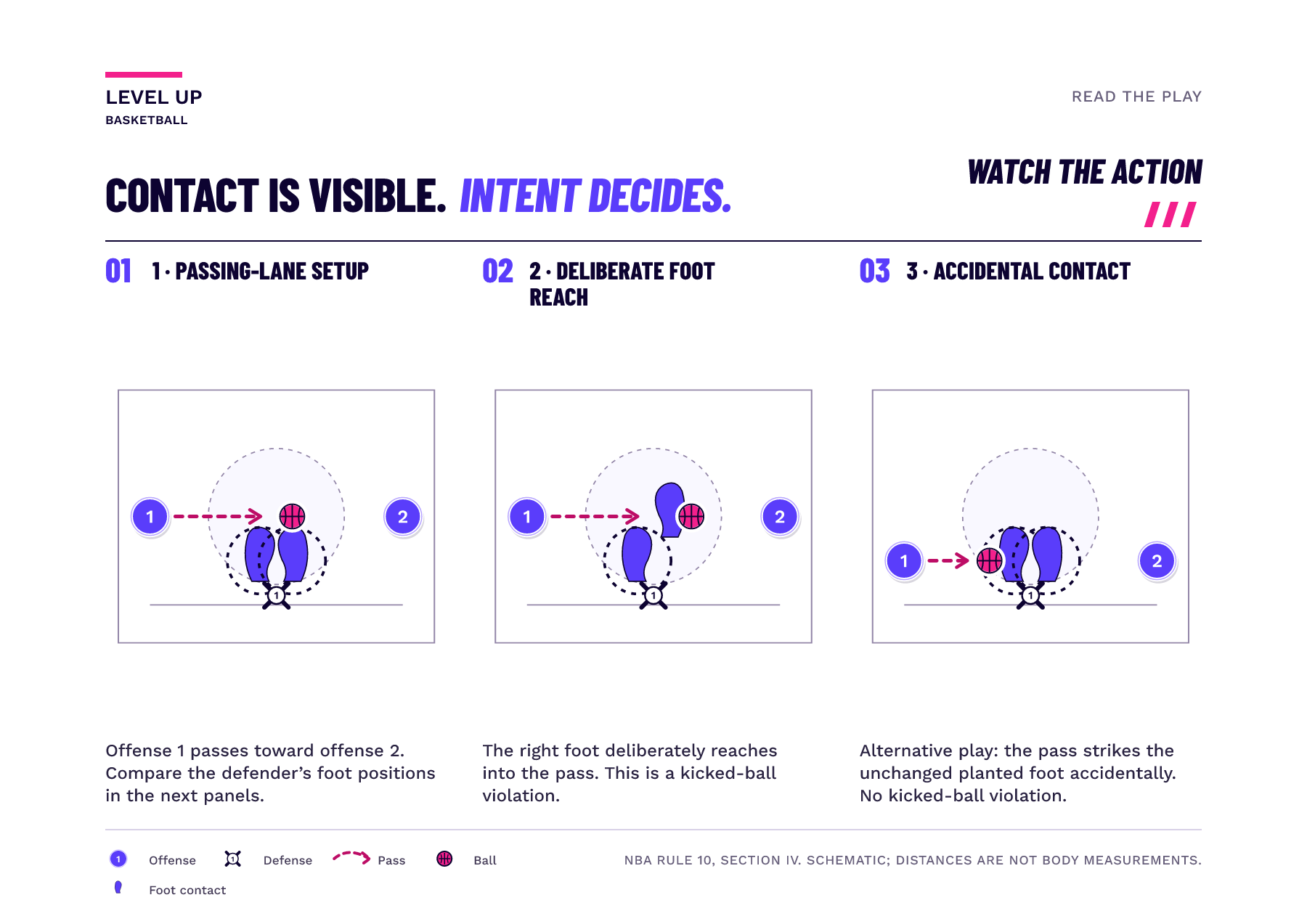
Consider two hypothetical bounce passes. In the first, a defender deliberately reaches a foot into the ball’s path to stop it. In the second, the pass strikes a defender’s planted foot without any deliberate attempt to play the ball with it. Applying the NBA distinction, the first is a violation and the second is not. Foot movement can help explain the action, but movement alone is not the rule: the deciding issue remains intentional use of the leg.
The name “kicked ball” can make the rule sound narrower than it is. According to the NBA provision, any part of the leg counts, so deliberately blocking a pass with a knee or thigh is not a workaround. The same section also states: “A player may not use any part of his leg to intentionally move or secure the ball.” That includes a deliberate attempt to use a leg to gather the ball, not just to knock a pass away.
Swipe sideways to explore the full diagram.
Who gets the ball after an NBA kicked-ball violation?
| NBA situation | Possession and throw-in location |
|---|---|
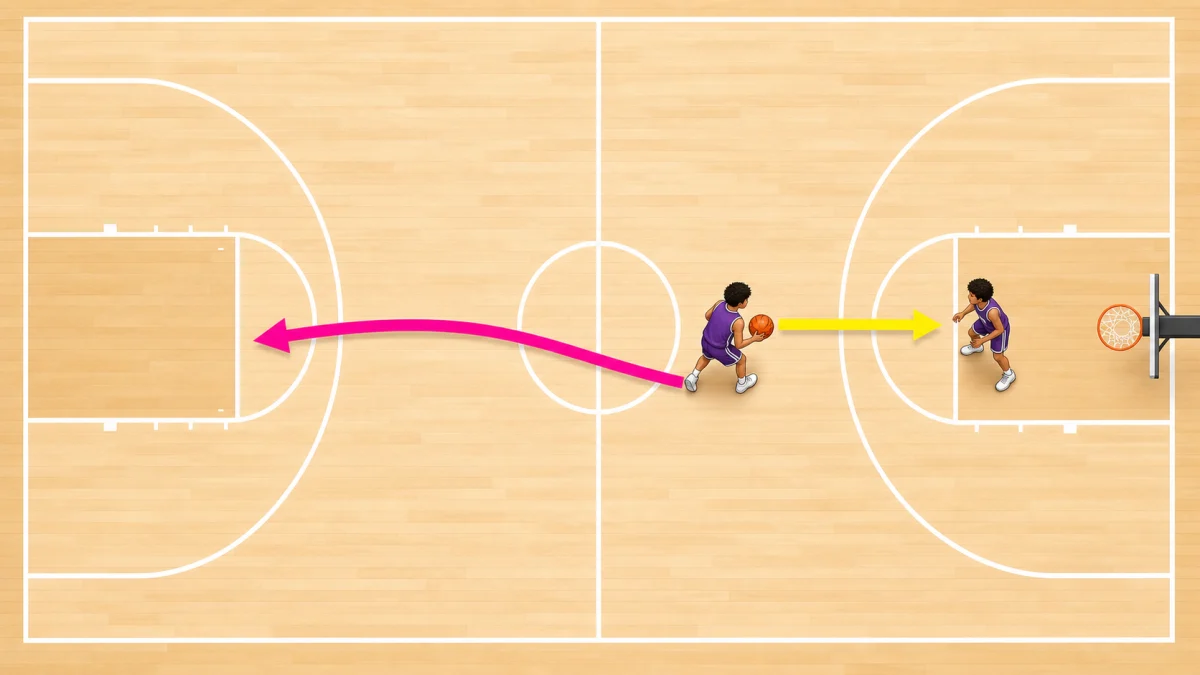
| The offense commits the violation | The opposing team receives the ball on the sideline nearest the violation, no nearer the baseline than the free-throw line extended. |
| The defense commits the violation while the ball is in play | The offense retains the ball on the sideline nearest the violation, no nearer the baseline than the foul line extended. |
| A player commits the violation during an opponent’s throw-in | The opposing team retains possession at the original throw-in spot, with any existing throw-in privileges. |
Both teams can commit the violation. Under the NBA penalties, an offensive violation costs possession; a defensive violation during play leaves possession with the offense. “Nearest the violation” also has a boundary: the specified sideline spot cannot be closer to the baseline than the free-throw line extended. That means the restart is not automatically beside the exact point where the ball touched the leg.
Teach the action before naming the call
Read the play: a bounce pass accidentally strikes a defender’s planted foot. The defender made no deliberate attempt to play the ball with the leg. Under the NBA rule, is that a kicked-ball violation?
Under NBA Rule 10, Section IV, no kicked-ball violation has occurred in this hypothetical: the contact was accidental. The fact that the ball touched a foot does not by itself make the play illegal.
Was this useful?