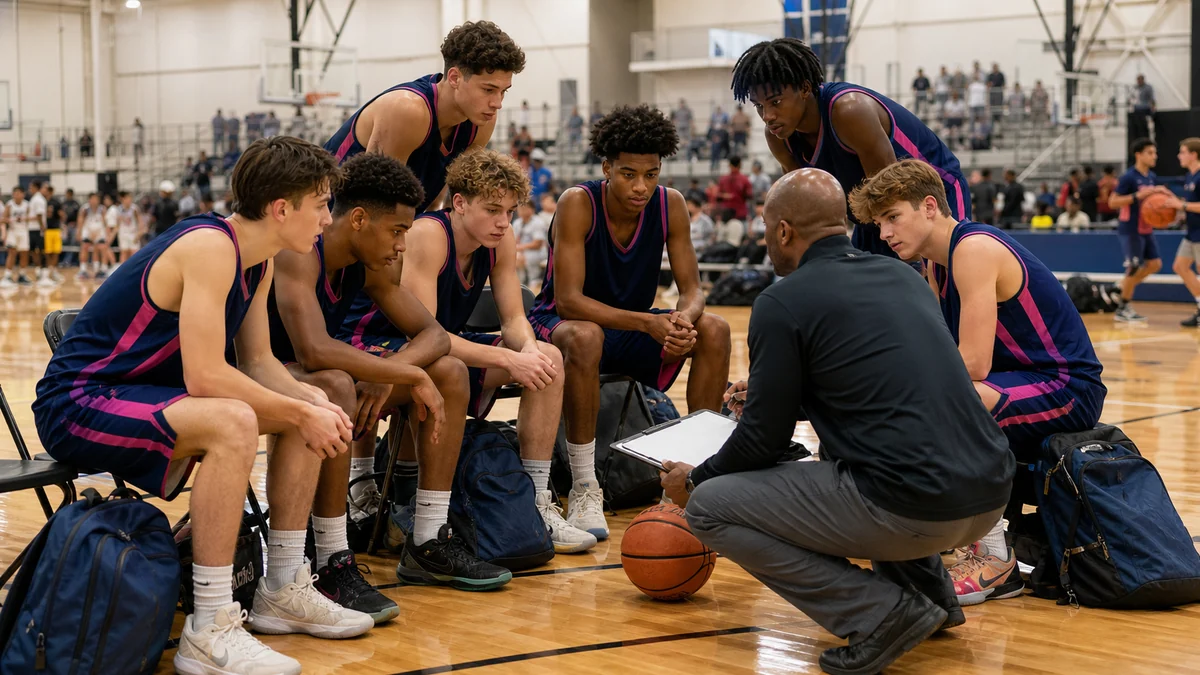


The short version: Build the season on one shared calendar and one complete budget. Count every team commitment, protect school and recovery time, clarify the player's likely role, and judge each trip by the development problem it is supposed to solve.
Key takeaways
- Calculate the full family cost, not only the team fee.
- Put school, sleep, recovery, and other sports on the calendar before adding tournaments.
- Ask what each event is meant to teach or reveal before paying for the trip.
- Treat AAU membership or branding as event structure, not a guarantee of coaching quality or recruiting exposure.
Plan the whole season, not just the tournament list
AAU basketball travel-season planning starts with one shared calendar, not a highlight reel of destination events. Put every practice, local league game, school commitment, lesson, other sport, family trip, and likely travel day in the same view. The important number is the player's total organized basketball load. The NBA and USA Basketball definition includes competition, practice, and structured training, so a weekend team cannot be evaluated as if the rest of the week were empty. NBA and USA Basketball Youth Basketball Guidelines build an offseason development plan
Start with fixed constraints: school dates, exams, family obligations, the player's other team, and the minimum recovery space the family intends to protect. Then add candidate events. This order changes the conversation from 'Can we squeeze in another tournament?' to 'What does this weekend add, and what will it displace?' A trip that forces repeated late arrivals, missed assignments, shortened sleep, and rushed recovery has a cost even when the entry fee looks affordable.
Build a budget that survives the real trip
Separate season costs into four buckets. Team costs include dues, coaching, uniforms, practice space, insurance or membership, and tournament entry. Travel costs include transportation, lodging, parking, tolls, and local rides. Event-day costs include admission, food, laundry, and supplies. Opportunity costs include missed work, childcare for siblings, and the value of family time committed to the schedule. Ask which items are firm, which are estimates, and which can change after the season begins. 2026 Ohio AAU Basketball Membership Tip Off
- Request the complete event list and identify which trips are required, optional, or conditional on qualification. AAU Basketball Event Operators Overview
- Price the likely room nights and ground travel instead of using the cheapest possible scenario.
- Ask whether families pay separate spectator admission, uniforms, coach travel, or late-added event fees.
- Set a season ceiling and a contingency amount before emotion turns every invitation into an emergency.
Do not assume every program using the term AAU follows the same travel model. AAU itself describes its events as opportunities rather than a mandatory national circuit. The practical questions still belong to the specific club and event: who operates it, what membership is required, how many games are guaranteed, where sites are located, and what happens if the schedule changes. Read the event packet rather than buying the label. choose an AAU basketball team
Protect recovery and school before adding volume
Dense tournament weekends can produce several games, long waits, hotel sleep, and travel on both sides of competition. The official youth guidelines urge caution with more than one game per day, especially across consecutive days, and call for additional time off after those events. They also recommend weekly rest from organized basketball. Use that guidance as a planning guardrail, then adjust with the player's parent, coach, school, and qualified health professional when pain, illness, injury, or individual medical needs are involved. condition without losing skill quality
Make recovery visible on the calendar. Mark the expected return time, the next school morning, the next team practice, and any other organized session. If the plan depends on perfect flight timing, no traffic, instant sleep, and a full-intensity practice the next day, it is not a resilient plan. The goal is not to invent one universal safe workload; it is to stop pretending that travel hours and compressed schedules do not count.
School planning should be equally concrete. Share dates early, identify assignments that cannot move, and decide which absences the family will not accept. A player who spends the ride home completing unfinished work is paying for the event with attention and recovery. Families may reach different decisions, but the tradeoff should be explicit rather than discovered after deposits become nonrefundable.
Make every trip answer a basketball question
Before committing, ask the coach to state the basketball purpose of the event. Is the team testing decisions against faster pressure, learning a new role, facing different size, or preparing for a later championship? A clear answer gives the player something to prepare and review. 'Exposure' by itself is not a development plan, and no event can guarantee that the right evaluator will watch the right possession. Jr. NBA/Jr. WNBA Instructional Curriculum
- Define the player's expected role: primary handler, spacer, defender, rebounder, connector, or a combination.
- Choose one observable goal, such as making the next pass against a second defender or maintaining defensive positioning through multiple actions.
- Review possessions rather than only points, wins, or minutes. Record the decisions the player handled well and the situations that broke down.
- Turn the review into the next practice priority before booking another event to solve the same problem.
The Jr. NBA curriculum is useful here because it treats development as progressive and adjustable: small-sided play, unpredictable starts, changes in difficulty, and decision making. A travel event should not replace that teaching. It should reveal whether practiced skills survive a less predictable environment. When a player repeatedly encounters the same failure, the answer may be a better practice constraint, not another flight.
Use a family decision scorecard
Score each candidate weekend from one to five across development purpose, expected role clarity, competition fit, total cost, school disruption, travel burden, and recovery space. Do not hide a weak category inside one average number. A costly trip with an excellent basketball purpose may still be a deliberate family choice; a cheap trip with no role, no teaching goal, and a bad calendar fit may still be poor value. The scorecard exists to make the tradeoffs discussable.
Revisit the plan after the first two travel weekends. Compare the estimated and actual cost, sleep, school impact, minutes, role, and useful film collected. If the reality differs from the sales conversation, adjust before the sunk cost of the season makes every remaining event feel compulsory. Good planning is not predicting every variable in November; it is creating enough visibility to change course in March.
Frequently asked questions
How much should families budget for AAU basketball travel?
There is no responsible universal number. Build a family-specific total from dues, uniforms, memberships, event fees, coach travel, transportation, lodging, admission, food, parking, childcare, and missed work. Ask which events are required and price the likely itinerary, not the cheapest theoretical one.
How many tournaments should an AAU team play?
The useful number depends on age, total organized basketball load, school, other sports, travel, recovery, role, and the purpose of each event. Use the official participation and rest guidance as guardrails, then remove weekends that do not add a clear development or competition need.
Does AAU basketball require national travel?
No single AAU travel requirement applies to every team. AAU describes its basketball opportunities as not travel mandated, while individual clubs choose their own schedules. Families should verify required and optional events directly with the program before committing.
What should a player track after a travel tournament?
Track role, decisions, recurring game situations, useful film, recovery, school impact, and actual cost. Points and wins matter to competition, but development review should identify what transferred from practice and what the next practice block needs to address.