

The short version: FIBA Europe Basketball Terminology defines a UCLA cut as movement from the top of the key to the low post over a high-post screen. Check that complete route before labeling the cut.
Key takeaways
- FIBA Europe Basketball Terminology connects three features: a top-of-key start, a high-post screen and a low-post destination.
- Record uncertainty when the footage hides an essential part of the route.
- Observe any subsequent pass, shot or continuation separately.
What makes the movement a UCLA cut?
FIBA Europe Basketball Terminology, page 12, defines a UCLA cut by the player’s route: from the top of the key to the low post, over a screen at the high post. On film, follow that whole movement before assigning the name. FIBA Europe Basketball Terminology Off-ball screens explained
FIBA Europe Basketball Terminology 2022 describes the high post as the area around the free-throw line. Use that court marking to locate the screen during your review. FIBA Europe Basketball Terminology 2022
Follow one cutter through the sequence
This original film-review example uses player 1 as the cutter and player 5 as the screener. Exact positions and timing are illustrative; 5 remains stationary. The ball, other teammates and defenders are omitted. Read the panels in order, then replay from A without adding a return route.
Swipe sideways to explore the full diagram.
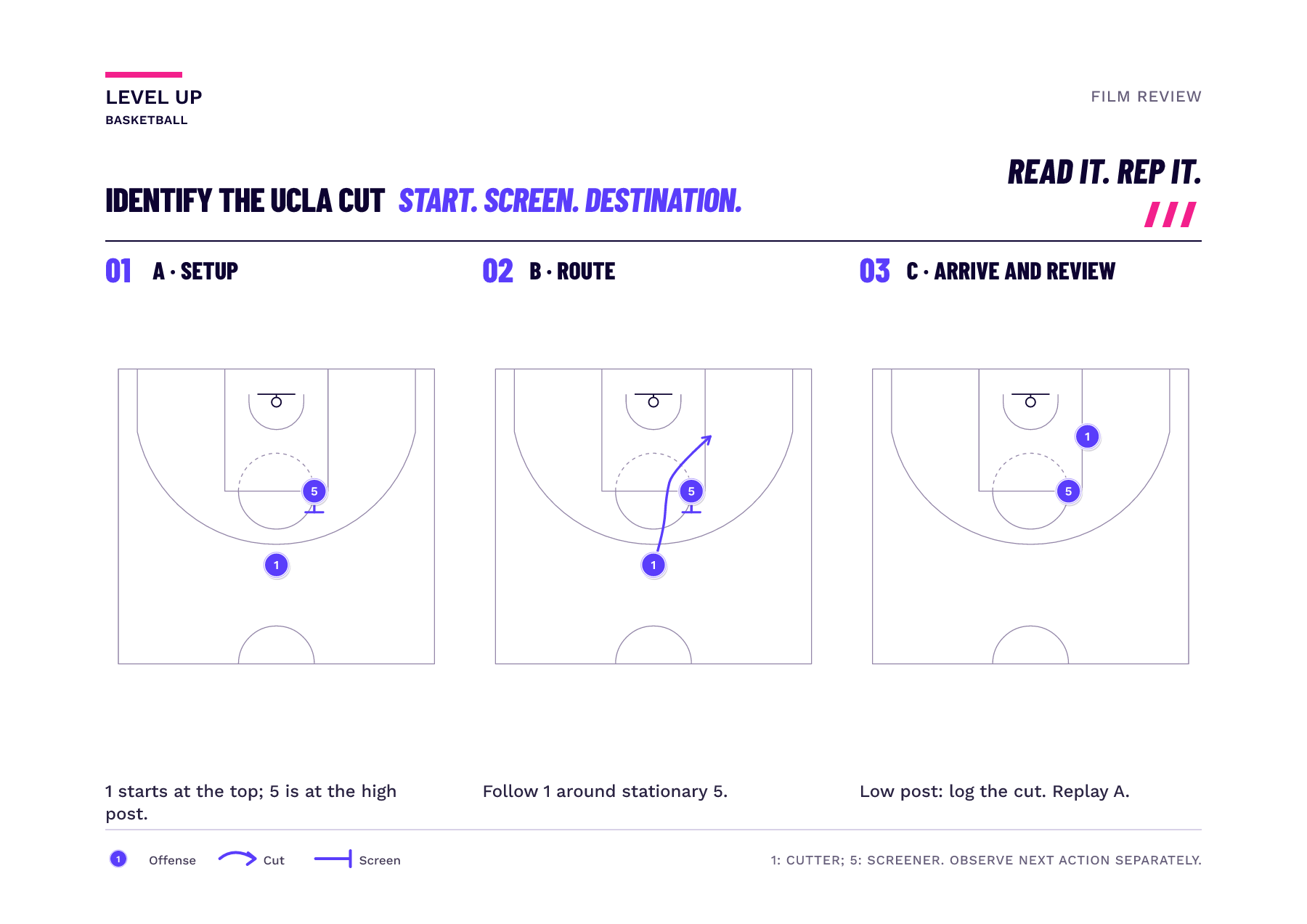
Using the UCLA-cut definition in FIBA Europe Basketball Terminology, pause at panel C: where did the cutter start, at what level was the screen, and where did the cutter arrive?
Player 1 started at the top of the key, used player 5’s high-post screen and arrived at the low post. That matches the UCLA-cut route defined in FIBA Europe Basketball Terminology. On actual footage, record uncertainty if the start, screening relationship or destination is obscured.
Where does identification end?
For this review, stop the illustrated sequence at the cutter’s low-post arrival. Record any following pass, shot or team continuation as a separate observation. You do not need to invent an entry pass or defensive reaction to describe the route you can see.
Was this useful?