

The short version: The FIBA box-score legend labels FD as Fouls Drawn and PF as Fouls. The FIBA Statisticians’ Manual credits a foul drawn to the player who was fouled. Read PF for the fouls charged to the player in that row.
Key takeaways
- In the FIBA Statisticians’ Manual’s charge example, A3 gets one personal foul and B2 gets credit for one foul drawn.
- The FD total alone doesn’t identify the individual calls or tell you how many free throws the player took.
How to read FD and PF in a player’s row
FD, short for Fouls Drawn in the FIBA box-score legend, counts how many times the player in that row was fouled. The FIBA Statisticians’ Manual credits one foul drawn to the player who was fouled. The same box-score legend labels PF as Fouls: read that column for the fouls charged to the player in that row. FIBA Statisticians Manual 2024 V2 View
How one called charge changes two rows
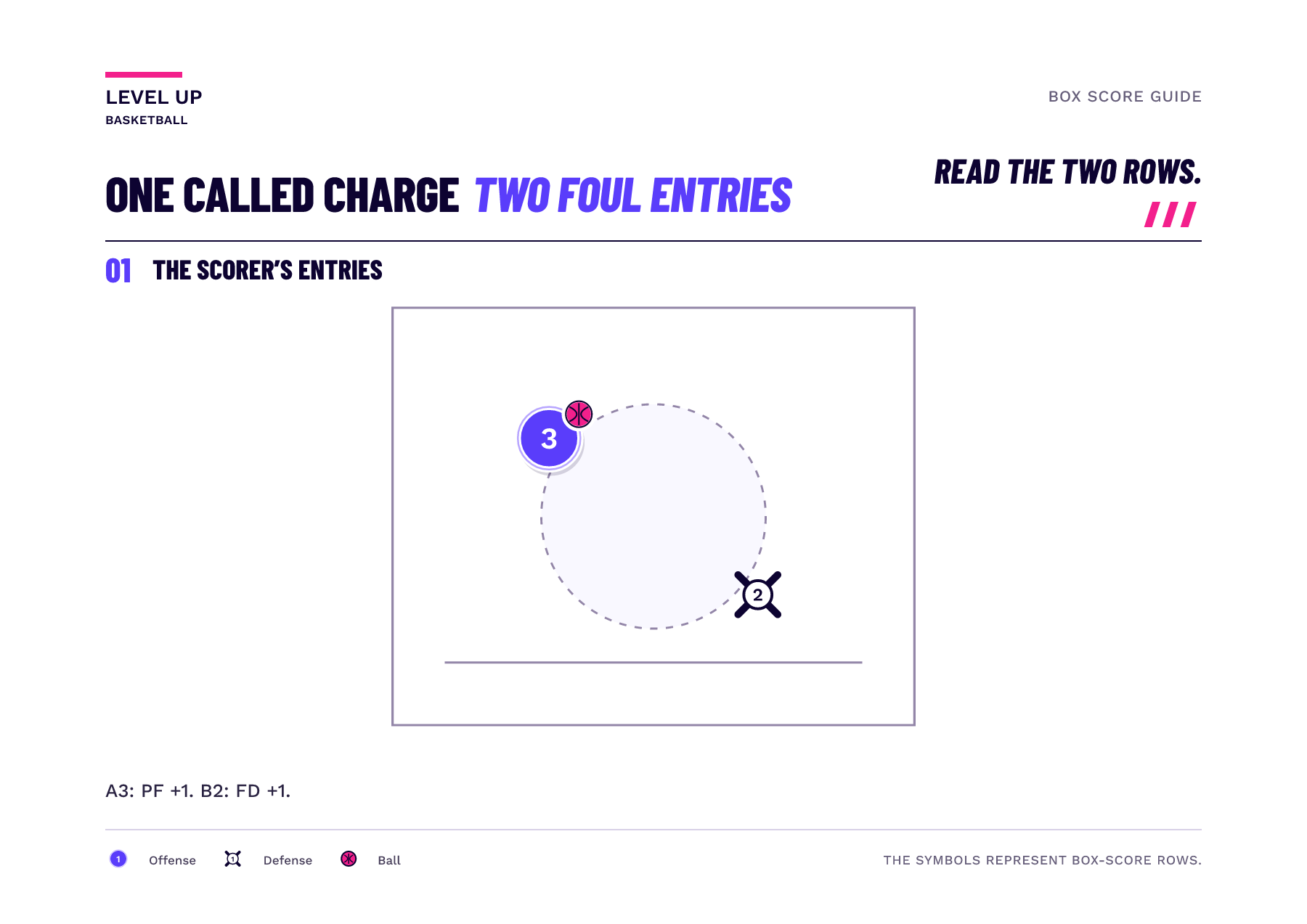
In the FIBA Statisticians’ Manual, recording a foul starts with the referee’s decision. In the manual’s example, the referee has already called a charge on A3 against B2. The scorer then updates a different column for each player. Blocking vs. charging fouls
| Player’s row | Column | Change from the call |
|---|---|---|
| A3 | PF | +1 personal foul |
| B2 | FD | +1 foul drawn |
Swipe sideways to explore the full diagram.
What the FD total leaves out
Using the FIBA Statisticians’ Manual’s definition, read FD as a tally of the fouls the player was credited with drawing. The number alone doesn’t tell you which calls made up the total or how many free throws the player took. Read the player’s free-throw totals separately.
Was this useful?