
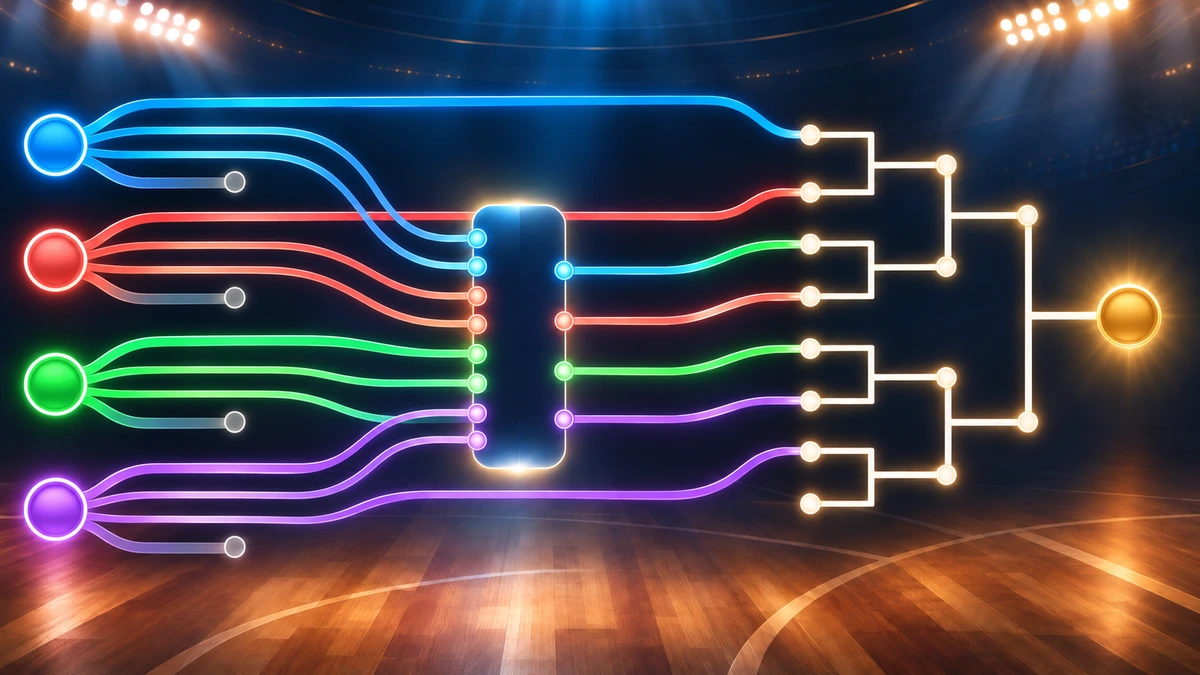
The short version: Sixteen teams begin in four groups of four. Each group winner advances directly to the Quarter-Finals, second- and third-placed teams enter a single-game Qualification to Quarter-Finals crossover, and fourth-placed teams are eliminated. The crossover winners join the group winners in an eight-team, single-elimination Final Phase. This Berlin crossover round is separate from the earlier tournaments used to qualify teams for the World Cup.
Key takeaways
- First place in any group earns direct entry to the Quarter-Finals.
- Second- and third-placed teams must survive a single-game Qualification to Quarter-Finals crossover; fourth-placed teams are eliminated.
- The four crossover winners join the four group winners in an eight-team, single-elimination Final Phase.
- The March Qualifying Tournaments decide entry into the World Cup; the similarly named September crossover round decides entry into the Quarter-Finals.
The 16-team map in one view
FIBA describes the 2026 World Cup in Berlin as a 16-team event with 36 games across 10 days, from September 4 to 13. That is the whole tournament in one sentence; understanding it as a fan or coach requires seeing that it has three different competitive layers: groups, a crossover qualification round, and the final knockout phase. Competition System - FIBA Women's Basketball World Cup 2026 | FIBA Basketball
According to FIBA, the field expanded from 12 teams to 16 for 2026. The important consequence is not merely four additional places. The Berlin format now begins with four separate groups and gives each finishing position a clearly different consequence. Everything you need to know about the FIBA Women's Basketball World Cup 2026 Qualifying Tournaments | FIBA Basketball
What every group finishing position means
The 16 teams are divided into Groups A, B, C, and D, with four teams in each group. The key target is first place: every group winner bypasses the extra qualification game and goes directly to the Quarter-Finals. Teams finishing second or third remain alive but must play in the Qualification to Quarter-Finals round. Fourth place means the tournament ends after the Group Phase.
| Group finish | What happens next | Competitive meaning |
|---|---|---|
| 1st | Direct place in the Quarter-Finals | Skips the Qualification to Quarter-Finals round |
| 2nd | Enters Qualification to Quarter-Finals | Must win one crossover elimination game |
| 3rd | Enters Qualification to Quarter-Finals | Must win one crossover elimination game |
| 4th | Eliminated after the Group Phase | Does not advance |
For coaches and players, the standings create two objectives rather than one. First, stay out of fourth to keep the tournament alive. Second, chase first because it removes an entire win-or-go-home hurdle. Second and third both preserve a path to the title, but neither provides the direct route earned by a group winner.
The Qualification to Quarter-Finals round is a crossover knockout
The Qualification to Quarter-Finals round is part of the Berlin tournament itself. It is an intermediate knockout stage for the eight teams that finish second or third in their groups. Each matchup is a single elimination game: win and advance; lose and the World Cup run is over.
FIBA’s published competition-system description specifies cross-group matchups between Groups A and B and, separately, between Groups C and D. The approved evidence for this guide does not establish the exact place-by-place pairings, so readers should use FIBA’s live event page for the official bracket rather than infer a specific A2-versus-B3 arrangement.
The four winners of those crossover games advance to the Quarter-Finals, where they meet the four group winners. That produces the eight-team quarter-final field: four teams arriving directly from first place and four arriving through an additional elimination game.
The Final Phase is a classic single-elimination bracket
Once eight teams remain, the competition follows a familiar knockout path. The Quarter-Finals and Semi-Finals determine the two finalists. The Semi-Final winners play for the championship, while the Semi-Final losers meet in the Third Place Game. Every game in this Final Phase is single-elimination.
There is no series and no second leg to repair a bad night. From the Qualification to Quarter-Finals round onward, every participating team faces an immediate result: advance or leave the title path. A group winner simply enters that pressure one stage later.
Qualifying for Berlin is different from qualifying for the Quarter-Finals
The phrase “Qualification to Quarter-Finals” can be confusing because it is not the same as qualifying for the World Cup. According to FIBA, the separate FIBA Women’s Basketball World Cup 2026 Qualifying Tournaments were scheduled for March 11–17 in Wuhan, Lyon-Villeurbanne, San Juan, and Istanbul. Those tournaments concerned entry into the 16-team World Cup field, with 11 World Cup tickets available at that stage.
According to Competition System - FIBA Women's Basketball World Cup 2026 | FIBA Basketball, the Qualification to Quarter-Finals round happens inside the September 4–13, 2026 World Cup in Berlin. Its participants have already qualified for the World Cup; they are playing for a place in its Quarter-Finals. A useful reading shortcut is: the March Qualifying Tournaments decide who reaches Berlin, while Berlin’s Qualification to Quarter-Finals round decides who reaches the last eight.
A simple way to follow the tournament
- Start with 16 teams arranged in four groups of four.
- Move each first-place team directly into the Quarter-Finals.
- Send each second- and third-place team into a single-game crossover qualification round; eliminate each fourth-place team.
- Add the four crossover winners to the four group winners to form the Quarter-Finals.
- Continue by single elimination through the Semi-Finals, Third Place Game, and Final.
Eugene Lisovskiy authors Level Up Basketball’s international competition and basketball-trends analysis. Event formats can be updated or clarified, so use FIBA’s live event pages as the final authority for the official bracket and current competition details.
Was this useful?