
The short version: The qualification process for the 2027 FIBA Basketball World Cup includes specific rules for the Asian Qualifiers, where teams compete to qualify alongside prequalified host Qatar.
Key takeaways
- A total of 80 national teams compete across six nine-day windows, playing 420 games globally from November 2025 to March 2027.
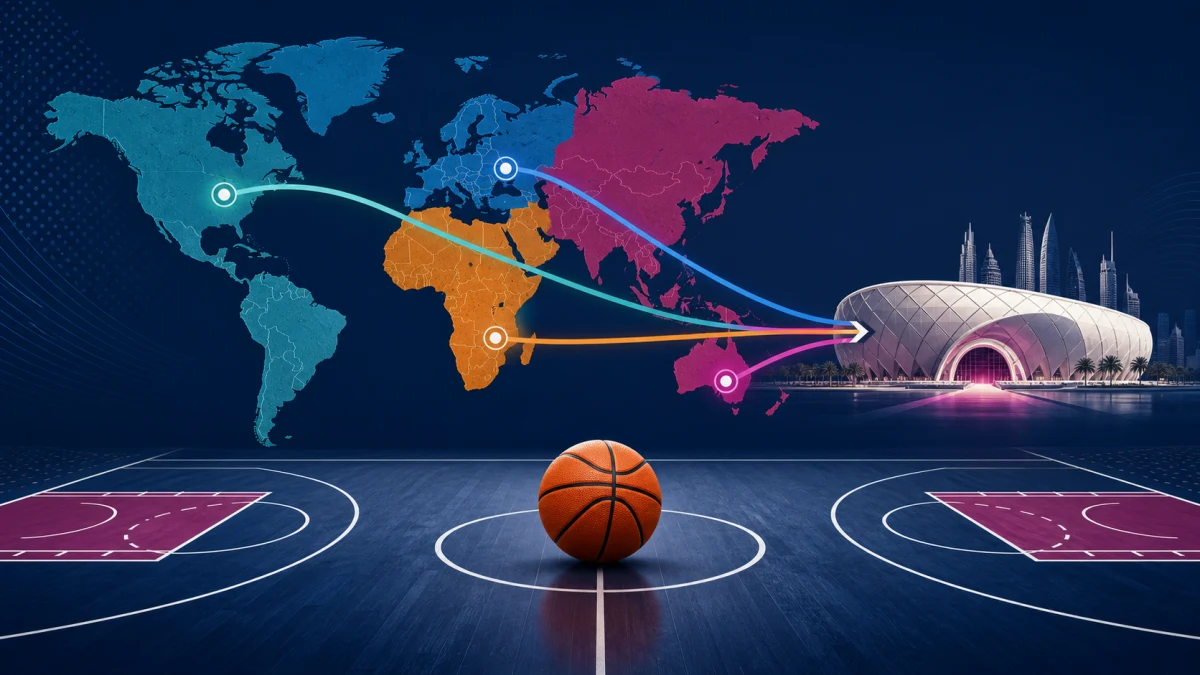
- The qualification path is region-specific, with Europe receiving 12 spots, the Americas 7 spots, Africa 5 spots, and Asia/Oceania 6 spots (plus host Qatar).
- Results from the First Round carry over completely to the Second Round, making every early game critical for qualification.
- Africa uses a centralized tournament format for its windows, unlike the home-and-away system used by the other three regions.
- Qatar qualifies automatically as host but still participates in the First and Second Rounds of Asian qualification, affecting group dynamics.
- The World Cup serves as a direct pathway to the Los Angeles 2028 Olympic Games, qualifying seven national teams directly.
Introduction to the Road to Qatar 2027
The global basketball landscape is entering a critical transition phase. As national teams conclude the third qualifying window in July 2026, the focus shifts immediately to the high-stakes Second Round of qualifiers starting in late August 2026. This transition represents a defining moment for players, coaches, and federations worldwide. The margin for error disappears as teams carry forward their hard-earned results into new, consolidated groups where every possession, point differential, and victory dictates their sporting destiny.
The stakes extend beyond the World Cup trophy itself. The FIBA Basketball World Cup 2027 will directly qualify seven national teams for the Los Angeles 2028 Olympic Games, making these qualifiers the foundational step for any country harboring Olympic ambitions. For players, coaches, and families following their national teams, understanding the mechanics of this qualification process is essential to appreciating the drama that unfolds during every international break. National Team Basketball Competition System | About FIBA
Understanding the FIBA Window System and Calendar
To accommodate domestic club seasons while maintaining the excitement of national team basketball, FIBA utilizes a structured 'window' system. Each qualifying window is nine days long, starting on a Monday and ending on the following Tuesday. During this brief period, players pause their club commitments, travel to join their national selections, and typically play two games before returning to their professional teams. FIBA Basketball World Cup | About FIBA
The FIBA Basketball World Cup 2027 Qualifiers will feature 80 national teams playing 420 games across six dedicated windows from November 2025 to March 2027. This synchronized global calendar ensures that fans across the world experience high-level international basketball simultaneously, creating a unified narrative leading up to the main tournament in Qatar. Everything you need to know about the FIBA Basketball World Cup 2027 Qualifiers Draw | About FIBA
While the timing of these windows is identical worldwide, the game format is not entirely uniform. Unlike other regions that play home-and-away games, Africa's qualifiers are played in a tournament format. This operational difference is crucial for coaches and players to understand, as tournament-style windows require different physical preparation and roster depth compared to the standard home-and-away travel schedule.
| Window | Timeline | Key Milestone |
|---|---|---|
| Window 1 | November 2025 | First Round Opening Games |
| Window 2 | February 2026 | First Round Midpoint |
| Window 3 | June / July 2026 | First Round Conclusion & Transition |
| Window 4 | August 2026 | Second Round Opening Games |
| Window 5 | November 2026 | Second Round Midpoint |
| Window 6 | February / March 2027 | Final Qualifiers Decided |
Regional Breakdowns: How Each Zone Qualifies
The African Qualifiers
In the African Qualifiers, 16 teams will play across 5 windows to determine the 5 nations that advance to the FIBA Basketball World Cup 2027. The 16 teams participating in the African Qualifiers are the same 16 teams that will compete at the FIBA AfroBasket 2025. In the African Qualifiers First Round, teams play each other twice across two tournaments for a total of 6 games, with the top three teams in each group advancing. How to Qualify for the World Cup - FIBA Basketball World Cup 2027 African Qualifiers | FIBA Basketball
In the African Qualifiers Second Round, results are carried forward and the top two teams in each of the two new groups, plus the best third-placed team, advance to the World Cup. Specifically, First Round Groups A and C merge to form Group E, while Groups B and D merge to form Group F in the Second Round. This merge ensures that teams only face opponents they have not yet played, preserving the competitive integrity of the first-round results.
The Americas Qualifiers
In the Americas Qualifiers, 16 teams play across 6 windows to qualify 7 nations to the FIBA Basketball World Cup 2027. For the Americas Qualifiers, 12 teams qualify via the FIBA AmeriCup 2025, and 4 teams qualify through the Americas Pre-Qualifiers. This blend of established continental powerhouses and emerging programs creates a highly competitive environment from the very first window. How to Qualify for the World Cup - FIBA Basketball World Cup 2027 Americas Qualifiers | FIBA Basketball
Following the First Round, the advancing teams are split into two new groups of six. In the Americas Qualifiers Second Round, the top 3 teams in each of the two new groups, along with the best-placed fourth team, will advance to the World Cup. This format rewards consistency, as a single slip-up in the early windows can jeopardize a team's standing in the final group calculations.
The Asian Qualifiers (including Oceania)
The Asian qualification pathway features a unique dynamic due to the host nation's participation. In the Asian Qualifiers, host nation Qatar is guaranteed a spot in the World Cup but will still play in the First and Second Rounds of the Qualifiers. In the Asian Qualifiers, prequalified host team Qatar will take up one of the three Second Round group spots regardless of their final position in their First Round group. How to Qualify for the World Cup - FIBA Basketball World Cup 2027 Asian Qualifiers | FIBA Basketball
This rule has significant mathematical implications for the other competing nations. In the Asian Qualifiers Second Round, the top 3 teams in each group, the best fourth-placed team, and Qatar will advance to the World Cup. Because Qatar's spot is guaranteed, their presence in the standings does not block other deserving teams from advancing, ensuring that Asia still sends its strongest competitive representatives to the tournament.
The European Qualifiers
Europe features the largest and most complex qualification bracket. In the European Qualifiers, 32 teams will play across 6 windows, with 12 nations advancing to the FIBA Basketball World Cup 2027. For the European Qualifiers, 24 teams qualify via the FIBA EuroBasket 2025, and 8 teams qualify through the European Pre-Qualifiers. How to Qualify for the World Cup - FIBA Basketball World Cup 2027 European Qualifiers | FIBA Basketball
The transition to the Second Round involves a massive consolidation of groups. In the European Qualifiers, the First Round groups merge in the Second Round as follows: A and B form I, C and D form J, E and F form K, and G and H form L. Once these six-team groups are established, the competition intensifies. In the European Qualifiers Second Round, the 3 best-placed teams in each of the four new groups will advance to the World Cup, leaving no room for error for traditional European basketball giants.
Crucial Rules: Carry-Over Results and Host Status Nuances
One of the most critical aspects of the African Qualifiers is the carry-over rule. In the African Qualifiers Second Round, results from the First Round are carried forward, meaning every single game counts. The top two teams in each of the two new groups, along with the best third-placed team, will advance to the World Cup.
Additionally, understanding the host status nuances is vital for fans and analysts following the Asian region. In the Asian Qualifiers, prequalified host team Qatar will take up one of the three Second Round group spots regardless of their final position in their First Round group. In the Asian Qualifiers Second Round, the top 3 teams in each group, the best fourth-placed team, and Qatar will advance to the World Cup.
Limitations and Overlapping Calendars
A common source of confusion for international basketball fans is the overlapping calendar between the FIBA Basketball World Cup Qualifiers and various Continental Cup Qualifiers, such as the FIBA AmeriCup 2025 or FIBA EuroBasket 2025 qualifiers. While these tournaments often feature the same national teams and run during similar calendar windows, they are entirely separate competitions with distinct qualification paths. Success or failure in a EuroBasket qualifier does not directly impact a team's standing in the World Cup Qualifiers, though the roster selections and team chemistry certainly carry over.
Furthermore, it is important to clarify that Level Up Basketball is an independent educational publisher. We publish explanatory basketball articles for players, coaches, families, and fans to help them better understand the global game. Level Up Basketball is not affiliated with FIBA, does not own official competition data, and does not represent the governing body of international basketball.