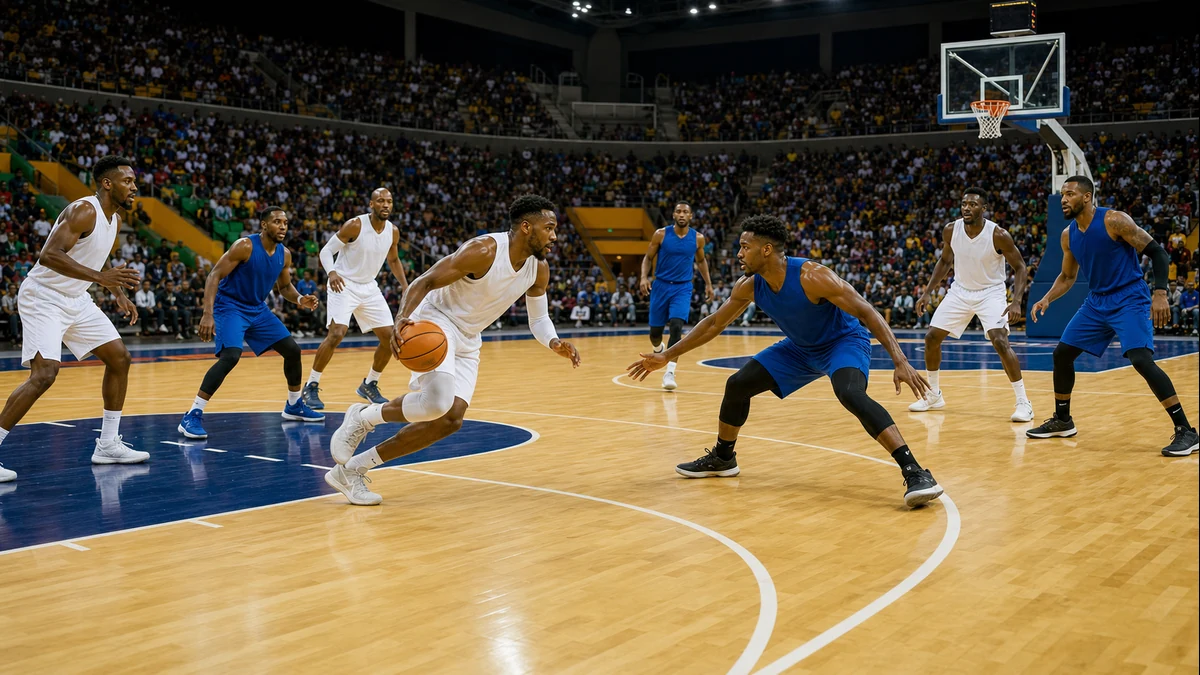


The short version: For five-on-five FIBA national teams, a player needs the relevant legal nationality and must satisfy the current national-status rules. Birthplace, passport timing, significant links, youth transfers, and earlier final rosters can change the result. Some players count as Restricted Players, with only one allowed on a final roster. A federation—not a player or agent—submits a case to FIBA, and 3x3 uses separate Book 6 provisions.
Key takeaways
- Legal nationality is necessary, but the current framework also tests birthplace, passport timing, links, and prior representation.
- The current rules use Restricted Player status for some cases, with one Restricted Player permitted on a final roster.
- Final-roster inclusion matters more than a casual invitation because it can select national status under Book 3.
- A switch is not a general free-transfer rule: competition type, elapsed time, game count, federation input, timing, and one-change limits apply.
- Five-on-five and 3x3 are connected but not interchangeable; Book 6 supplies specific 3x3 conditions.
What does FIBA national-team eligibility mean?
FIBA national-team eligibility has two connected layers. First, a player must hold the required legal nationality. Second, the player must satisfy FIBA's eligibility and national-status rules for that federation. A passport matters, but it is not an automatic ticket. The current Book 3 asks how the nationality relates to birthplace, when the passport was issued, whether the player has significant links, and whether an earlier roster already selected another national status. FIBA Internal Regulations Book 3 — Players and Officials how FIBA World Cup qualifying is structured
Version control is unusually important here. FIBA's official regulations hub is the live index for its governing documents, and the current Book 3 reflects amendments approved in December 2025 to clarify status decisions and introduce more objective criteria. This explainer was checked against that live book, not the older April 2024 PDF still linked in some search results. It summarizes the framework; it cannot determine a named player's case or replace a federation or FIBA ruling. FIBA General Statutes and Internal Regulations hub FIBA Central Board approves national-status amendments
How do birthplace, passports, and significant links work?
The cleanest route in Article 3-14 combines three facts: the player was born in the represented country or territory, holds its valid passport, and gives a written declaration choosing that federation, which the federation submits to FIBA. When the player holds the passport but was born elsewhere, Article 3-15 adds another test. The player must either hold—or previously have held—a qualifying passport issued before the eighteenth birthday, or demonstrate significant links that FIBA accepts.
Significant links are a whole-picture assessment, not a points quiz a reader can score at home. Book 3 lists residence, seasons in domestic competitions, a parent's birthplace, schooling, basketball development, visits and physical presence, immediate family, and other connections such as marriage or property. It says no single factor is decisive. That is why two players with superficially similar passports can receive different classifications after their full records are reviewed.
If a passport holder born elsewhere does not satisfy the Article 3-15 route, FIBA may classify that player as a Restricted Player. A team may carry only one Restricted Player on its Final Team Delegation Roster under the cited categories. This is the current regulatory concept behind many conversations that casually use labels such as acquired-nationality or naturalized player. The shorthand is not enough to decide the roster classification; the current FIBA decision is what controls.
Who submits the case, and what evidence matters?
The formal request belongs to the relevant National Member Federation. Book 3 says players, agents, and other people or entities do not have standing to submit a national-status request directly. The federation must send the required information and documents no later than fourteen days before the competition begins; FIBA may decline an incomplete or late request. A player or family should therefore work through the federation early rather than treating a passport photo as the complete filing.
- Confirm which current FIBA book and competition rules apply on the planned roster date.
- Collect valid identity and passport records plus the written choice required for the claimed federation.
- If significant links are relevant, organize the underlying residence, school, family, and basketball records instead of relying on a summary assertion.
- Disclose earlier final rosters in five-on-five and 3x3 because prior representation can control whether a change is available. FIBA Internal Regulations Book 6 — 3x3
- Ask the federation and FIBA for a case-specific decision; do not use a media report or this explainer as eligibility clearance.
Youth-transfer history can add another constraint. Under Article 3-21, a player who transferred through the cited young-player provisions generally cannot represent the destination federation until age twenty-three, even after receiving its passport, unless the player already held that destination passport before transferring. The exact registration history matters, so families should preserve federation records instead of assuming age-group play, schooling, or residency automatically resolves the question.
When does prior representation lock or change national status?
The key trigger in the current text is inclusion on a Final Team Delegation Roster for a FIBA national-team competition. Article 3-22 treats that inclusion as an irrevocable selection of national status, subject only to the following change provisions. Book 3 then draws a hard line around listed competitions, including the senior World Cups, Olympic tournaments, men's and women's continental cups, the U19 World Cups, U20 EuroBaskets, and most official 3x3 national-team competitions. For rosters in those listed events after the new rule took effect, national status may not change through the ordinary route. the difference between national-team and international club competition
Other FIBA national-team competitions can leave a narrow change path. Article 3-25 requires that at least five years have passed since the player's last final-roster appearance for the previous federation, that the player was on that federation's final roster for no more than five official games, and that the previous federation agrees—or the Secretary General decides in the absence of agreement. The player must still satisfy the recognition rules for the new federation. This is not a simple switch after a waiting period; every listed condition and the formal decision matter.
When FIBA authorizes an Article 3-25 change, the player represents the new federation as a Restricted Player. The approval enters into force forty-five days after notification, and Book 3 permits only one national-status change, including no later return to the original federation. Underage U16, U17, and U18 rosters have a separate route in Article 3-23, again requiring a federation request and the underlying eligibility conditions. Readers should avoid turning one exception into a universal rule.
What special cases does FIBA handle?
Dependent territories use a specific framework because a player may hold the passport of the main territory while representing a distinct FIBA member. Book 3 looks for a qualifying passport plus birthplace in the dependent territory, a parent born there, or significant links. A player who lacks one of those connections may be restricted. The terminology is technical: political identity, passport identity, and FIBA membership do not always map to the same label.
Marginal and exceptional cases sit with the FIBA Secretary General. Book 3 expressly mentions refugees, people with asylum rights, and displaced persons under relevant United Nations conventions, and it permits a specific FIBA nationality in exceptional circumstances. This is not a public checklist that guarantees an answer; FIBA decides facts the standard nationality paths do not resolve.
Are the rules the same for FIBA 3x3?
No. Book 3 says its national-status chapter excludes 3x3 unless another provision expressly brings it in, and the current Book 6—effective 22 April 2026—contains the separate 3x3 rules. For the senior Open category, Book 6 requires the country's legal nationality, uses a passport-date condition tied to the calendar before the competition, and considers whether the player previously represented another country in a main official five-on-five or 3x3 competition, subject to its special cases. Olympic 3x3 adds another passport-timing rule. how FIBA competition systems use separate rule frameworks
The disciplines still interact. Book 6 states that inclusion on specified national-team rosters can select national status for both 3x3 and five-on-five, subject to Book 3's change provisions. It also explains how later restricted or unrestricted Book 3 decisions affect 3x3 eligibility. The practical lesson is simple: check both books before treating a 3x3 roster as separate history. A federation needs the exact competition, roster, date, passport, and prior-decision record.
Frequently asked questions
Is a passport enough to play for a FIBA national team?
Not always. A valid passport is part of the framework, but Book 3 also distinguishes birthplace, passport timing, significant links, youth-transfer history, and earlier final rosters. A passport holder born outside the represented country may need a pre-eighteen passport or accepted significant links; otherwise FIBA may classify the player as restricted. The federation must submit the actual case.
How many Restricted Players can a FIBA team use?
The current Book 3 permits one Restricted Player on a national team's Final Team Delegation Roster under Articles 3-17, 3-26, or 3-32. Restricted status can arise through different paths, including a passport holder who does not satisfy the principal recognition conditions or a player authorized to change status under Article 3-25. The final FIBA classification, not a fan label, determines the count.
Can a player switch national teams after appearing for another country?
Sometimes, but not through one universal rule. The listed major competitions can block a change, while certain other competitions may allow a request after at least five years and no more than five official games, with the prior federation's agreement or a Secretary General decision. An approved change is restricted, takes effect after forty-five days, and can happen only once.
Does playing 3x3 affect five-on-five eligibility?
It can. Book 6 says inclusion on specified final or event rosters can select national status for both 3x3 and five-on-five, subject to Book 3's change provisions. Book 6 also uses its own passport timing, prior-representation, profile, and competition requirements. A player or federation should review both current books before assuming the two disciplines create separate eligibility histories.