

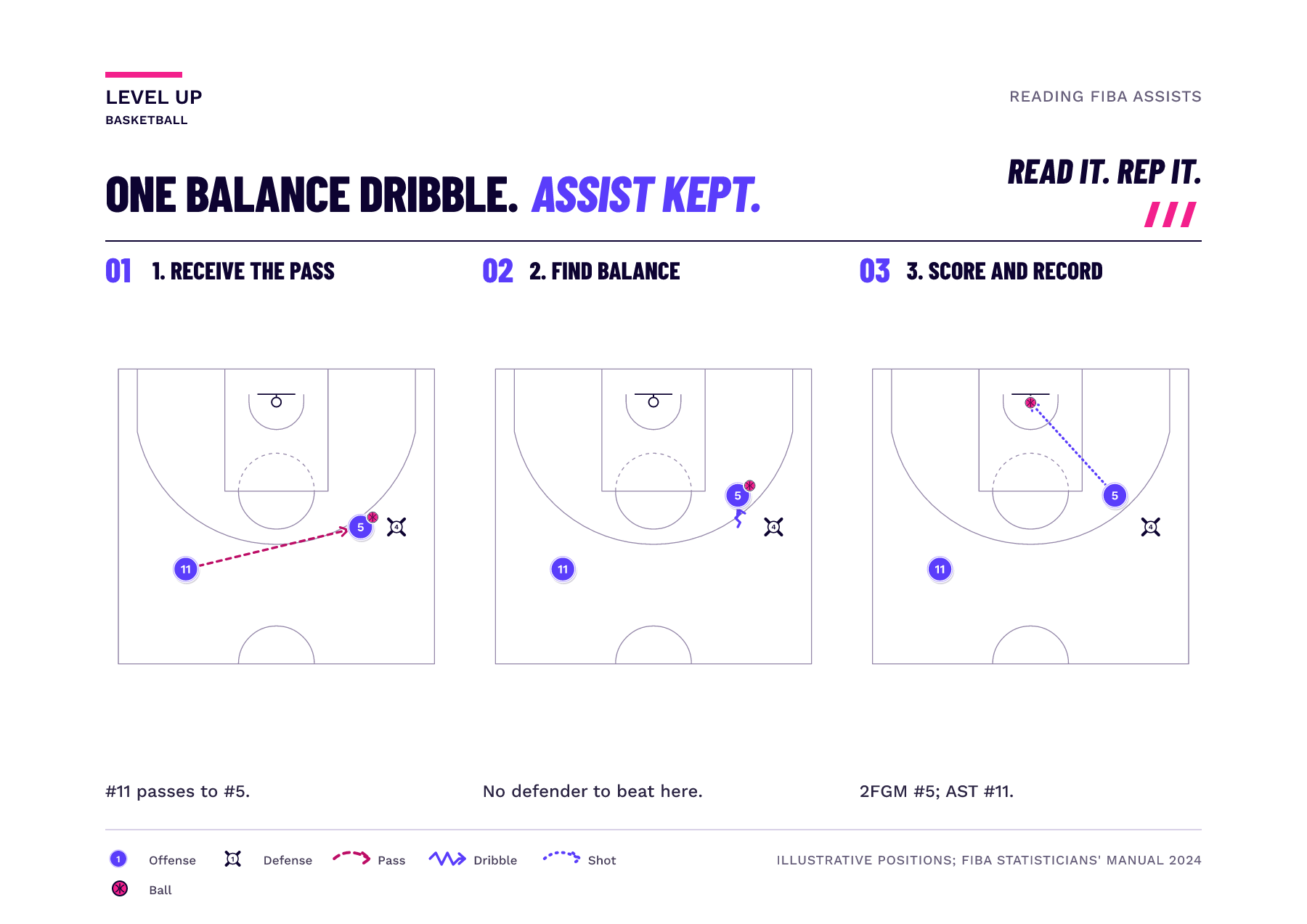
The short version: Yes, the passer can still receive an assist. In FIBA’s 2024 Statisticians’ Manual, white #11 passes to white #5, who takes one dribble to find balance and makes a two-pointer. #11 receives the assist. For outside-paint catches, the manual’s criterion considers whether the scorer needed to beat their defender.
Key takeaways
- FIBA’s 2024 manual preserves the assist in Example 3 after one dribble to find balance.
- For outside-paint catches, FIBA’s 2024 manual allows one or more dribbles when the scorer does not need to beat their defender.
- FIBA’s Example 3 credits two different contributions: the made two-pointer to #5 and the assist to #11.
Does the bounce erase the assist?
No—the bounce does not automatically erase the passer’s credit. FIBA’s Statisticians’ Manual gives an example in which the receiver takes one dribble to find balance, makes the shot and leaves the passer with an assist. FIBA Statisticians' Manual 2024
FIBA’s manual defines an assist as a pass that leads directly to a teammate scoring. When you read the play, follow that connection between the pass and the finish.
Follow #11’s pass to #5’s basket
In Example 3 of FIBA’s Statisticians’ Manual, white #11 passes to white #5. #5 takes one dribble to find balance, then shoots and scores. FIBA records a made two-pointer for #5 and an assist for #11.
Swipe sideways to explore the full diagram.
Finding balance or beating a defender?
For a catch outside the paint, FIBA’s Statisticians’ Manual allows an assist after one or more dribbles when the scorer does not need to beat their defender. It withholds the assist when the scorer beats a defender one-on-one who is facing the scorer directly between the scorer and the basket.
Ask what the dribble accomplished: did the receiver settle for the shot, or have to get past that defender? Counting bounces alone misses this distinction. FIBA’s wording allows one or more dribbles in the outside-paint situation, so Example 3 should not become a one-dribble maximum.
Read the two statistical credits
| Player | Entry | Meaning |
|---|---|---|
| #5 white | 2FGM | Credit for the made two-pointer |
| #11 white | AST | Credit for the pass leading directly to the basket |
Was this useful?