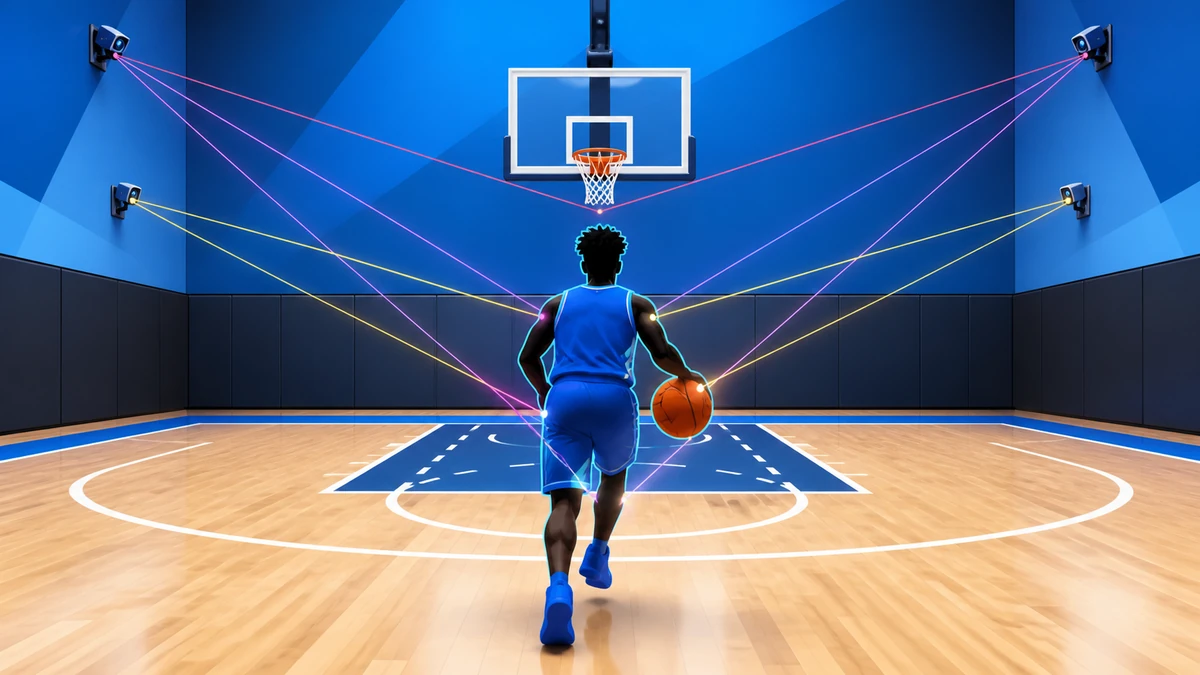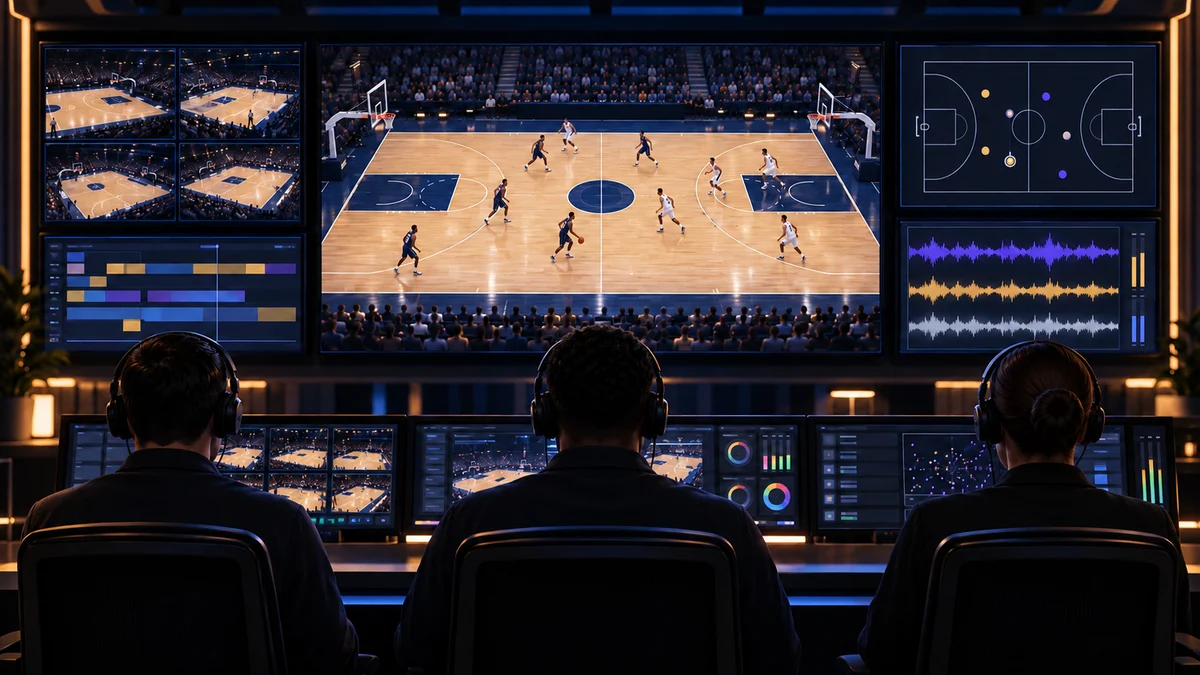

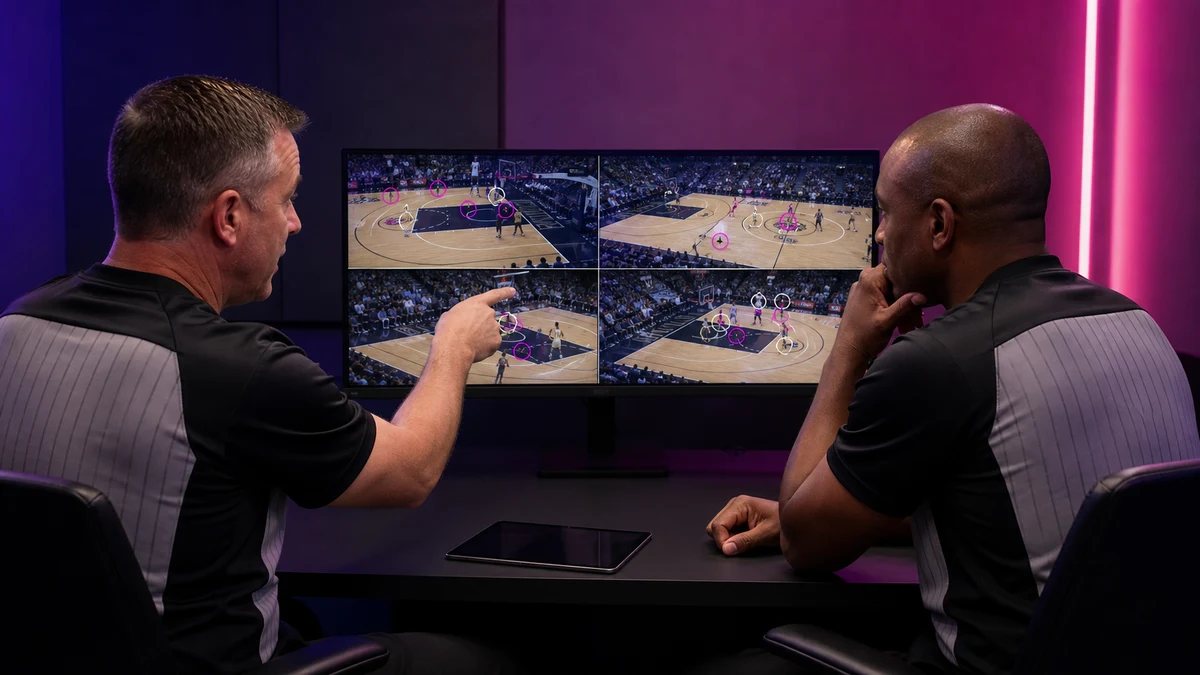
The short version: Basketball officiating programs use technology as a review loop: capture video, tag plays, apply shared criteria, add evaluator feedback, track patterns, and turn selected clips into training. The NBA has described data-driven review, video-integrated tools, replay archives, and virtual reality. FIBA documents tagged-video monitoring, performance reports, feedback, workshops, and simulations. Public transparency and internal evaluation can share evidence, but they are not the same system.
Key takeaways
- Video gives evaluators repeatable views of the play, but the review still needs rule context, coverage responsibility, and a defined standard.
- Tagged plays, playlists, comments, and trend tracking turn isolated clips into a development record.
- Accuracy and error measures can reveal patterns, yet a single number cannot fully represent positioning, communication, mechanics, or game management.
- Simulation, video tests, workshops, and on-court evaluation connect screen-based review to real officiating decisions.
- Replay archives and Last Two Minute Reports are public transparency tools; confidential referee evaluation should not be inferred from public pages.
What is basketball referee performance technology?
Basketball referee performance technology is the collection of video, tagging, review, collaboration, testing, reporting, and simulation tools used to develop and evaluate officials. The useful unit is not the dashboard by itself. It is the review loop: preserve the play, identify the decision and coverage responsibility, compare the sequence with a shared standard, add instructor feedback, track patterns, and select examples for future training. FIBA summarizes its referee-operations mission through planning and analysis, education and training, and delivery—three functions that technology can connect but cannot collapse into one number. FIBA Refereeing Initiatives
The systems operate at different layers. In-game replay supports decisions on specifically reviewable events. Postgame review looks backward at calls, non-calls, positioning, mechanics, communication, and recurring situations. Development platforms organize clips and comments over time. Public archives and reports explain selected decisions to teams, media, and fans. These layers may use some of the same video, but they answer different questions and should not be treated as one all-purpose grading machine. NBA Referee Engagement and Performance System (REPS) NBA Replay Center NBA.com/Official Relaunch and Transparency Resources basketball instant replay technology
Step 1: capture, synchronize, and tag the right plays
Review starts with reliable video and event identity. A useful record ties the play to game time, crew, call or non-call, rule context, court location, and available camera angles. The NBA Replay Center connects all 30 arenas and gives officials multiple views for reviewable situations. FIBA's planned Referee Operations Centre goes further as a monitoring workflow: video operators tag and analyze games so statistics and clips can support evaluation and future training. The tag does not decide whether the official was correct; it makes the evidence findable and comparable. FIBA Referee Operations Centre for the Basketball World Cup 2027 Qualifiers
Angle selection matters because basketball decisions are spatial. One view may clarify contact; another may reveal whether the official had an open look, whether a partner owned the primary coverage, or whether bodies blocked the line of sight. Synchronization lets an instructor move between those views without pretending that the clearest broadcast angle was available to the on-court official in real time. That distinction keeps video review educational instead of merely outcome-biased.
Step 2: apply criteria, comments, and trends
The NBA has publicly described two complementary ideas. First, its officiating initiatives called for a data-driven game-review system with objective measurement standards and multi-season tracking of call accuracy and errors per game. Second, the REPS application gives officials and management a centralized video environment for watching, analyzing, sharing, saving, categorizing, and commenting on plays. That combination supports both quantitative pattern finding and qualitative explanation. NBA Initiatives to Enhance Referee Performance, Training, and Development basketball advanced statistics
REPS also shows why a development record is more useful than a folder of isolated mistakes. The official description includes playlists, video-integrated rule tests, search, notifications, standardized performance criteria, individual and staff-wide trend tracking, and organized qualitative feedback. An instructor can curate several examples of the same coverage or decision type, discuss why the reads differ, and revisit the pattern later. The technology keeps the trail coherent; the evaluator still has to interpret the basketball context.
What performance measures can and cannot tell you
| Review signal | Useful question | Important limitation |
|---|---|---|
| Call accuracy and errors | Are decision patterns changing over time? | The total needs a defined play set, review standard, and context. |
| Tagged play categories | Which rule, coverage, or action types recur? | A tag organizes evidence; it does not prove responsibility. |
| Positioning and line of sight | Was the official in a credible place to observe the play? | The best camera angle is not the same as the official's live view. |
| Qualitative evaluator feedback | What should the official recognize or adjust next time? | Consistency depends on shared criteria and instructor calibration. |
| Crew and staff trends | Does a pattern appear across games or groups? | Aggregation can hide game difficulty, roles, and different sample sizes. |
FIBA Internal Regulations Book 3 — Referee Instructor Duties
A percentage can answer a narrow question when its denominator and review protocol are known. It cannot, by itself, explain mechanics, communication, crew coordination, advantage and disadvantage, game control, play difficulty, or whether the official had a credible viewing angle. FIBA's regulations reflect that broader frame by pairing analysis and performance reports with direct feedback, and by allowing competition-level rankings within an instructor process. The public documents do not disclose every internal weighting or personnel decision, so readers should not reverse-engineer one from a public clip archive.
Step 3: turn review into training and simulation
Review becomes development when the official has a next repetition. The NBA has publicly identified technology-based training, including virtual reality, while REPS includes video rule tests and curated examples. FIBA's 2025 Africa camp combined rule review and real-game clips with two- and three-person coverage practice, simulations, group discussion, physical testing, and on-court evaluation. The progression is important: see the situation, explain the standard, rehearse the read, then observe the official applying it under movement and time pressure. FIBA Africa Referee Training Camp in Abidjan
Simulation is most useful when it preserves the decision, not just the visual spectacle. A clip can stop before contact and ask for the likely call, coverage owner, or next rotation. A virtual or classroom scenario can vary player speed, screen angle, or line of sight. An on-court drill can then test mechanics and communication with a live crew. None of those methods needs to claim perfect realism. Their value is controlled repetition around a clearly defined officiating problem.
Public transparency is not the same as internal evaluation
The NBA publicly offers a video rulebook, replay archive, and Last Two Minute Reports. Those resources help teams, media, and fans inspect selected rules and decisions. They also create useful teaching material. But a public explanation has a different purpose from a confidential performance file that may contain a broader game sample, instructor comments, assignments, development goals, or employment-sensitive information. Seeing one published assessment does not reveal the league's complete evaluator model.
The same caution applies to artificial intelligence. Computer vision, search, automated tagging, and pattern detection may reduce review friction, but the official sources cited here describe human instructors, referee operations staff, video operators, reports, feedback, and training. They do not support the claim that an algorithm can fully grade an official or replace contextual judgment. A responsible system should make evidence easier to find and decisions easier to discuss while keeping the criteria, reviewer, uncertainty, and appeal path visible. basketball live-stats technology
A practical review workflow for an officiating program
- Define the purpose first: in-game replay, postgame evaluation, development, recruitment, or public transparency.
- Capture synchronized video and preserve game, crew, play, rule, and coverage context.
- Tag a bounded review set and publish the criteria internally before calculating trends.
- Pair quantitative signals with evaluator comments and a clear feedback route for the official.
- Turn recurring findings into playlists, rule tests, simulations, workshops, and on-court repetitions.
- Audit whether the tools improve consistency and learning without claiming that one score captures total officiating quality.
Frequently asked questions
Do basketball leagues grade every referee with one accuracy score?
The NBA has publicly described objective measurement standards and tracking of call accuracy and errors, and FIBA documents performance reports and feedback. Those facts do not establish that either organization reduces every referee to one public score. A responsible reading separates specific measures from the broader evaluation process and avoids guessing at confidential weights or personnel decisions.
Is replay technology the same as referee evaluation technology?
No. Replay technology helps officials review defined in-game situations and reach rulings using available camera angles. Evaluation technology can use video after the game to organize decisions, positioning, trends, instructor comments, and training examples. The layers can share footage, but their timing, audience, criteria, and consequences are different.
How is video used to train basketball referees?
Official NBA and FIBA examples include categorized clips, playlists, comments, video-integrated rule tests, workshops, game-situation review, simulations, and feedback. The strongest workflow asks the official to recognize the rule and coverage context, explain the decision, rehearse the required mechanics or communication, and then apply the lesson in another scenario or on court.
Can AI replace human referee evaluators?
The official sources here support technology for video organization, tagging, trend tracking, testing, replay, simulation, and collaboration. They also describe human referee operations staff, video operators, instructors, reports, and feedback. That evidence supports AI-assisted review tools, not a claim that an algorithm can fully replace contextual human evaluation of officiating performance.