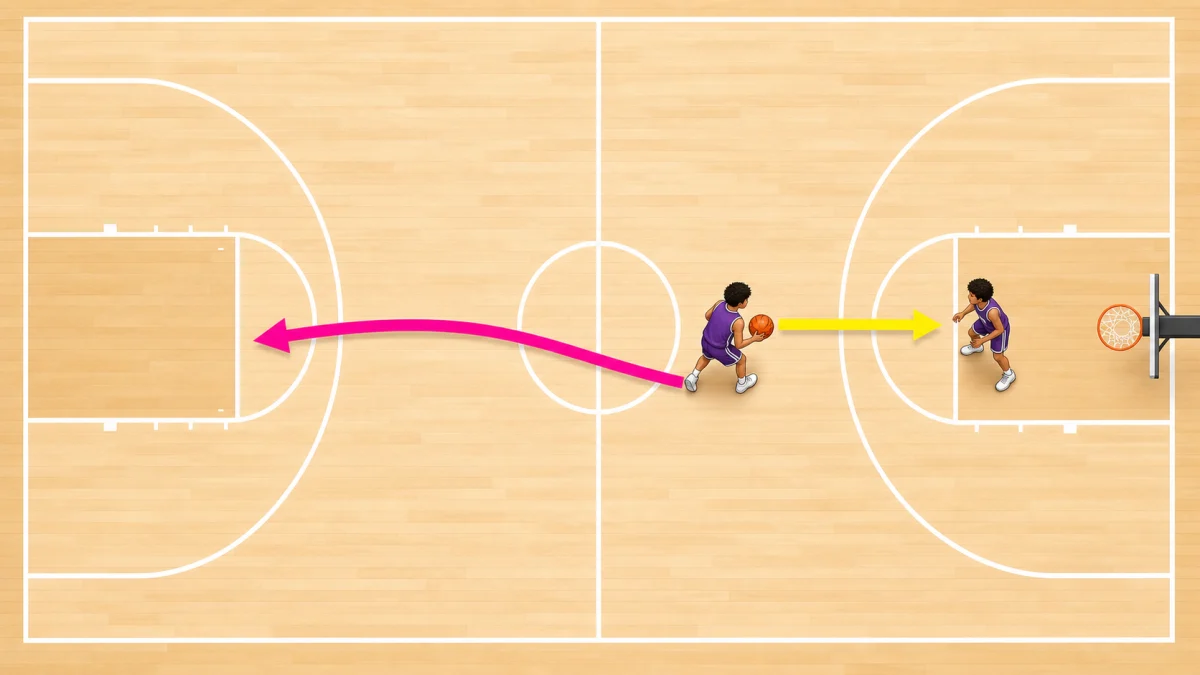


The short version: An elevator screen uses two teammates as doors: a cutter passes between them, then they close the gap. The closure must respect the defender's time and distance to avoid contact; getting the cutter through first does not excuse an illegal screen.
Key takeaways
- Recognize the action by its sequence: a cutter goes between two screeners, then the gap closes.
- The cutter clearing the opening does not automatically make the closure legal.
- When teaching or watching the play, follow the defender through the closure as carefully as you follow the cutter.
What does an elevator screen look like?
An elevator screen, also called a gate screen, is an action in which a player cuts through a gap between two teammates. After the cutter passes through, those teammates move together to close the gap behind them. Think of the two screeners as elevator doors and the cutter as the passenger getting through before they close. 17 Basketball Screens All Players and Coaches Must Know
The door analogy has a limit: closing the gap does not give the screeners permission to make illegal contact. Referee's explanation identifies the key boundary: the defender must have time and distance to avoid contact by stopping or changing direction. Closing too soon can create illegal contact. Understand Elevator Screens - Referee.com
Follow the cutter through the gap
Watch the order: gap, cutter, closure. The two screeners begin separated. Their teammate travels between them. Only after that teammate clears the opening do the screeners bring the doors together. The defining feature is that route through the middle followed by the gap closing behind it.
To picture the jobs, imagine a hypothetical possession with a passer on the wing and a cutter approaching two teammates near the middle of the floor. The cutter goes through the opening and presents a target beyond it. The passer looks for the catch while the screeners coordinate their positions. As a coaching cue, teach the whole possession: getting through the doors is only part of the task; the receiver still needs to find the ball and prepare for the next decision.
When does closing the doors become illegal?
The cutter clearing the gap is not, by itself, proof that the screeners can legally close it. The defender's position matters too. If the closure leaves the defender without time or distance to avoid contact, Referee describes the screen as illegal. A neat-looking finish with the two screeners together does not erase what happened while they were moving.
For coaching, avoid making “shut the doors faster” the only correction. Ask the players to explain where the cutter and defender were when the gap began to close. If the action becomes crowded, reset it and review the spacing rather than treating contact as evidence of a successful screen. review the spacing
A cutter clears the opening, but the trailing defender is immediately behind. The screeners close into the defender's path and cause unavoidable contact. Does the cutter getting through first make the screen legal?
No. The cutter being through establishes the action's sequence, but it does not establish legality. The defender must still have time and distance to avoid contact; closing too soon can create an offensive screening foul.