
The short version: An effective basketball practice is not a collection of disconnected drills, but a deliberate, progressive arc. By structuring practices around USA Basketball's progressive coaching principles—moving systematically from baseline assessment and technical mastery to small-sided decision-making and game-speed pressure—coaches can bridge the gap between training and live competition.
Key takeaways
- Ditch the Random Drills: Practice must follow a progressive arc from technical mastery to random, game-like decision-making.
- Follow Official Ratios: Align your training-to-competition ratios with established developmental age guidelines.
- Assess First: Establish baseline measurements of individual player strengths and weaknesses before setting team goals.
- Structure with Intent: Break practices into time-based segments of 5 to 15 minutes to keep players engaged and active.
- Introduce Sudden Change: Use unexpected scenarios in practice to teach players how to respond quickly without panic.
The Problem with "Peaking by Saturday"
Many coaches fall into the trap of designing practices to survive the next game. They run a series of disconnected drills—a passing line, a layup line, and a 5-on-5 scrimmage—hoping it all magically translates when the referee tosses the ball. This approach promotes a short-term mentality focused purely on immediate outcomes.
According to the Basketball England Player Development Framework, coaches should move beyond a short-term "peaking by Saturday" mentality to focus on long-term success. Their framework advocates for a "Developing Game Awareness" approach, which is built around five core Development Pillars: being Committed, Game Aware, a Skilled Technician, Physically Robust, and a Persistent Performer. When you design your practice plans with these pillars in mind, you shift your focus from merely running drills to actively developing complete players.
The Foundation: Progressive Coaching and Baseline Assessment
To build an effective practice plan, you must first understand who you are coaching. You cannot design a progressive path if you do not know where your players are starting.
As outlined in the USA Basketball Player Development Curriculum, progressive coaching requires establishing a baseline measurement of individual player strengths and weaknesses before setting goals. Once this baseline is established, you can set individualized goals and build a plan to help players reach them.
USA Basketball categorizes player skills into eight distinct categories:
- Ball Handling & Dribbling
- Footwork & Body Control
- Passing & Receiving
- Rebounding
- Screening
- Shooting
- Team Defensive Concepts
- Team Offensive Concepts
By assessing players across these eight categories, you can structure practice segments that directly address their developmental needs.
Structuring Your Practice: Time Blocks and Progression
To keep energy high and maximize learning, your daily practice plans should be highly structured. The National Federation of State High School Associations (NFHS) notes that daily practice plans should be posted to break down every segment of practice and reinforce team philosophies. This transparency helps players understand coach expectations and prepares them mentally for each phase of the session.
The NFHS recommends breaking practices down into time-based segments ranging from five to 15 minutes. This keeps practices fast-paced and prevents players from standing around. Within these segments, you should systematically transition your drills from "blocked" repetitions to "random" game-like decisions.
The Progression Framework
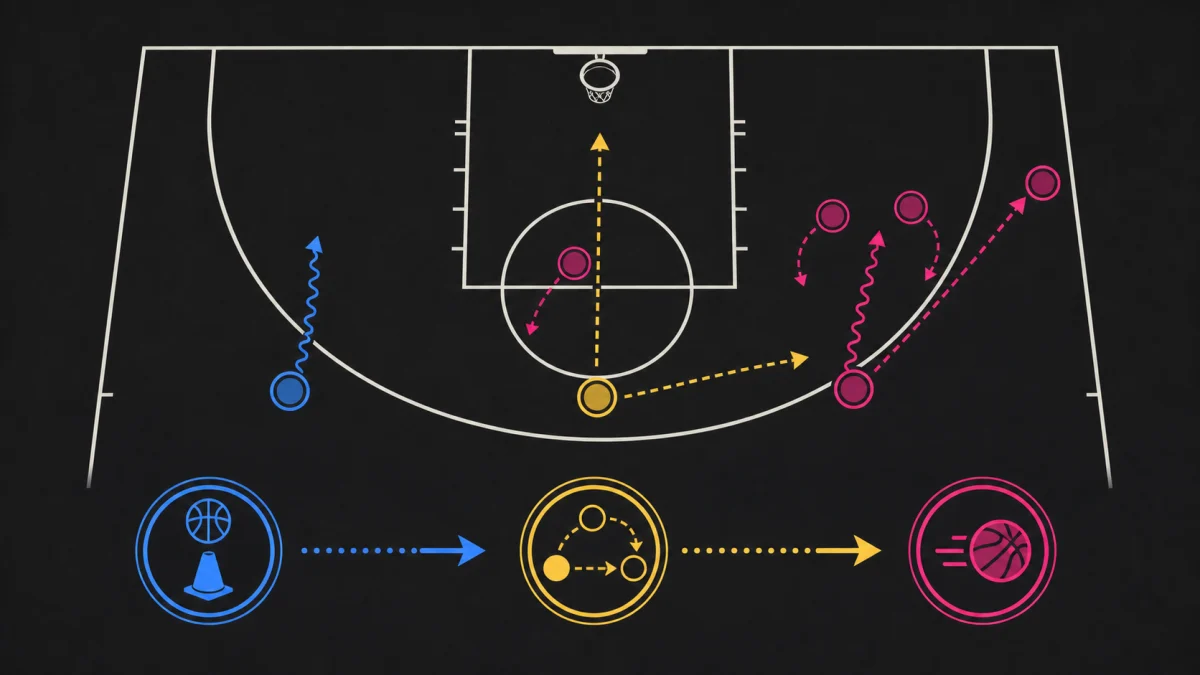
To bridge the gap between training and competition, structure your practice segments using this four-stage progression:
- Assessment & Warm-up (5–10 mins): Dynamic movement combined with basic footwork and ball-handling to activate the body and mind.
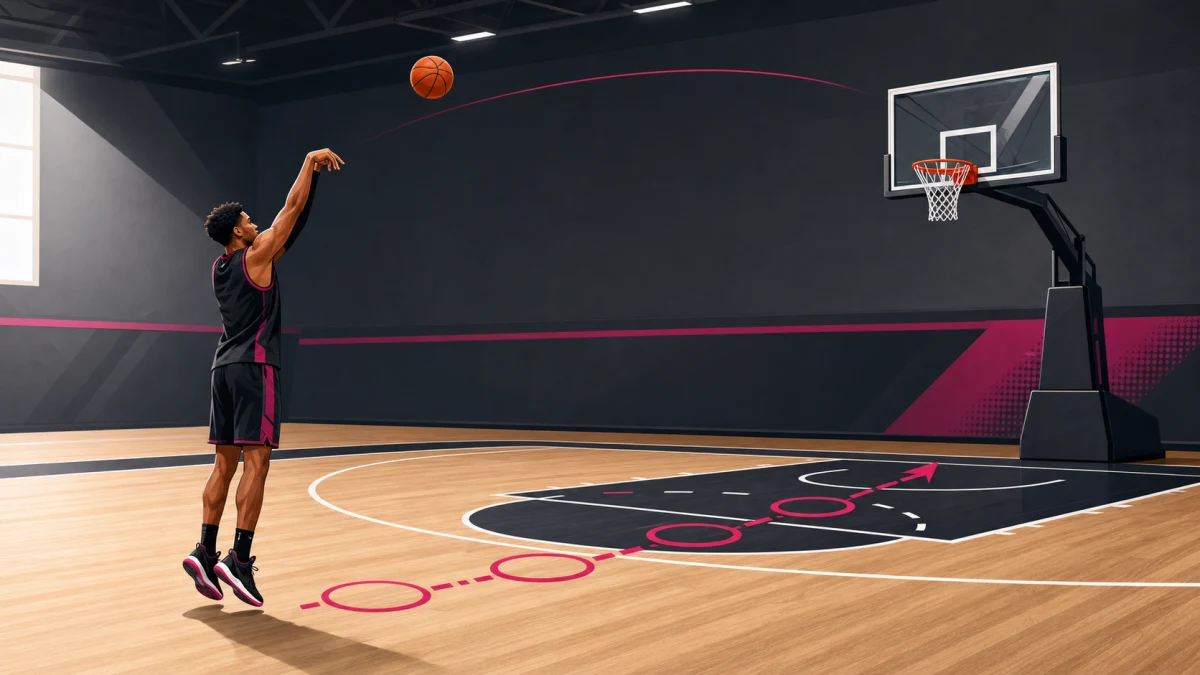
- Technical Mastery (10–15 mins): Blocked drills focusing on mechanics (e.g., shooting form, passing accuracy) where players get high repetitions without defensive pressure.
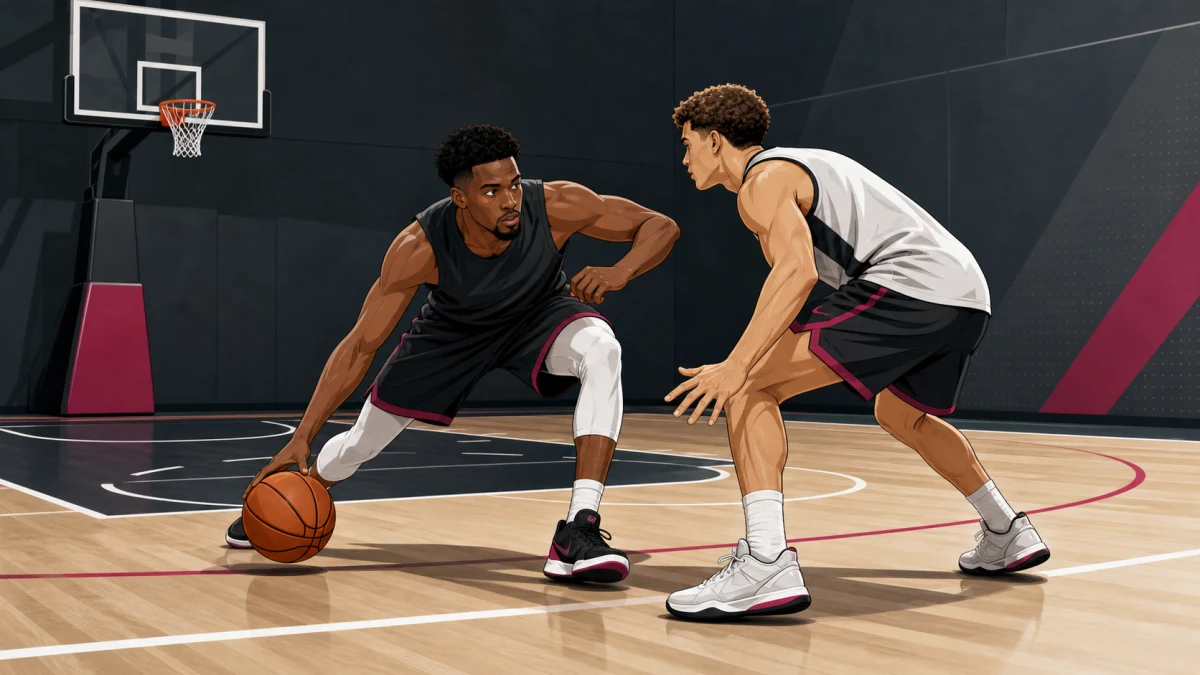
- Small-Sided Decisions (15–20 mins): Transitioning to random practice. Use 1v1, 2v2, or 3v3 scenarios where players must read a defender and make a choice.
- Game-Speed Pressure (15–20 mins): Full-court or half-court scenarios with live defense, transition elements, and constraints that force quick execution.
The NFHS also highlights that introducing sudden change scenarios in practice helps athletes learn to respond quickly without panic. You can insert these sudden changes—such as an unexpected whistle signaling a turnover or an immediate transition from offense to defense—directly into your competitive segments to build mental toughness.
Balancing Training vs. Competition by Age Group
How much of your practice should be dedicated to skill development versus live play? USA Basketball provides clear definitions to guide this balance. They define training as all activity related to a player's technical skill development, while competition is defined as competing against another team or imparting team strategies to prepare for competition.
The recommended training-to-competition ratios vary significantly by developmental stage:
| Developmental Stage | Approximate Age | Recommended Ratio (Training : Competition) | Primary Focus |
|---|---|---|---|
| Learning to Train | 8–12 years old | 70:30 | Fundamental basketball skills and overall sports skills |
| Training to Train | 12–15 years old | 60:40 | Aerobic base, strength development, and skill consolidation |
| Training to Compete | 14–17 years old | 50:50 | Fitness optimization, individual, and position-specific skills |
Applying these ratios ensures that younger players spend the vast majority of their time building a technical foundation before they are expected to execute complex team strategies under competitive pressure.
What This Means for Players and Coaches
For players, this progressive approach means training sessions will feel more challenging but far more rewarding. Instead of memorizing static drill patterns, you will learn how to read defenders, attack space, and make decisions on the fly. This directly translates to more confidence and better performance during real games.
For coaches, this framework requires a shift in preparation. You must spend time planning your practice segments, posting your daily plans, and tracking individual player baselines. However, the payoff is immense: your practices will be highly organized, player engagement will soar, and you will see actual skill transfer from your drills to live competition.
Limitations and Challenges in Practice Planning
While this progressive framework is highly effective, coaches often face real-world limitations that make implementation difficult. The World Association of Basketball Coaches (WABC), which was established to improve the standard of the game by improving the standard of those teaching it, notes that each athlete is different. A coach must have the skill to assess the developmental needs of each player and address those needs within the context of the overall team.
This is particularly challenging when you have varying skill levels on a single team. If you have some players who struggle to dribble with their weak hand and others who are ready for advanced pick-and-roll decisions, you must differentiate your progressions. You can achieve this by using constraints (e.g., limiting stronger players to their weak hand) or splitting your court into different skill stations.
Additionally, limited court space, high player-to-basket ratios, or short practice times can restrict your ability to run extensive full-court drills. In these situations, prioritizing small-sided games (like 2v2 or 3v3) is highly effective, as it maximizes ball touches and decision-making opportunities in a confined space.
To help coaches stay up to date with these types of modern instructional methods, the WABC introduced Global Coaching Clinics in 2011. These clinics continue to help thousands of coaches worldwide adapt their practices to current trends and developmental realities.
Frequently asked questions
What should a basketball practice plan include?
A practice plan should connect an assessment to a few clear objectives, then organize teaching, repetition, decisions, and competitive play around those objectives. It also needs realistic timing, transitions, water, and enough flexibility to respond to what the coach observes.
How much time should coaches spend on each drill?
Time should depend on the objective, player age, group size, and quality of execution. Coaches should avoid keeping a drill simply because the schedule says so; progress, regress, or move on when the task stops serving the practice goal.
Why should practice include game-speed decisions?
Technique must eventually operate while players perceive defenders, space, timing, and teammates. Adding decisions after a skill is introduced helps coaches see whether the action can transfer beyond a predictable repetition without sacrificing the teaching progression.