

The short version: This guide discusses evaluating AI coaching systems, leveraging the NIST AI Risk Management Framework and key machine learning metrics.
Key takeaways
- The NIST AI Risk Management Framework offers a voluntary, structured approach to evaluate AI trustworthiness.
- Standard accuracy is often a misleading metric for evaluating AI performance on imbalanced datasets.
- Recall and precision provide mathematically precise measures of detection rates and prediction quality.
- A complete evaluation requires analyzing false positives, false negatives, and transparent model cards.
How Do We Establish Trustworthiness in AI Coaching Systems?
According to the AI RMF - AIRC, the AI Risk Management Framework (AI RMF) is intended for voluntary use and to improve the ability to incorporate trustworthiness considerations into the design, development, use, and evaluation of AI products, services, and systems. According to the AI RMF - AIRC, this framework was developed in an open, transparent, multidisciplinary, and multistakeholder manner over an 18-month time period and in collaboration with more than 240 contributing organizations. AI RMF - AIRC
Identifying and managing AI risks and potential impacts requires a broad set of perspectives and actors across the AI lifecycle. For AI systems to be trustworthy, they often need to be responsive to a multiplicity of criteria that are of value to interested parties. Approaches which enhance AI trustworthiness can reduce negative AI risks. AI coaching systems
What Are the Core Functions and Profiles of AI Risk Management?
According to the AI RMF - AIRC, the AI RMF Core provides outcomes and actions that enable dialogue, understanding, and activities to manage AI risks and responsibility develop trustworthy AI systems. This is operationalized through four functions: Govern, Map, Measure, and Manage. practical roadmap for technology buyers
According to the AI RMF - AIRC, the use-case Profiles are implementations of the AI RMF functions, categories, and subcategories for a specific setting or application based on the requirements, risk tolerance, and resources of the Framework user. According to NIST, NIST released NIST-AI-600-1, Artificial Intelligence Risk Management Framework: Generative Artificial Intelligence Profile, on July 26, 2024. According to NIST, the Generative AI Profile helps organizations identify unique risks posed by generative AI and proposes actions for generative AI risk management. AI Risk Management Framework | NIST
According to the AI Risk Management Framework | NIST, on March 30, 2023, NIST launched the Trustworthy and Responsible AI Resource Center. This resource center will facilitate implementation of, and international alignment with, the AI RMF. Furthermore, on April 7, 2026, NIST released a concept note for an AI RMF Profile on Trustworthy AI in Critical Infrastructure.
How Do Machine Learning Metrics Differ from Common Language?
In machine learning, words like recall, precision, and accuracy have mathematical definitions that may differ from, or be more specific than, more commonly used meanings of the words. True and false positives and negatives are used to calculate several useful metrics for evaluating models. Classification: Accuracy, recall, precision, and related metrics | Machine Learning | Google for Developers
Which evaluation metrics are most meaningful depends on the specific model and the specific task, the cost of different misclassifications, and whether the dataset is balanced or imbalanced. The metrics you choose to prioritize when evaluating a model and choosing a threshold depend on the costs, benefits, and risks of the specific problem. According to Model cards — Google DeepMind, model cards are simple, structured overviews of how an advanced AI model was designed and evaluated. Model cards â Google DeepMind
Why Is Standard Accuracy Misleading on Imbalanced Datasets?
Accuracy should be used as a rough indicator of model training progress or convergence for balanced datasets, but avoided for imbalanced datasets. When a dataset is imbalanced, or where one kind of mistake is more costly than the other, it is better to optimize for metrics other than accuracy.
For heavily imbalanced datasets where one class appears very rarely, say 1% of the time, a model that predicts negative 100% of the time would score 99% on accuracy despite being useless. detect critical, rare movements
What Is Recall and Why Does It Matter for Detection?
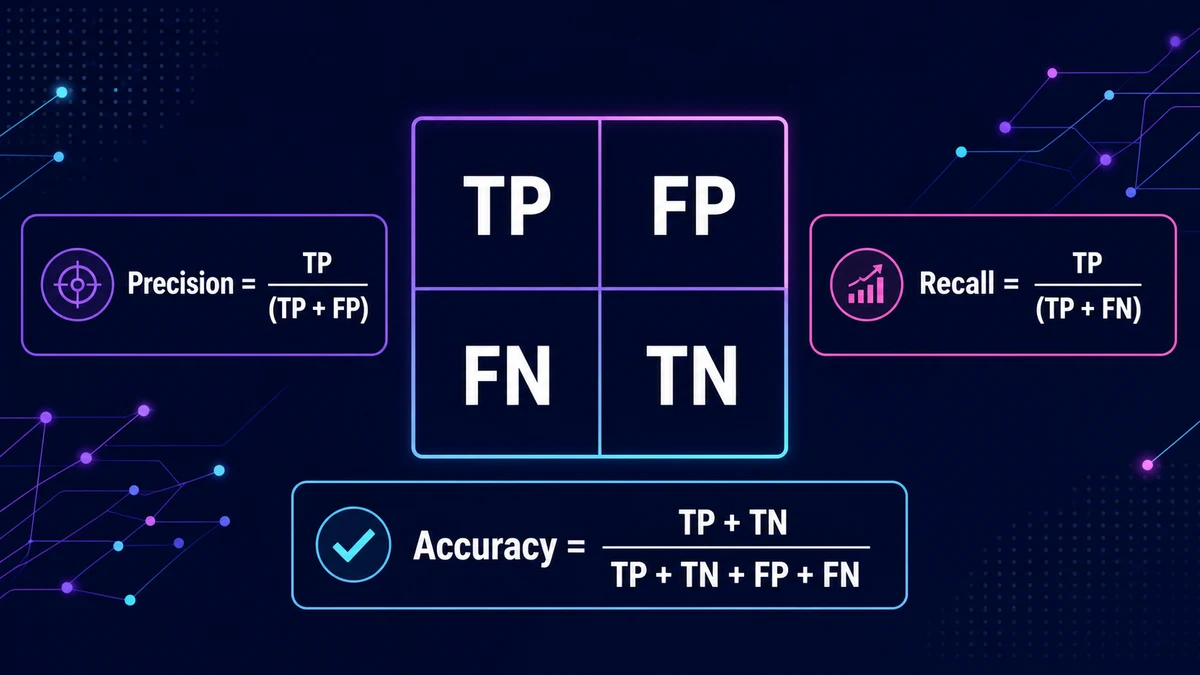
Recall, or the true positive rate (TPR), is the proportion of all actual positives that were classified correctly as positives. Mathematically, recall is defined as correctly classified actual positives divided by all actual positives, or TP / (TP + FN).
False negatives are actual positives that were misclassified as negatives, which is why they appear in the denominator of the recall formula. A hypothetical perfect model would have zero false negatives and therefore a recall of 1.0, representing a 100% detection rate. In practice, recall should be prioritized when false negatives are more expensive than false positives.
How Do Precision and False Positive Rates Impact Usability?
Precision is the proportion of all the model's positive classifications that are actually positive. Mathematically, precision is defined as correctly classified actual positives divided by everything classified as positive, or TP / (TP + FP). A hypothetical perfect model would have zero false positives and therefore a precision of 1.0.
Conversely, a model that never predicts positive would have 0 TPs and 0 FPs, resulting in a precision calculation of NaN. Precision should be prioritized when it is very important for positive predictions to be accurate.
The false positive rate (FPR) is the proportion of all actual negatives that were classified incorrectly as positives, also known as the probability of false alarm. FPR is mathematically defined as incorrectly classified actual negatives divided by all actual negatives, or FP / (FP + TN). False positives are actual negatives that were misclassified, which is why they appear in the denominator of the false positive rate (FPR) formula.
A perfect model would have zero false positives and therefore an FPR of 0.0, representing a 0% false alarm rate. For an imbalanced dataset, FPR is generally a more informative metric than accuracy. This rate should be prioritized when false positives are more expensive than false negatives.
However, if the number of actual negatives is very low, FPR may not be an ideal choice due to its volatility. For example, if there are only four actual negatives in a dataset, a single misclassification results in an FPR of 25%, while a second misclassification causes the FPR to jump to 50%.
How Do We Apply Classification Metrics to Practical Examples?
To understand how these metrics function in a real-world scenario, we can look at a standard spam classification example. In this context, recall measures the fraction of spam emails that were correctly classified as spam. This is why another name for recall is the probability of detection, as it answers the question of what fraction of spam emails are detected by the model.
In the same spam classification example, the false positive rate (FPR) measures the fraction of legitimate emails that were incorrectly classified as spam, representing the model's rate of false alarms. Precision measures the fraction of emails classified as spam that were actually spam. When evaluating such a system, it often makes sense to prioritize recall, precision, or some balance of the two, above some minimum accuracy level.
Frequently asked questions
What is the difference between recall and precision in AI evaluation?
Recall, or the true positive rate, is the proportion of all actual positives that were classified correctly as positives. Precision, on the other hand, is the proportion of all the model's positive classifications that are actually positive.
Why is accuracy a poor metric for imbalanced datasets?
Accuracy should be avoided for imbalanced datasets because a model can score highly while being useless. For example, if a rare class appears only 1% of the time, a model predicting negative 100% of the time scores 99% accuracy.
What are the four core functions of the NIST AI Risk Management Framework?
According to the AI RMF - AIRC, the AI RMF Core is operationalized through four functions: Govern, Map, Measure, and Manage. The AI RMF Core provides outcomes and actions that enable dialogue, understanding, and activities to manage AI risks and responsibility develop trustworthy AI systems.