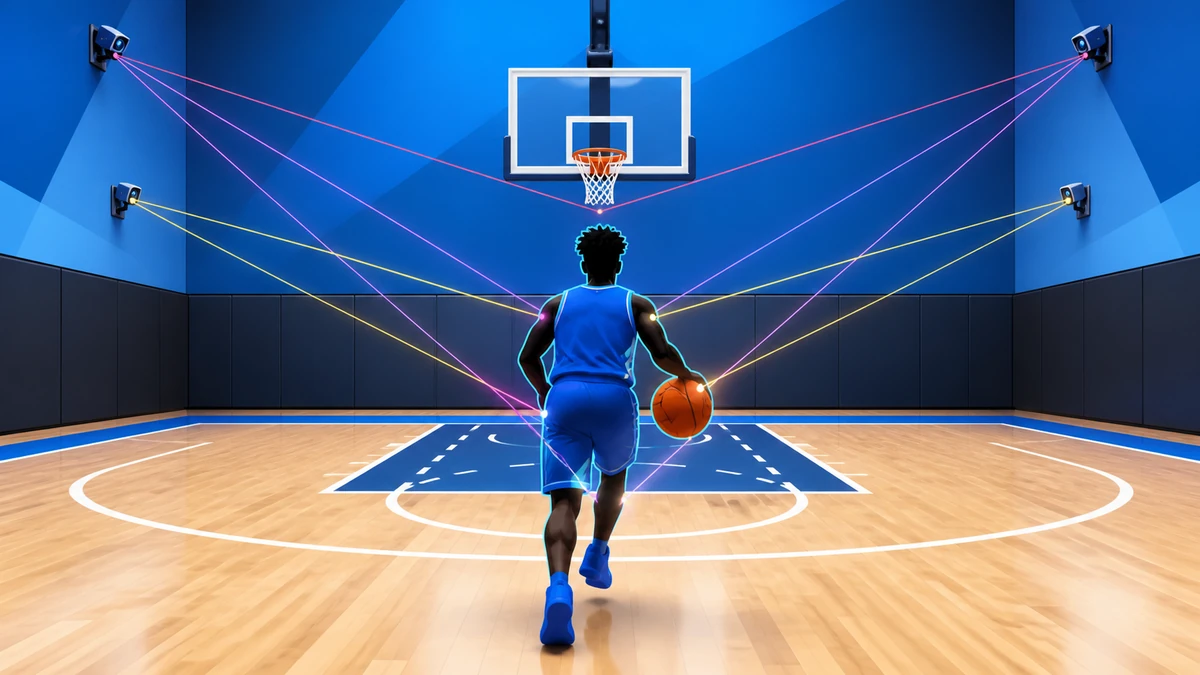

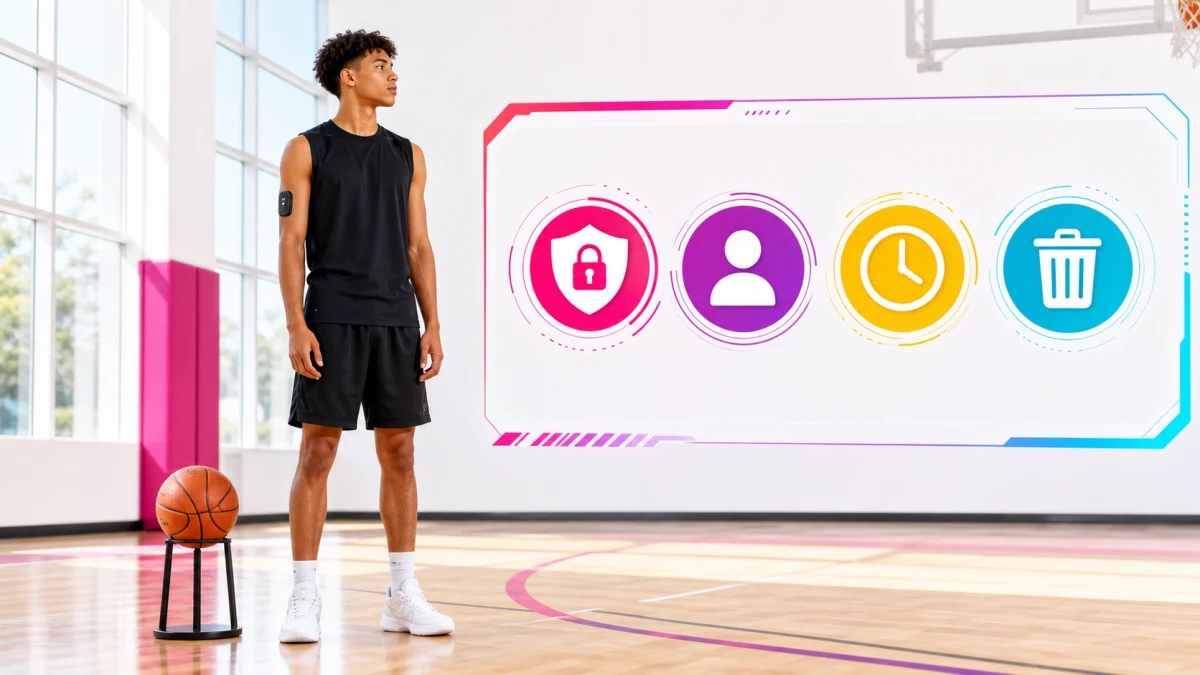
The short version: Treat basketball tracking data as a lifecycle, not a one-time upload. Explain collection in age-appropriate language, collect only what the feature needs, restrict access by role, set a real deletion date, and let players and families understand and exercise their choices.
Key takeaways
- Tracking data can include location, speed, jump, movement, and load signals, not only a final score.
- Consent is meaningful only when collection and consequences are understandable.
- Players, parents, coaches, and vendors should not automatically receive identical access.
- Retention needs a purpose and an end date; indefinite storage should not be the default.
What basketball player tracking data includes
Basketball player tracking data is any digital record used to describe where a player moved, how the body moved, or what a system inferred from that activity. Depending on the product, the raw inputs can include video frames, wearable signals, timestamps, court position, speed, movement intensity, jumps, and estimates of physical load. The outputs may be clips, charts, shot events, technique labels, workload summaries, or recommendations. A privacy review should cover both layers because deleting a video while retaining its derived profile may not meet the player's expectation of deletion. FIBA Tracking Solutions Approval Test ICO: What Data Protection Rights Do Children Have? how basketball player tracking works
FIBA's current tracking approval work shows how broad the technical category has become: wearable and camera systems can measure position, speed, intensity, jumping, and load. Accuracy testing matters because bad measurements can mislead coaches and players. It is not a privacy certificate, however. A system can measure movement accurately and still collect too much, keep it too long, share it too broadly, or explain it poorly. Technical validity and responsible governance are separate gates.
Consent must be understandable, not buried
Consent is not a checkbox that repairs an unclear experience. Before recording begins, a player and, where required, a parent should be able to answer five questions: what will be captured, what the product will infer, why the feature needs it, who can see it, and when it will be deleted. The ICO's guidance for children's data emphasizes concise, accessible, age-appropriate explanations of risks and safeguards. That standard is useful even outside the United Kingdom because it forces a product team to explain the feature to the person whose performance becomes data.
The notice should appear where the decision happens. A short recording screen can explain the immediate use; a layered detail view can describe derived metrics and recipients; a dashboard can show active permissions and retention dates; a just-in-time message can explain a new sharing feature before it turns on. The ICO specifically points to bite-size information, dashboards, and just-in-time notices. One dense policy linked from the footer cannot do all of those jobs. ICO Children's Code: Transparency
- Name the data source: uploaded video, live camera, wearable sensor, or manually entered result.
- Separate essential processing from optional analytics, research, marketing, or third-party sharing. ICO: Data Protection by Design and by Default FTC Final Changes to the Children's Online Privacy Rule
- Explain whether an AI label is an observation, an estimate, or a recommendation, and show the relevant uncertainty. NIST Privacy Framework
- Make the off switch and deletion route as visible as the feature activation.
Access should follow the basketball role
A player, parent, private trainer, school coach, club administrator, teammate, and technology vendor do not need the same view. The player may need the original clip, feedback, and history. A coach may need the current team's assigned sessions. An administrator may need account status but not body-level analysis. A vendor may need tightly scoped processing access without a right to reuse the data for unrelated model development. Role-based access follows the privacy-by-default principle: process and expose only what is necessary for the stated purpose.
Team changes create a specific boundary. When a player leaves a program, the old coach should not silently retain indefinite access to every future upload. The product needs a revocation rule: what remains in the team's historical record, what returns to the player's control, what the coach can export, and what is deleted. A visible access log can make this concrete by showing who opened or exported a record and under which role.
Third-party sharing deserves its own decision rather than being bundled into core coaching. The FTC's 2025 COPPA changes, for covered services, require a separate parental opt-in for certain disclosures tied to targeted advertising. The broader product lesson is simple: a family agreeing to shot feedback is not automatically agreeing to every downstream commercial use. Purpose boundaries should survive the handoff to analytics, cloud, and AI providers.
Retention and deletion need an actual clock
Retention should start with a purpose and end with a date or event. A raw video may be needed until analysis finishes and the player has time to review it. A derived metric may support progress tracking for a season. A team roster link may end when membership ends. Keeping every original and inference forever because storage is cheap creates risk without automatically creating value. The FTC's updated children's privacy rule says covered data may be retained only as long as reasonably necessary for the specific purpose and rejects indefinite retention as a default.
Deletion must specify scope. Does it remove the original video, extracted keypoints, event labels, coach comments, backups, exports, and model-training copies? Which records must remain for security, billing, or legal obligations, and for how long? A responsible interface describes the difference instead of promising one magical delete button. For young athletes, biometric identifiers also deserve explicit attention: the FTC's updated COPPA definition includes biometric identifiers, and motion or identity features can be more sensitive than an ordinary practice note.
Security supports the lifecycle but does not replace it. Encryption, access controls, audit logs, and incident response reduce the chance of unauthorized use. Data minimization reduces what can be exposed in the first place. The strongest storage system still carries avoidable risk if the product keeps unneeded raw video, broad exports, and old team permissions indefinitely.
A governance checklist for basketball products
- Map every raw input, derived metric, inference, export, backup, and external processor used by the feature.
- Write the player-facing purpose in one sentence, then remove collection that the sentence cannot justify.
- Choose age-appropriate notices and identify when a parent or guardian decision is required.
- Define roles, default access, revocation, exports, and third-party boundaries before onboarding a team.
- Set a retention rule for every data class and test deletion across active storage, backups, and processors.
- Review accuracy, bias, uncertainty, and the harm of a wrong label before presenting an AI conclusion as coaching truth.
The NIST Privacy Framework can organize this work as risk management rather than paperwork. Start with the people and basketball decisions affected, identify data processing and dependencies, choose protections, communicate choices, and review the outcome when the product changes. A new live-analysis feature, team dashboard, or model-training program should reopen the assessment because it changes the purpose or audience, even when the original camera upload remains the same. what AI can and cannot coach in a basketball shot
Players should not have to choose between useful feedback and basic control over their history. A well-designed basketball product can make the responsible path the normal path: local preprocessing where practical, limited uploads, clear roles, visible retention, export and deletion controls, and explanations that do not require a lawyer. Those choices also improve trust in the analysis because the product shows where its authority begins and ends. see how Level Up uses AI basketball feedback
Frequently asked questions
Is basketball tracking data personal information?
It can be. Video, account identifiers, location and movement records, derived performance profiles, and some biometric identifiers may identify or relate to a player. The legal classification depends on the data, jurisdiction, age, and processing context, so a product should obtain qualified legal advice rather than relying on a generic label.
Who should be able to see a young player's tracking data?
Access should follow a defined purpose and role. The player and authorized parent may need broad control; a coach may need assigned team sessions; an administrator or vendor usually needs less. The product should make access visible and revoke it when the role ends.
How long should a basketball app keep player videos?
There is no universal period. Keep each data class only as long as the stated feature, contractual, security, or legal purpose reasonably requires, then delete or de-identify it according to a documented rule. Indefinite retention should not be the automatic setting.
Does consent make every use of tracking data acceptable?
No. Consent must be informed and appropriate to the context, and it does not remove duties around minimization, security, purpose limits, age-appropriate design, access, or deletion. A new use such as advertising, unrelated research, or external model training may require a separate decision.