
The short version: The low man is the deepest useful weak-side helper, while a tag is a temporary action that slows a rolling screener. Read the screen and spacing, tag from a balanced angle, keep the ball and receivers in view, then help the helper and rotate on the pass. Practice the chain from guided recognition to live play and review the first moment that removed a defensive choice.
Key takeaways
- Protect the basket before chasing the original matchup.
- Tag the roller early enough to delay the route without losing the ball.
- Make the second rotation move when the first helper leaves.
- Follow the pass into the best new matchup instead of racing back blindly.
- Review the screen, roll, tag, pass, and recovered matchup as separate events.
What do low-man and tag responsibilities mean?
In common coaching language, the low man is the deepest weak-side defender positioned to protect the basket when the ball is above or beside the lane. A tag is the temporary help action against a rolling screener. FIBA's terminology defines the tag as an off-ball defender bumping the roller after an on-ball screen so the roller cannot travel deep to the basket. FIBA also treats weak side and help side as equivalent terms. Teams may rename the low-man role, but the picture is consistent: someone away from the ball must protect the rim before recovering or rotating onward. FIBA Europe Basketball Terminology
The responsibility is temporary, not a permanent switch by default. The low man leaves an assigned player long enough to stop the most urgent threat, communicates that help, and then responds to the next offensive decision. If the helper stays attached to the roller for too long, a corner or wing receiver can be left alone. If the helper recovers before the ballhandler is contained, the roller can catch at the rim. The useful question is not simply did we tag, but did the whole defense cover the next two threats in order? WABC Level 1 Coaches Manual basketball pick-and-roll coverages
Treat the terms as role labels rather than universal coordinates. On a side ball screen, the deepest defender may already be near the baseline. On a middle screen, the roller and weak-side spacing may make a different defender the first helper. The coverage, personnel, and offensive alignment determine the exact footwork. What should remain stable is the priority order: protect the basket, slow the roller, see the ball and nearby receivers, then complete the rotation.
Read the ball screen before moving
The low man should identify the action early enough to move with purpose. Start with the ball screen's location, the direction of the ballhandler, the screener's release, and the spacing behind the play. A low man who watches only the roller can miss a skip pass. A defender who watches only the corner can arrive late at the rim. WABC's secondary-rotation guidance requires a helper to keep vision of the ball and more than one offensive player, which is the right visual habit for this decision.
Name the first coverage before teaching the second rotation. If the on-ball pair contains the drive and the roller, the low man may only stunt or show a body. If the ball defender trails and the screener's defender steps toward the ball, the roller can become the immediate interior threat. The tag must be early enough to affect the route but controlled enough to preserve a recoverable angle. This is why the same tag cue cannot be separated from the team's primary pick-and-roll coverage.
Use a freeze one beat after the screen. Ask the low man to point to the ball, the roller, and the next pass. Then ask which teammate is covering the helper's original assignment. If nobody owns that answer, the defense does not yet have a rotation; it only has an isolated act of help. Rehearse the information before increasing speed so players learn the shared map instead of memorizing one path on the floor.
Tag the roller without losing the next pass
The tag should meet the roller's path from a balanced position. The helper shows enough presence to delay or widen the roll, keeps the ball in view, and avoids turning the action into a blind collision. FIBA's definition uses the word bump, but legal, controlled positioning remains the practical standard. The goal is to keep the roller from arriving deep and untouched while buying time for the primary defenders to recover or for the next rotation to arrive.
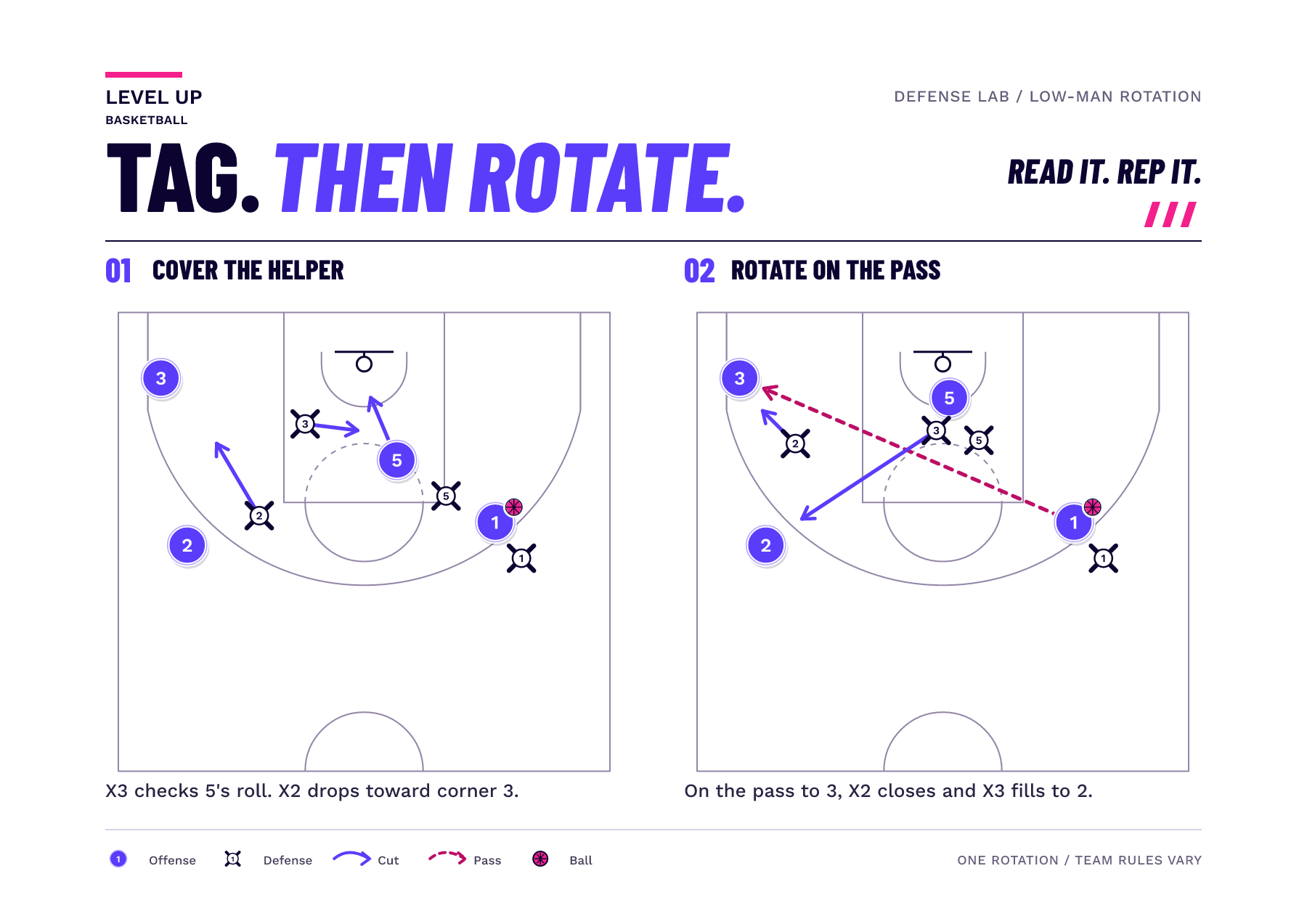
Communication must describe both the help and the open space it creates. A short early call alerts the on-ball defenders that the roller is covered. The next defender can then move toward the helper's player instead of reacting after the pass is already in flight. WABC calls this help the helper: when one defender rotates, another also moves to protect the basket or assume the next assignment.
Recovery should follow the ball, not a fixed sprint back to the same jersey. If the pass goes directly to the helper's original matchup and the angle is short, a closeout may be available. If the offense skips over that player or makes an extra pass, the nearest rotation may take the receiver while the original helper fills behind. WABC's rotation-on-the-pass examples explicitly assign new matchups, showing why possession defense can end with different pairings from where it began. WABC Level 2 Coaches Manual offensive spacing
Help the helper and close out under control
A successful first tag can still produce a bad possession if the second helper stands still. WABC's progression shows one defender rotating and another moving to protect the basket. It also asks a top defender to see two players plus the ball. That is the core of weak-side rotation: defenders shrink the floor around the urgent threat while keeping enough vision to expand again when the ball moves.
On the kick-out, closeout distance and assignment depend on the pass. The defender nearest the receiver takes the most dangerous immediate shot or drive; teammates fill the open spots behind that closeout. WABC uses the same team logic against a low-post double, anticipating the pass back to the perimeter and rotating to avoid an uncontested shot. The exact names differ, but the sequence is transferable: help, cover the helper, then rotate on the pass.
Do not reward a frantic fly-by merely because the defender reached the shooter. Finish the rotation with high hands, a balanced base, and a stance that can contain the next drive. If the offense makes one more pass, communicate the next switch or peel rather than turning every player into a chaser. The possession is not solved when the tag happens; it is solved when the defense regains matched-up, controllable positions.
Swipe sideways to explore the full diagram.
A four-stage practice progression
- Walk-through map: place a ballhandler, screener, corner, wing, and defenders; freeze after the screen and require every defender to name the ball, roller, and next pass.
- Guided tag: the offense runs one side or middle ball screen, the roller takes a clear route, and the low man tags before recovering to a declared receiver.
- Rotation on the pass: allow a direct kick-out or skip pass and score the defense only when the next defender takes the receiver and the helper fills behind.
- Live three-on-three or four-on-four: vary screen location and spacing, then play until a score, turnover, or controlled rebound so every recovery has a consequence. WABC Coaching Development Project
Score the chain, not just the first act. Award one point for early help position, one for a controlled tag, one for the correct second rotation, and one for a balanced closeout or recovered matchup. If the first helper is right and the second helper is late, preserve the correct first decision and coach the next link. That gives the defense a precise correction instead of the vague instruction to rotate faster.
Film review: five checkpoints
Film from a high sideline or baseline angle that keeps the ball screen, roller, weak-side receivers, and rim in the same frame. A tight crop on the ball hides the low man's starting position. Mark five moments: screen contact, roller release, tag, first pass, and recovered matchup. At each moment, note who sees the ball and which offensive player is temporarily uncovered.
Review the earliest lost choice. A late closeout may begin with a low man standing too high. An open corner may begin with the second helper failing to move when the tag occurred. A layup may begin with the on-ball pair never communicating the roller. WABC's help-the-helper and rotation-on-the-pass examples make the same point structurally: defensive movement is connected, so the correction should target the first broken responsibility.
Frequently asked questions
Is the low man always the corner defender?
No. The low man is a functional role for the deepest useful help position, not a permanent label attached to one player. Screen location, weak-side spacing, coverage, and team rules determine who can protect the basket and still connect to the next rotation.
What is a tag in ball-screen defense?
FIBA terminology defines a tag as an off-ball defender bumping the roller after an on-ball screen to prevent a deep roll. In practice, it should be a controlled, legal help action that delays the route and allows the defense to recover or rotate.
Who covers the tagger's player?
The next helper or nearest rotation covers that space according to the team's rules and the pass. WABC calls the principle help the helper and demonstrates new assignments on the pass rather than an automatic race back to every original matchup.
When is the rotation complete?
The rotation is complete when the immediate rim threat is controlled, the next pass has a defender, and the defense has recovered into balanced, communicative matchups. A correct tag alone is only the first link in that sequence.