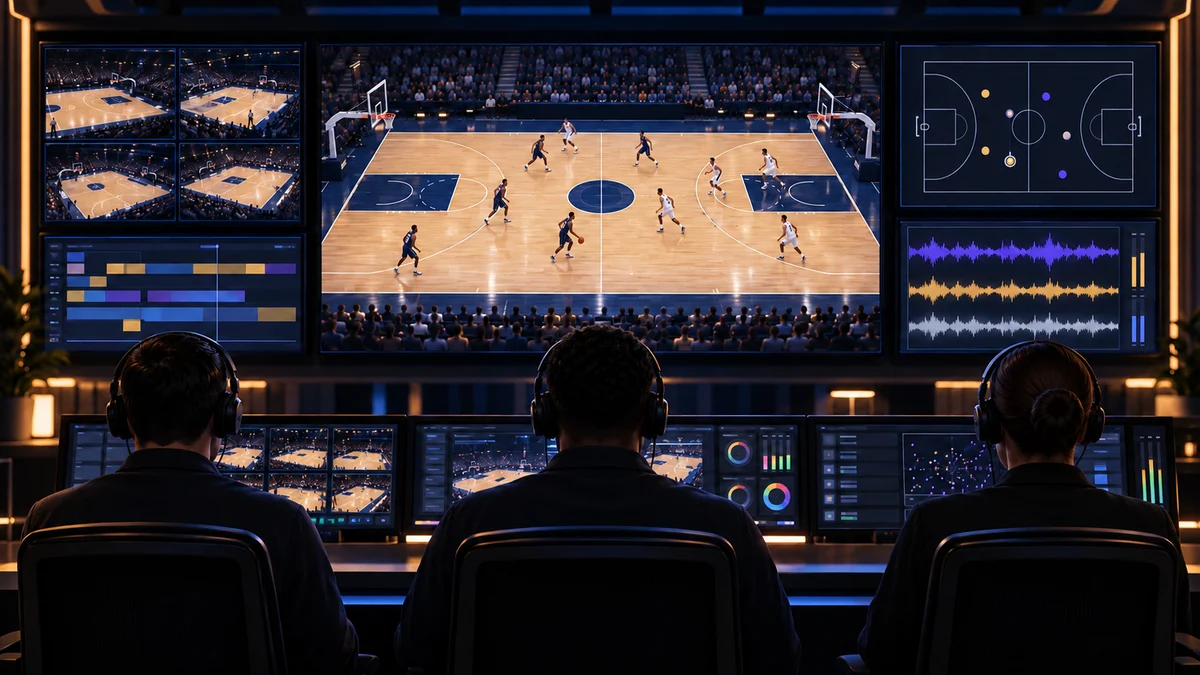

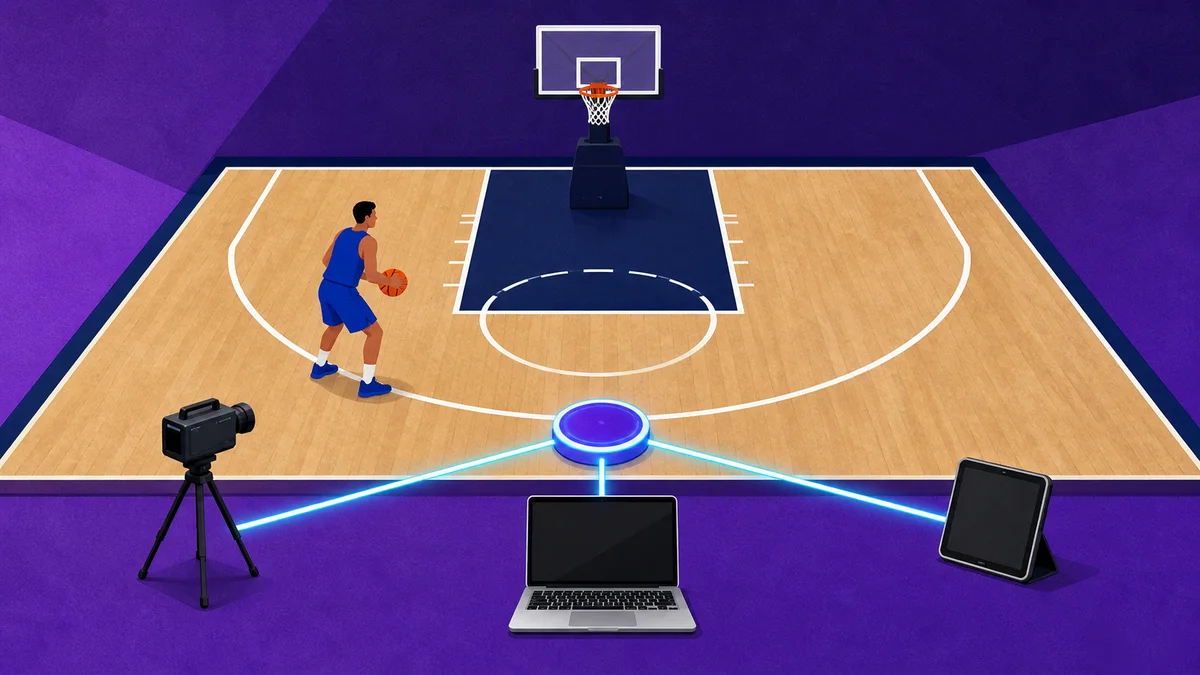
The short version: Basketball data interoperability connects statistics, video, tracking, schedules, rosters, and coaching tools without losing identity, timing, meaning, provenance, or permission context. Use stable entity IDs, preserve source clocks, version event schemas, name one authority per domain, and pair real-time push with replayable recovery. Rights, retention, raw-payload evidence, and correction history belong in the interface.
Key takeaways
- Stable source IDs and verified crosswalks are safer than player or team display names.
- UTC timestamps, local dates, game clocks, shot clocks, and video timecodes should remain distinct fields.
- Field names do not define event semantics; schema versions, corrections, and source authority do.
- Real-time push improves speed, while snapshots or change logs restore completeness after gaps.
- Permissions, provenance, retention, replay, and deletion rules belong in the integration contract.
What does basketball data interoperability mean?
Basketball data interoperability means that statistics, video, tracking, schedules, rosters, and coaching notes can move between tools without losing identity, timing, meaning, or permission context. It is not simply the ability to download two files or call two APIs. A useful connection lets a coach move from a possession in the box score to the matching video clip, the players involved, and the relevant tracking sequence while preserving which system supplied each fact. FIBA OVR LiveStats Interface Description
The need is visible in the official ecosystem. FIBA LiveStats collects and publishes real-time statistics and connects with competition, broadcast, scoreboard, API, and export workflows. FIBA also describes connected services that bring statistics, video, and player tracking together. Those products demonstrate the opportunity, but each organization still needs a deliberate contract for identifiers, clocks, event definitions, updates, rights, and failure handling. FIBA LiveStats FIBA and Genius Sports Data and Video Solutions basketball player tracking
Start with stable identity, not display names
Every integration needs durable keys for competitions, seasons, games, teams, players, venues, periods, and possessions. Display names are labels for people, not join keys. A player may use initials in one feed, a full name in another, and a corrected spelling later. Team names change with sponsors or localization. If the pipeline joins on visible strings, a routine correction can create a duplicate athlete or attach a clip to the wrong record. Sportradar NBA ID Handling
Sportradar's NBA guidance makes the distinction concrete: it recommends a UUID as the primary identifier and offers an optional SR ID for broader cross-API use. A robust warehouse keeps the source identifier, the internal canonical identifier, and every verified crosswalk in separate fields. Mapping changes should be dated and auditable. Do not silently overwrite an old identity when two records are merged; retain the alias and the evidence that justified the merge.
- Store source system, source entity type, source ID, canonical ID, and mapping confidence as separate values.
- Treat player, team, game, and competition mappings independently; a correct team match does not prove a correct player match.
- Quarantine ambiguous matches for review instead of guessing from a name, jersey number, or roster position.
Normalize clocks while preserving the source time
A basketball event can carry several legitimate times: the UTC time when it was emitted, the arena's local date, the period and game-clock value, the shot-clock value, the video frame time, and the moment the vendor processed an update. Flattening those into one field destroys information. Keep every source value, parse it into a documented normalized form, and record the timezone and precision used for the conversion. Sportradar Basketball APIs Timestamp Format Sportradar Global Basketball FAQ basketball video analysis
Even standards-compliant timestamps can look different. Sportradar notes that a UTC instant may use either a Z suffix or +00:00. Those strings should be parsed as times before comparison. Date-only fields need a different rule because some follow the league's local convention. For video alignment, use the game clock and a verified anchor event, then measure drift. A clip beginning two seconds before the event can be a presentation choice; it should not be mistaken for evidence that the event itself occurred two seconds earlier.
Event schemas determine what the data means
Two systems may both emit an event called rebound, assist, turnover, or shot, yet disagree about when the event is created, how a correction is represented, or which participant owns it. FIBA LiveStats follows the FIBA Statistics Manual, while the FIBA OVR interface specifies a format for transferring players, statistics, team score, timing, and game actions. That is why field names alone are not a semantic contract: the definition, version, allowed values, correction behavior, and source authority all matter.
Version schemas explicitly and store the raw payload beside the normalized record. When a provider changes a field, the team should be able to replay the old payload through a new transformer and compare results. A schema registry does not need to be elaborate: a checked-in field dictionary, sample payload, transformation version, and migration note can be enough. The dangerous state is an undocumented parser that keeps running while silently dropping new values.
Choose one authority for each domain
Interoperability works better when each domain has a named authority. The competition system may own fixtures and rosters; the official statistics system may own scored game events; the video platform may own media renditions; a coaching tool may own private annotations. Genius Sports describes separate interfaces for streaming, in-arena data, fixtures, and matching because those jobs have different lifecycles. Do not let whichever webhook arrived last become the accidental authority for every field. Genius Sports Developer Centre
Real-time delivery also needs a recovery path. Sportradar says its push feeds enhance but do not replace the REST backbone. That is a useful design rule: consume push for speed, use authoritative snapshots or change logs for completeness, and reconcile after disconnects. Save the last successful cursor, detect sequence gaps, make writes idempotent, and support replay. If the same corrected possession arrives twice, the second delivery should update or confirm the same record rather than create another one. Sportradar NBA API Basics
Permissions and provenance are part of the interface
Technical access does not automatically grant reuse rights. An organization may be licensed to show a feed in one product but not export it to another audience, train a model on it, or retain it indefinitely. Keep the contract scope, permitted purpose, retention window, audience, and deletion rule alongside the data product. Apply least-privilege credentials and separate public information from team-private video, athlete data, and coaching notes.
Provenance should survive every transformation. Retain the source system, retrieval time, source ID, schema version, transformation version, and raw-payload hash. A coach looking at a derived metric should be able to see which games and inputs produced it. If a correction changes the value later, the system should explain the revision rather than presenting the new number as though it had always existed.
A practical basketball interoperability checklist
- Inventory every source, owner, credential, schema version, update method, retention rule, and permitted use.
- Define canonical IDs and explicit crosswalks for competitions, games, teams, players, and media assets.
- Preserve raw timestamps, timezone context, game-clock values, and video anchors before creating normalized time fields.
- Document event definitions, corrections, null behavior, and schema changes with replayable examples.
- Use push for speed and an authoritative snapshot or change log for recovery and reconciliation.
- Verify permissions, provenance, observability, and deletion behavior before exposing a combined view.
A pilot should prove one complete reader journey, not merely a successful API call. Select one game, reconcile its roster, ingest official events, align several possessions to video, attach any tracking records, process a correction, revoke and restore access, then rebuild the result from retained inputs. That small end-to-end test reveals identity, timing, semantic, rights, and recovery problems before the integration becomes a dependency for a full season.
Frequently asked questions
Is a shared file format enough for basketball interoperability?
No. A shared format helps transport data, but it does not by itself settle entity identity, event definitions, timestamp meaning, correction behavior, authority, or reuse permission. A working interface needs both a syntactic contract and an operational contract for how records are matched, updated, audited, and recovered.
Should a push feed be the source of truth?
Usually not by itself. Push is valuable for low latency, but Sportradar explicitly describes push as an enhancement to a REST backbone. Keep a snapshot, change log, or comparable authoritative recovery source so the system can fill gaps after a disconnect and prove completeness.
Can display names be used to match players across systems?
Display names can help a reviewer, but they are unsafe as the primary match key. Use provider IDs, internal canonical IDs, verified crosswalks, roster and competition context, and an ambiguity queue. Sportradar's distinction between UUID and SR ID illustrates why identity deserves its own layer.
How should video and play-by-play be aligned?
Preserve the provider timestamp, arena date context, period, game clock, shot clock, and media timecode. Establish an anchor event visible in both sources, measure offset and drift, and keep a confidence window for ambiguous plays. Never infer exact synchronization from two similar-looking timestamp strings alone.