
The short version: Occlusion happens when another body, the rim, a player's own limbs, or the camera angle hides a player or the ball. A system may miss the object, create duplicate boxes, or attach the wrong identity after it returns. Motion history, pose and appearance features, court constraints, and synchronized cameras can bridge some gaps. They cannot make every hidden moment observable, so reliable products preserve uncertainty and link results to video.
Key takeaways
- Occlusion is missing visual evidence, not proof that the player or ball stopped moving.
- Basketball is difficult because similar uniforms, fast direction changes, dense paint traffic, and a small fast ball occur together.
- Detection finds visible objects frame by frame; tracking must associate those observations with persistent identities over time.
- Temporal models can bridge short gaps, while multi-camera and 3D systems can provide another view of the same moment.
- A trustworthy analysis exposes confidence, gaps, identity switches, and the original video instead of presenting every coordinate as certain.
What is occlusion in basketball computer vision?
Occlusion occurs when the camera cannot directly see all or part of the object a vision system is supposed to measure. A defender may pass between the lens and the ballhandler. Three players may overlap under the rim. The ball may disappear behind a forearm, torso, backboard, or referee. The athlete and ball continue moving in the physical world, but the image no longer contains enough visible evidence for an unambiguous frame-level observation. SportsMOT: A Large Multi-Object Tracking Dataset in Multiple Sports Scenes Iterative Scale-Up ExpansionIoU and Deep Features Association for Multi-Object Tracking in Sports basketball player tracking
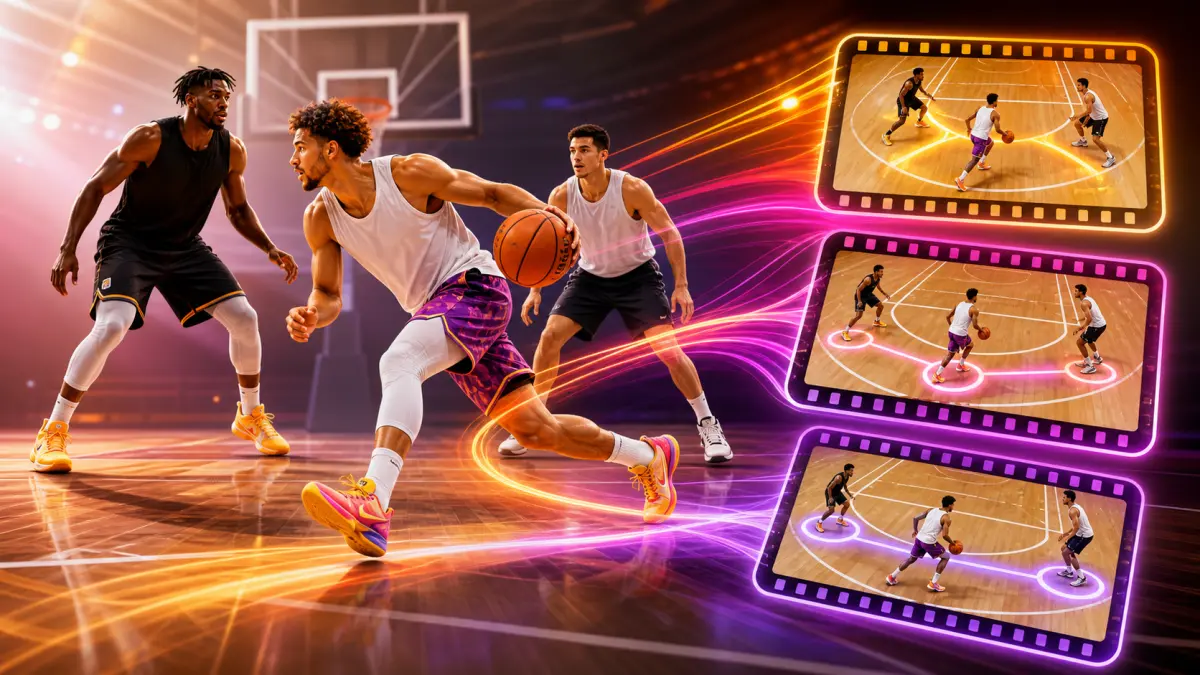
That distinction matters because a tracking output can look continuous even when part of it is inferred. A detector may see a player before the overlap, miss several frames, then see a similar player afterward. The tracker has to decide whether those observations belong to the same identity. Basketball makes the decision difficult: SportsMOT highlights frequent occlusion, while other sports-tracking research adds similar team uniforms and unpredictable movements such as crossovers to the problem. Single-Camera Basketball Tracker through Pose and Semantic Feature Fusion
The four common forms of basketball occlusion
| Occlusion type | Basketball example | Likely failure |
|---|---|---|
| Player-player | A screener and defender overlap from the camera angle | A missed detection, merged box, or identity switch |
| Self-occlusion | The shooter's torso hides the elbow or wrist | Missing or unstable pose landmarks |
| Object-scene | The ball passes behind the rim, backboard, or referee | A short ball-track gap or false location |
| Frame and view | A pan, zoom, crop, blur, or low angle removes useful detail | Low confidence, delayed reacquisition, or wrong association |
Partial and complete occlusion are points on a spectrum. A visible head and one shoulder may be enough to keep an identity alive but not enough to estimate a full skeleton. A ball can remain partly visible yet resemble a hand, jersey patch, or background shape at game speed. Confidence should therefore be attached to the specific output—detection, identity, joint, or ball coordinate—not compressed into one claim that the entire frame was either tracked or untracked.
Why detection and tracking fail differently
Detection asks which players or balls are visible in this frame and where they appear. Tracking asks which current observation corresponds to each earlier identity. Occlusion can break either layer. A detector may produce no box for a hidden athlete, one box around two athletes, or two boxes around one partly visible athlete. The D3 paper formalizes the last failure as duplicate detection: multiple boxes incorrectly report the same athlete during an occlusion. D3: Duplicate Detection Decontaminator for Multi-Athlete Tracking in Sports Videos
Association becomes the harder question after visibility returns. Teammates wear nearly identical uniforms, several athletes may have crossed paths, and a crossover or cut invalidates a simple straight-line forecast. The system can attach the reappearing box to the wrong track, creating an identity switch. That one mistake can contaminate speed, distance, matchup, possession, and downstream event labels even though every later box is visually accurate. Observation Centric and Central Distance Recovery for Athlete Tracking
How temporal tracking bridges a hidden moment
- Carry forward recent position and velocity as a short motion hypothesis rather than treating the track as immediately gone.
- Compare new detections with recent appearance, pose, and semantic features instead of using center-point distance alone.
- Use court boundaries, plausible speed, team side, and known game geometry to eliminate impossible matches.
- Keep several candidate associations when evidence is weak, then resolve them when later frames provide more separation.
- Mark recovered or interpolated spans so downstream users can distinguish observation from estimation.
These steps are forms of evidence management, not proof. Pose and semantic feature fusion can give the association richer clues, as the single-camera basketball tracker demonstrates. Observation-centric recovery can reconnect a trajectory after a missed detection. But a long overlap, a sharp direction change, or two visually similar players separating in opposite directions may remain ambiguous. The responsible output can be a lower-confidence identity or a flagged gap rather than a falsely precise path.
Why multiple cameras and 3D pose help
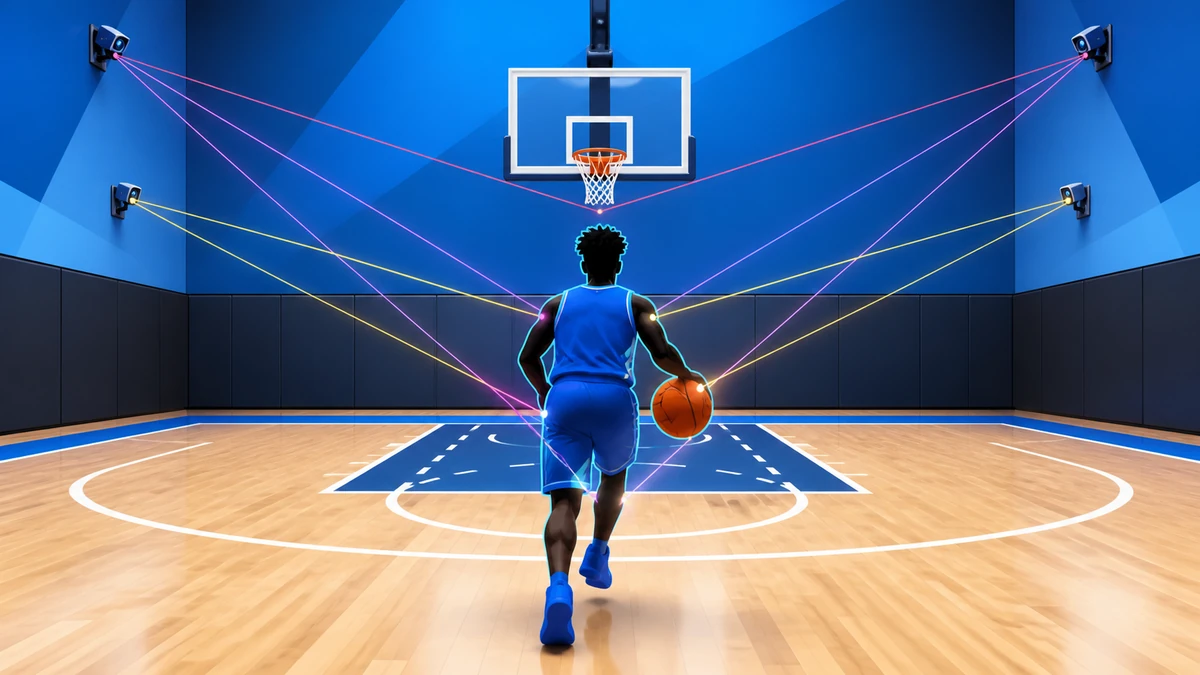
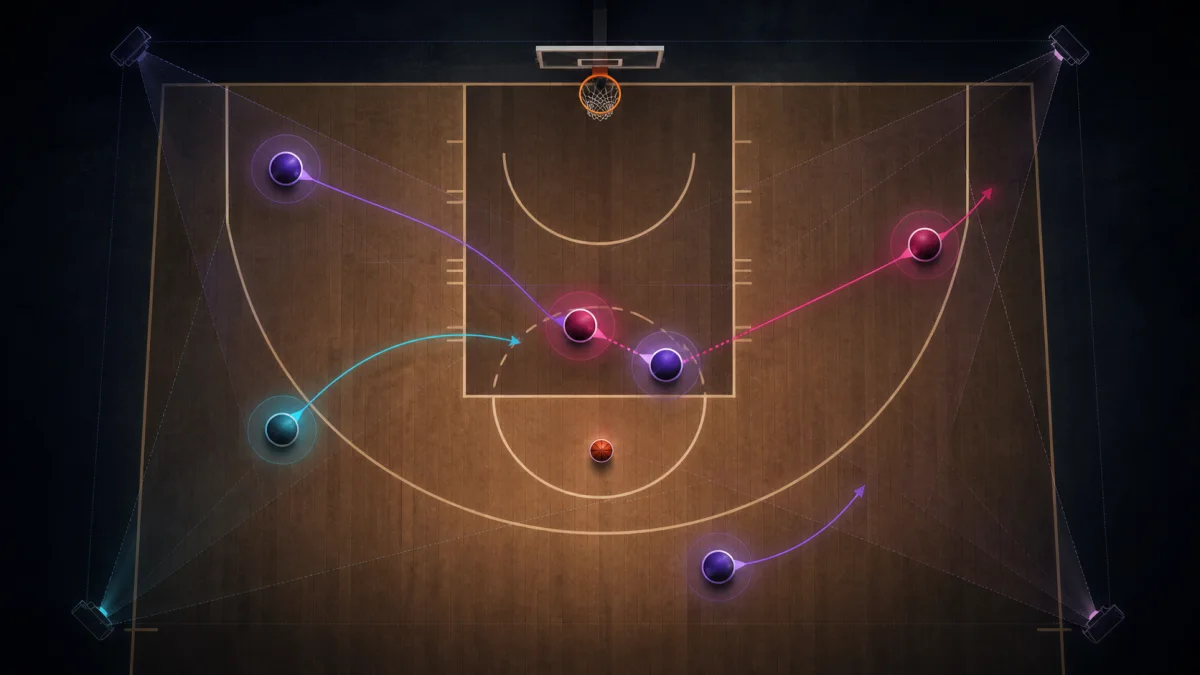
Another camera may retain visibility when one view is blocked. The NBA and Sony announced a system designed to capture every player and the ball in three dimensions at sub-second latency. The NBA's current Gravity explainer says its optical system applies 3D pose detection to 29 body points per player at 60 samples per second. Multiple synchronized views and a court calibration can therefore support a shared 3D estimate instead of relying on one broadcast image. NBA and Sony Hawk-Eye Next Generation 3D Tracking Partnership NBA — Intro to Gravity and 3D Pose Tracking
More views reduce some ambiguities, but they do not make the scene perfectly observable. Players can cluster from several angles, a ball can be hidden by hands or the rim, calibration can drift, and each camera can have blur or exposure limits. The NBA announcement describes capabilities and intended applications; it does not promise zero occlusion. A strong system combines views, time, geometry, and uncertainty rather than treating any single sensor as infallible.
Why tracking the basketball is especially difficult
The ball occupies far fewer pixels than a player, changes direction during passes and rebounds, accelerates rapidly, and spends time next to hands, jerseys, the rim, and the backboard. Motion blur can turn it into a streak; a broadcast crop can remove it entirely; several orange or circular image regions can look plausible. When possession changes inside a crowd, the system must solve both location and ownership while the best visual evidence may be temporarily absent. NBA G League and Second Spectrum Optical Tracking Partnership
Game context can narrow the options—a pass should follow a physically plausible arc, and possession should not teleport between distant players—but context is still an inference. A derived statistic such as touch time, pass speed, or shot context should carry the quality of the underlying ball track. Optical tracking can unlock useful metrics, as the G League partnership describes, while downstream products still need rules for gaps, low-confidence ownership, and manual review.
How to evaluate an occlusion-aware basketball system
- Measure missed detections, false detections, duplicate boxes, identity switches, fragmented tracks, and time to reacquire—not only average position error.
- Report results by scenario: dense paint traffic, screens, rebounds, transition, broadcast pans, and ball-hand contact.
- Separate observed coordinates from interpolated or recovered spans and expose confidence at the output level.
- Test same-uniform teammates and abrupt cuts because easy isolated-player clips understate basketball association risk.
- Keep the original synchronized video available so analysts can review consequential low-confidence events.
The business question follows the model question. A broadcast graphic can tolerate a brief delayed correction differently from an officiating aid, a coaching report, or player-health metric. Define the consequence of an error before selecting thresholds. A system that abstains on one ambiguous rebound may be more trustworthy than one that produces a complete but wrongly attributed possession history.
What this means for player-facing AI feedback
A single-phone training clip has fewer viewpoints than an arena system, so capture quality matters. Place the camera where the full body, ball, feet, and target remain visible; avoid teammates crossing directly between the lens and the athlete; keep enough light for a short exposure; and leave space around the movement. Better capture cannot eliminate every self-occlusion, but it can reduce avoidable gaps before any model runs. AI basketball shot feedback
The feedback layer should say what was visible and where confidence fell. If the shooting wrist disappears behind the torso, the product can ask for another angle instead of inventing a joint path. If a teammate crosses the frame, it can preserve the visible phases and flag the blocked phase. The useful promise is an inspectable coaching observation tied to the submitted video—not a claim that the model saw through bodies.
Frequently asked questions
Can AI track a basketball player when another player blocks the camera?
It can sometimes maintain a hypothesis through a short blockage using recent motion, appearance, pose, court geometry, or another camera. That is temporal association, not direct visibility. The longer and more ambiguous the overlap, the more important confidence and later evidence become.
What is an identity switch in player tracking?
An identity switch occurs when a tracker assigns a visible detection to the wrong persistent player track. It often happens after overlapping teammates separate, especially when their uniforms and body appearance are similar. The path may remain smooth while the named or numbered identity becomes wrong.
Do more cameras eliminate basketball occlusion?
No. Multiple calibrated views can provide evidence when one camera is blocked and can support 3D reconstruction. Dense player clusters, hands around the ball, blur, calibration limits, and shared blind regions can still create gaps. The gain is more evidence and better geometry, not perfect visibility.
Why not just interpolate every missing coordinate?
Interpolation can bridge a short, predictable gap, but basketball contains stops, cuts, jumps, deflections, and possession changes. A smooth mathematical path can be physically plausible and still belong to the wrong player or ball. Good systems constrain interpolation, mark it as estimated, and reopen the original video when the result affects an important analysis.