
The short version: The dunker spot is a baseline area just outside the lane and close to the basket. Teams often place a finisher there so a driver can force the low defender to choose between stopping the ball and protecting a drop-off pass or lob. The player in the spot must keep useful spacing, move with the drive, show a safe target, and finish quickly. Labels vary: FIBA terminology equates dunker spot with short corner, while NBA and Jr. NBA teaching often distinguish a tighter area nearer the lane.
Key takeaways
- The dunker spot is a baseline spacing reference just outside the lane; exact labels and boundaries vary by program.
- A player there can occupy the low defender without standing in the driver's path.
- The best read is dynamic: hold, slide, lift, cut, screen, or crash according to the ball and the low defender.
- The ballhandler should read the helper before choosing a bounce pass, pocket pass, lob, or finish.
- Defenses can shrink the action by roaming, switching, zoning the area, or making the dunker-spot player participate farther from the rim.
Where is the dunker spot on a basketball court?
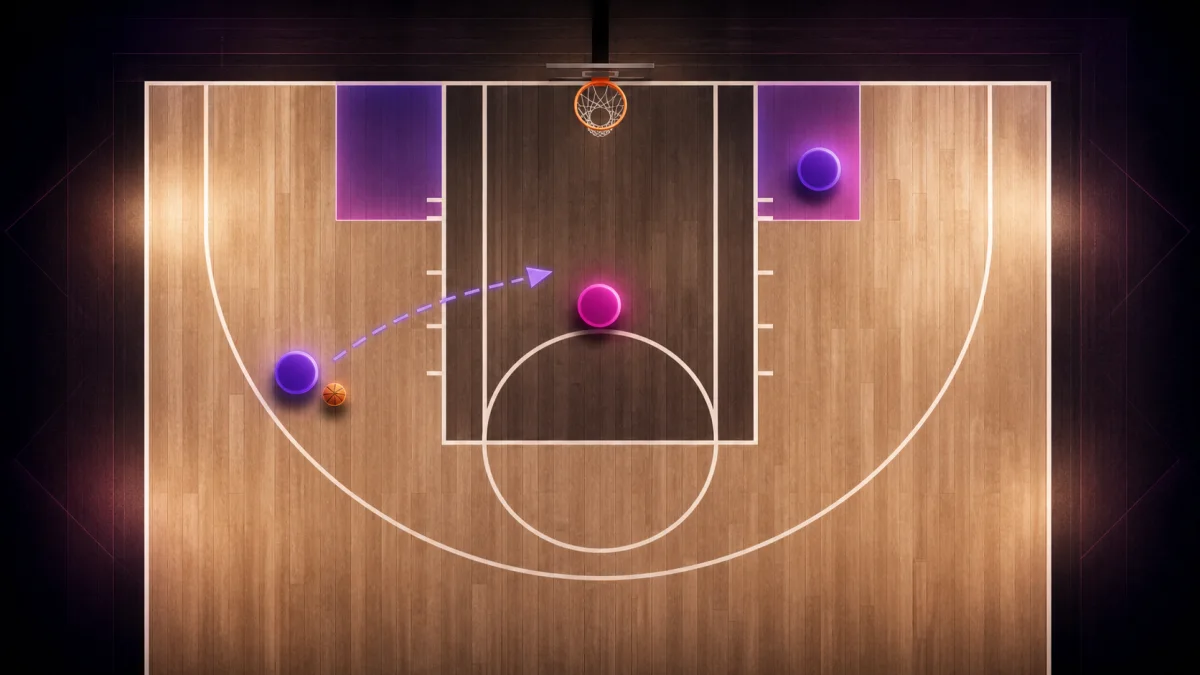
The dunker spot is a small baseline area beside the paint, close enough for a quick finish but far enough outside the lane to preserve a driving window. Picture the lower lane line or lower hash area on either side of the rim. The offensive player usually keeps the back near the baseline, sees the ball, and stays ready to catch and finish in one or two steps. The Oklahoma City Thunder described it as just outside the lane but not quite in the short corner, while Jr. NBA uses the same practical description. Oklahoma City Thunder — Finding the Dunker Spot Jr. NBA All-Star Practice Plan — Dunker Spot 2 on 1
Basketball vocabulary is not perfectly universal. FIBA Europe terminology lists dunker spot as another name for short corner, yet NBA coaching language often uses dunker spot for the tighter pocket nearer the lane and short corner for a wider baseline location. Use the floor reference before arguing about the label: ask the coach exactly how close to the lane the player should be, which defender that spacing is meant to occupy, and what movement is expected when the ball drives. FIBA Europe Basketball Terminology
Why offenses place a player in the dunker spot
The placement creates a decision for the low defender. If that defender leaves the baseline receiver to stop a drive, the ballhandler may have a short drop-off pass or lob. If the defender stays attached, the rim can become more available to the driver. The player in the dunker spot is therefore not simply waiting for a dunk. The player is occupying a defender at a distance where one step in either direction can change the possession. basketball offensive spacing
Good spacing also protects passing lanes. WABC's introductory workbook warns that young players tend to chase the ball, compressing all ten players into a small area and making passes harder. The dunker spot gives one off-ball player a disciplined home that is near the rim without standing directly in the drive. That structure is especially useful for a strong finisher or a player whom the defense is willing to leave, but any position can learn the read. WABC Coach Workbook — Head-Heart-Hands Spacing
What should the dunker-spot player read?
- Hold the spot when your defender is the primary rim helper and your spacing keeps that defender away from the drive.
- Slide along the baseline with the drive when a small adjustment creates a safer passing angle without crowding the ball. WABC Coaches Manual Level 1 — Offensive Movement and Spacing
- Lift or clear when the driver needs the baseline lane, the defender zones both players, or a teammate is already occupying the same pocket.
- Cut behind a defender whose eyes and body have fully committed to the ball, but keep the cut visible to the passer. Denver Nuggets — Jokic and the Roaming Dunker-Spot Defender
- Prepare the finish before the catch: show hands, land balanced, protect the ball, and know whether the rim, reverse side, or quick pass is available.
The receiver must expect traffic. Durant cautioned that the play is not automatically an easy catch and dunk because defenders collapse and the receiver still has to catch, move, and finish skillfully. A low target can invite a bounce pass around reaching hands; a lob may work when the receiver has vertical space; a quick touch pass may be safer when a second defender rotates. The finish begins with the spacing and read, not with the jump.
What should the ballhandler read?
Read the low defender before predetermining the pass. If the defender's chest and feet move toward the drive, identify whether the receiver remains behind the helper or slides into the open window. If the defender stays home, continue only if the rim path remains credible. If a second defender rotates early, the best answer may be a pass out to the perimeter rather than forcing a ball into the crowd. Patience means seeing the full rotation without losing the advantage.
Pass type follows the body positions. A bounce pass can travel under extended arms; a short pocket or scoop pass can arrive before the helper recovers; a lob needs clear vertical space and a receiver who can safely meet it. The Thunder emphasized precision in type, pace, and location. The goal is not to reward the receiver for standing near the rim. It is to deliver the ball where the receiver can control it and finish before the defense reorganizes.
How defenses take away the dunker spot
A defense can ask the low defender to guard two threats temporarily: show at the drive, stay long enough to discourage the pass, then recover. Another coverage can rotate a perimeter defender down while the original low defender commits to the ball. A switching or zone principle may trade assignments instead of chasing the original matchup. The offense should identify who owns the baseline receiver after the first rotation, not assume the same defender will remain attached throughout the possession. pick-and-roll coverages
The defender may also roam away from a limited shooter or stationary finisher. Denver's analysis showed a defender leaving Aaron Gordon in the dunker spot to add help against Nikola Jokic. The counter was not only a harder pass: Denver could involve that defender in a screen, find Gordon behind the help, or cut before the helper established position. A useful spot becomes less useful when the player is passive enough for one defender to control both the ball and the receiver.
A simple drill for dunker-spot reads
- Start two offensive players in opposite dunker spots with one defender in the middle, as in the Jr. NBA two-on-one activity.
- Begin with a coach pass to either side. Let the offense pass, finish, or use one dribble while the defender chooses which threat to stop.
- Add a wing ballhandler and require the opposite baseline player to hold, slide, lift, or cut according to the help defender.
- Progress to three-on-two, then live three-on-three, preserving the same spacing vocabulary and ending every repetition with a rebound or score.
- Review the first decision: defender commitment, receiver movement, pass type, and finish balance. Do not grade only the final make or miss.
The Thunder's reported practice routine reinforces that these reads deserve repetition rather than being treated as accidental layups. Short, game-shaped rounds work well: alternate sides, vary the drive angle, and let the defender change the coverage. Keep enough freedom for players to solve the possession. Prescribing the same pass every time teaches choreography; varying the helper teaches basketball.
Frequently asked questions
Is the dunker spot the same as the short corner?
It depends on the terminology system. FIBA Europe lists dunker spot as another name for short corner. Thunder and Jr. NBA explanations place the dunker spot along the baseline just outside the lane but not quite as wide as the short corner. Ask for the intended floor location and responsibility rather than assuming every team uses identical labels.
Does the dunker-spot player have to be a center?
No. Jr. NBA says post players or non-shooters commonly occupy it, and NBA examples often feature frontcourt finishers. But the spot is a spacing role, not a position label. Any player can use it when the lineup, action, and defensive matchup make that baseline pressure valuable.
Should the player stay in the dunker spot for the whole possession?
Usually not. The player may hold long enough to occupy the low defender, then slide, lift, clear, cut, screen, or pursue a rebound as the ball and coverage change. WABC receiver principles treat penetration as a trigger for purposeful off-ball decisions, not a reason to freeze in one footprint.
Why is a dunker-spot finish harder than it looks?
The receiver often catches near collapsing defenders with little time to secure the ball, establish balance, and choose a finish. Durant emphasized that the play still demands skilled catching and movement. A well-timed pass creates the chance; strong hands, footwork, body protection, and awareness complete it.